Uniswap’s liquidity plummets 50% and UNI price may follow
- Uniswap has experienced a massive liquidity outflow.
- The liquidity mining program is set to expire later on Tuesday.
- UNI/USD technical and on-chain data send mixed signals.

The largest decentralized cryptocurrency exchange Uniswap lost its leadership. According to DeFi Pulse, the platform now takes third place with the total value locked (TVL) of $1.6 billion.
Users drained nearly half of Uniswap's liquidity in less than 24 hours as the liquidity mining reward program is set to expire shortly, on November 17 at 12.00 UTC.

Uniswap chart, DeFi Pulse
The chart above shows that the liquidity topped at $3.06 on November 14 and decreased during the weekend. The sharpest drop has been registered during early Asian hours on Tuesday, November 17, with SushiSwap and Bancor protocols being the primary beneficiaries. Both protocols have experienced a massive liquidity inflow (60% and 40%, respectively).
UNI's liquidity mining comes to an end
Uniswap launched its liquidity mining reward program in September, together with the native token UNI. However, the plan was set to expire on November 17 at 12 AM UTC.
The team explained in the blog post:
After 30 days, governance will reach its vesting cliff, and Uniswap governance will control all UNI vested to the Uniswap treasury. At this point, governance can vote to allocate UNI towards grants, strategic partnerships, governance initiatives, additional liquidity mining pools, and other programs.
As explained at the time, four pools were initially seeded: ETH/USDT, ETH/USDC, ETH/DAI and ETH/WBTC. Some 20 million UNI was allocated to the pools, with each receiving 5 million tokens apiece.
Uniswap created four pools, ETH/USDT, ETH/USDC, ETH/DAI and ETH/WBTC, and allocated 20 million UNI tokens to them. Meanwhile, yield farmers poured over $2 million into the pools and are now ready to take their money back.
The growing popularity of SushiSwap and other competing protocols confirms the theory that the community is migrating to new lucrative fields to continue mining liquidity once the Uniswap's program is over.
Uniswap votes on the program renewal
Uniswap's team launched a poll to determine what will happen with the pools once the mining expires, given the massive liquidity outflow. Cooper Turley and another community member known as Monet Supply asked the community whether they should UNI liquidity to farmers.
They outlined the pros and cons of distributing UNI tokens to liquidity providers. They proposed allocating UNI to the same four pools for another two months with the reduced rate of the genesis distribution.
Distribute UNI for an additional two months from the time this proposal is adopted and executed by governance. Distribute to the same four pools, but at half the rate of the genesis distribution. This works out to 1.25 million UNI per month to each of the four covered pools (WBTC/ETH, USDC/ETH, USDT/ETH, DAI/ETH), for a total of 5M UNI per month, or 10M UNI total over the next two months.
At the time of writing, 58% of holders voted for the proposal, and 41% are against it. The poll ends on November 19, 11 PM UTC.
UNI charts send mixed signals
Meanwhile, UNI managed to recover the losses incurred at the beginning of the week. At the time of writing, UNI/USD is changing hands at $3.6 from Mondays low of $3.2.
Moreover, the TD Sequential indicator recently printed a buy signal in the form of a red nine candlestick on UNI's 4-hour chart. The bullish formation suggests that the price may rise for one to four daily candlesticks. If the demand is strong enough, the token will start a new upward countdown with the next focus on $4.0 and $4.2.
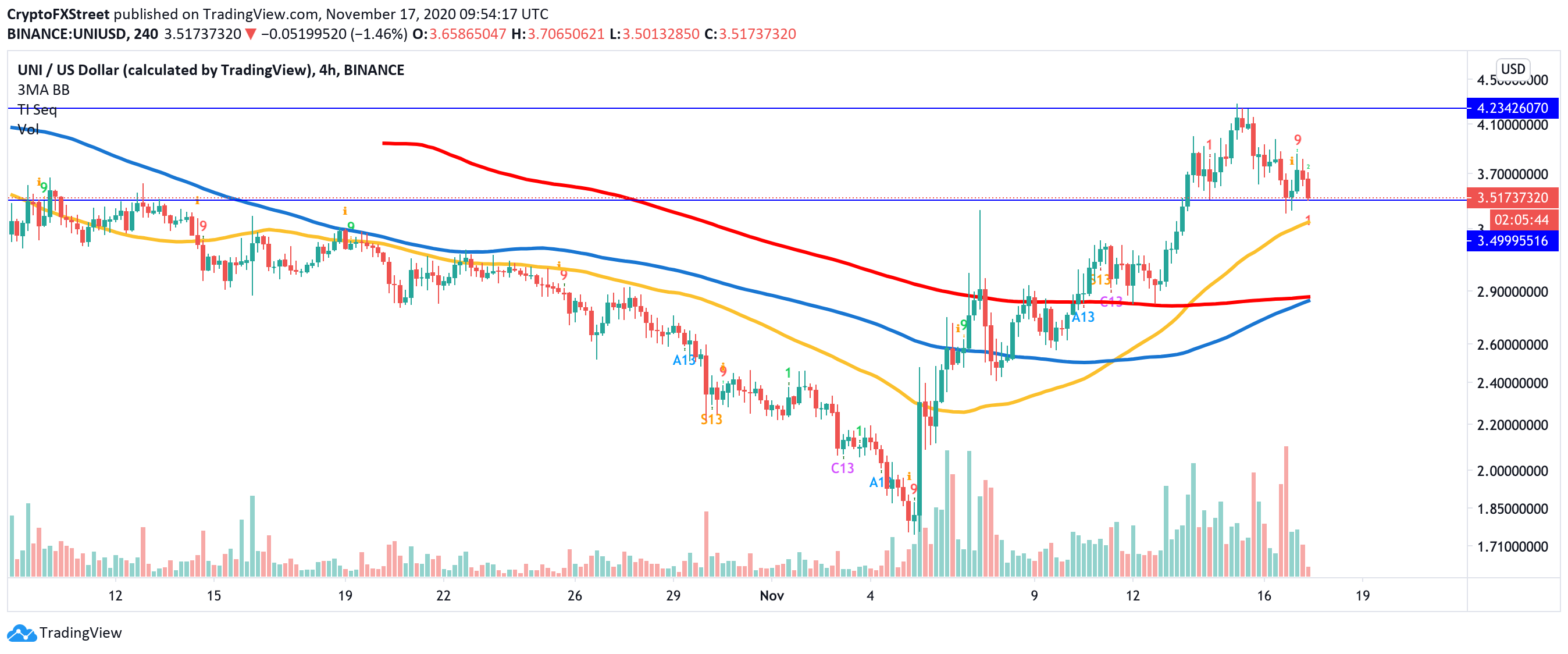
UNI/USD, 12-hour chart
Meanwhile, IntoTheBlock's IOMAP reveals Uniswap faces stiff resistance ahead of $4. Roughly 6,000 addresses had previously purchased nearly 58 million UNI between $3.67 and $4.
 Analytics and Charts-637412037142717337.png)
UNI's IOMAP data
Such a massive supply barrier may slow down the upside momentum. Thus, only a 4-hour candlestick close above $4 will confirm the bullish scenario and lead to further gains. Otherwise, Uniswap may resume the decline continue towards the $3.2 support level.
Author

Tanya Abrosimova
Independent Analyst