Traders skeptical about TrueUSD despite TUSD nearing USDT in Bitcoin trading volume on Binance exchange
- TrueUSD (TUSD) market share rose to 49%, almost equaling the Tether (USDT) market share.
- It comes after Binance assigned a zero fee discount to the BTC-TUSD trading pair last month, waiving the promotion from BTC-USDT.
- Despite the narrow range, traders hesitate to use the TUSD, Tether still tops in trading volume.
TrueUSD (TUSD) stablecoin has narrowed the gap in market share on trading volume metrics, drawing closer to Tether (USDT) on the Binance exchange. The move comes after the giant cryptocurrency exchange platform implemented a zero-fee trading discount. However, despite the growth in market share, traders are still hesitant about using TUSD, data from crypto firm Kaiko shows.
TUSD shows massive growth in a brief period
TrueUSD is a dollar-pegged stablecoin issued by cryptocurrency firm ArchBlock, formerly TrustToken. According to the proof-of-reserve monitoring tool of the blockchain data provider ChainLink, the value of TUSD is fully backed by fiat assets. Noteworthy, the intellectual property rights of TUSD were acquired by Asian conglomerate Techteryx in 2020
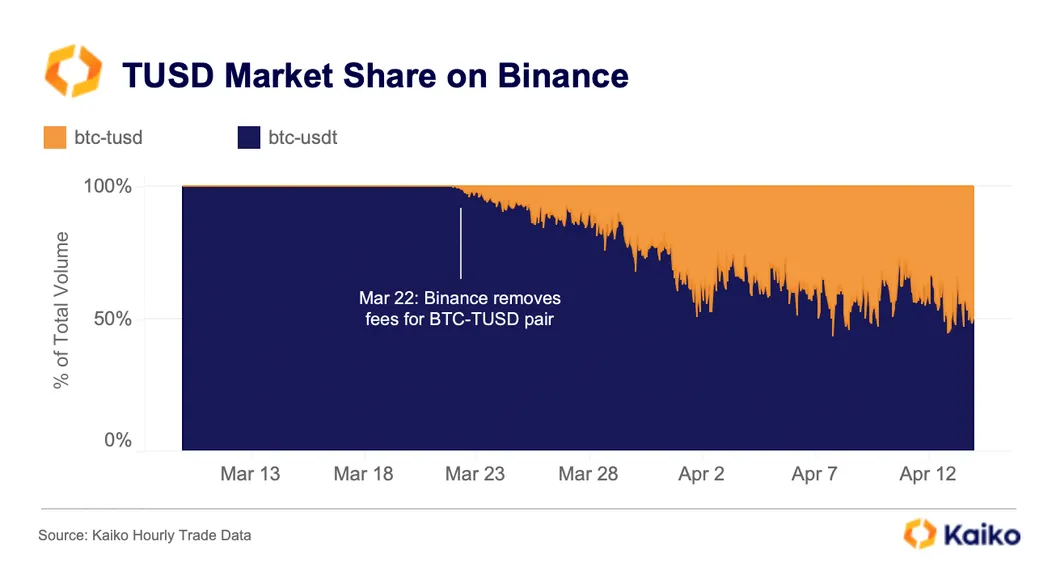
Binance data on the two stablecoins shows that the market share for the Bitcoin/TrueUSD (BTC-TUSD) trading pair has grown to 49% relative to the Bitcoin0Tether (BTC-USDT) trading pair. The head of research at Kaiko, Clara Medalie, has commented on the narrow gap, saying,
This is a massive increase over just a few weeks.
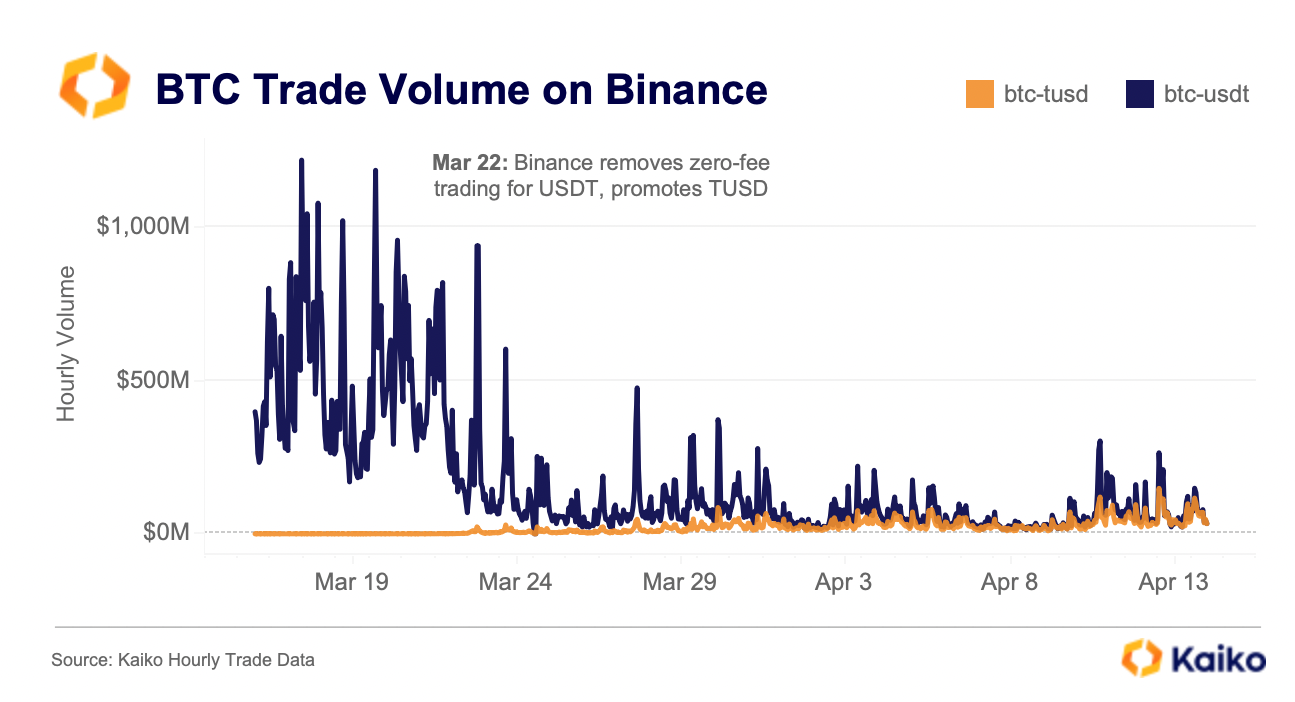
Kaiko data shows that while the change is commendable, the growth recorded by TUSD is not enough to neutralize or countervail the lead in the BTC/USDT pair's trading volume even after Binance relinquished its zero-fee discount for Tether.
Furthermore, traders are still placing larger buy and sell orders for the BTC/USDT pair, indicating that market players are skeptical about using TUSD despite zero fees.
Why Binance adopted TrueUSD and the reason for TUSD growth
The growth displayed by the TrueUSD stablecoin is attributed to Binance after the world's largest crypto exchange by trading volume adopted TUSD as heir of its native Binance USD (BUSD) stablecoin that Paxos Trust formerly issued.
Notably, Binance resumed facilitating TUSD trades after a six-month suspension when Paxos decided to terminate its issuance of BUSD. The move to stop issuing BUSD paved the way for the zero-fee trading discount to the BTC/TUSD pair in a strategic attempt to promote the stablecoin as a possible alternative. Similarly, the exchange waived the promotion from BUSD and USDT beginning March 22.
Growing turmoil in the stablecoin market
The stablecoin market, worth around $132 billion, has undergone major turmoil as of late, originating from a regulatory clampdown and a series of banking crises across the United States. As a result, the New York Department of Financial Services (NYFDS), the highest-ranking financial regulator in the US, strong-armed Paxos into ceasing and desisting from minting BUSD beginning February 2023. Notably, BUSD is the third largest stablecoin, boasting a market cap of around $16 billion.
In March, the closure of pro-crypto institution Silicon Valley Bank (SVB) sent turbulence across the market, given that SVB was the reserve partner of USD Coin (USDC), the second largest stablecoin. As a result, the stablecoin suffered over $10 billion in withdrawals.
USDT and TUSD emerged winners amid crises in the banking sector
Amid the banking crises, Tether and TrueUSD have emerged as the distinct winners, with TUSD securing a place as the fifth largest stablecoin in the crypto market with a market cap of around $2 billion. In the same way, the circulating supply of USDT is up by $10 billion over the past few months as its draws near to peak.
The dominance of stablecoins during challenging times in the traditional finance sector indicates that this digital asset category is a crucial part of the crypto ecosystem. At their core, stablecoins facilitate trading on exchanges while at the same time providing a link between digital assets and government-issued fiat currency.
Also Read: Binance market share could drop after abolishing most zero-fee trading, boosts TrueUSD stablecoin
Author

Lockridge Okoth
FXStreet
Lockridge is a believer in the transformative power of crypto and the blockchain industry.