Here is how Bitcoin price will react to new US economic stimulus deal
- Bitcoin price reacted positively to the news surrounding the latest US economic stimulus deal.
- Thus far this year, it seems like all COVID-related relief packages have led to bullish price action.
- The $22,800 support holds immense importance for BTC and is a crucial factor for deciding the next move.

On December 20, Bitcoin price retracted by $1,000 after topping at a new all-time high of $24,300. But the latest news of US congressional leaders striking a $900 billion stimulus deal to revive the flaccid American economy led to the BTC/USD trading pair posting fresh intraday gains.
The US dollar weakens as money printers are back on
The US COVID-19 stimulus deals have put bearish pressures on its sovereign currency, the dollar. Ever since the first stimulus checks started getting deposited, the greenback has only trended downwards. The Dollar Currency Index plunged to eventually hit its 2018 low last month, with only a lone revival move in December.
Indeed, while the $12,000 checks were flying out of the US Treasury Department since April, the DXY tumbled from near-100 points to 90.39 before posting fresh gains on December 21.
-637441462685316521.png)
DXY 1-day chart
In turn, this has only boosted Bitcoin's bullish case, which can be gathered from how the pioneer crypto-asset took off after April. Bitcoin's impending halving also added fuel to the fire, but it can be comfortably said investors flocked to the cryptocurrency industry to hedge against the US dollar's continuous free fall.
The latest $900 billion stimulus deal between US lawmakers posits further pain for the US Dollar. While the MACD indicator looks bullish, the Relative Strength Index number is losing steam and looks to drop lower.
This indicates an imminent rally for the BTC/USD trading pair.
Bitcoin price reaction to new US stimulus deal
Bitcoin is currently trading above a crucial support barrier at $22,500. On-chain data from IntoTheBlock reveals that more than 443,000 addresses had previously purchased over 438,000 BTC around this price level.
A rebound from this critical demand zone could send Bitcoin price to post higher gains.
The most significant area of interest ahead sits around $30,000, based on the Fibonacci retracement indicator.
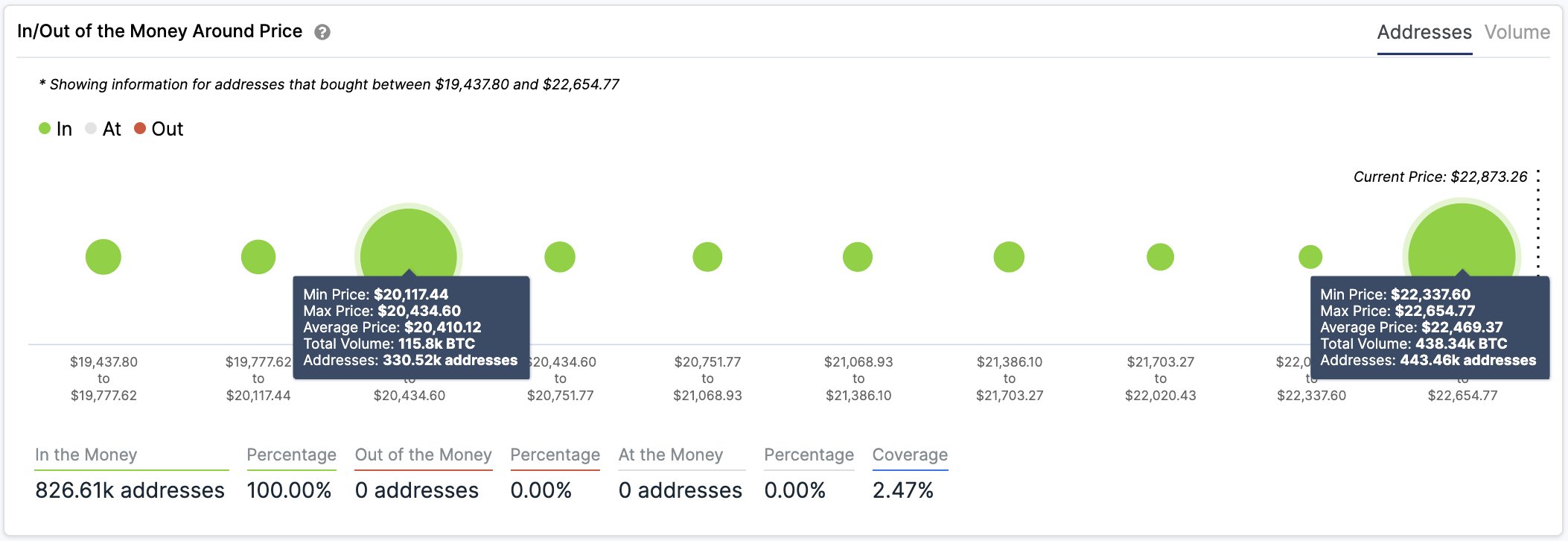
BTC IOMAP by IntoTheBlock
Nonetheless, a break below the $22,500 will be catastrophic for the bulls. The IOMAP cohorts show that if BTC price fails to hold above this support level, it will likely plummet towards $20,000.
Author

FXStreet Team
FXStreet
Composed of a group of economic journalists and FX experts, the FXStreet content team produces and oversees all content published on FXStreet. It provides a purely journalistic approach to the Forex market.