Four reasons why DeFi is set to disrupt the global financial system
- The shift from CeFi and DeFi continues to gain momentum.
- DeFi is set to disrupt the existing financial structure as it proves more beneficial.

Market participants seem to be divided on whether or not decentralized finance (DeFi) is set to disrupt the current centralized financial system. Given the rising number of issues that have led to millions of dollars lost within this sector, it is uncertain what the future will look like as blockchain technology begins to gain traction in the new economic order.
The challenges of centralized finance
Centralized finance can be defined as the current financial system that rules the world, where investors relinquish the custody of their funds to third parties. This economic structure relies on the trust that people have for financial institutions, while it promises improved accessibility to a range of services.
"CeFi is an extension of the existing financial model, but upgraded to the next level with crypto. It alleviates one of the biggest pain points of the traditional financial system — accessibility but keeps the usability and simplicity as it's more familiar to most people," affirms Bill Dashdorj, CEO at Pokket.
Centralized exchanges like Coinbase and Binance are good examples of CeFi services. These platforms are prone to several risks ranging from exit scams to hacks, as it happened with Mt. Gox in 2014. There have been many cases where investors cannot access their funds, as it is currently happening with OKEx users.
While the different features that CeFi provides are quite useful since there is someone to blame for any issues, these platforms do not completely satisfy the cryptocurrency industry's ethos.
Benefits of shifting to DeFi
On the other hand, DeFI creates an ecosystem that is based on a permissionless and decentralized model. It also enables access to cryptocurrencies and a wide range of financial services, where trust relies on the blockchain.
Some of the benefits of this new market sector include:
- Improved transparency: Being one of the core characteristics of cryptocurrencies in general, DeFi provides a high level of openness. It gives user autonomy, leveraging the blockchain to provide both transparency and accessibility.
- Better Transparency: The lack of adequate openness in traditional finance, particularly regarding how financial companies use clients' funds, was one thing that cryptocurrencies sought to fix. The CeFi model only brings a marginal improvement in transparency, while DeFi redefines transparency with the increasing use of on-chain data analysis.
- Less Third-Party Risk: DeFi's trustless system eliminates the need for a counterparty to validate transactions between two people or more, thereby making it safer to use.
- No Risk of Censorship: Eliminating any form of counterparty means that the DeFi ecosystem can operate without any suppression. Services cannot be stopped, and transactions are irrevocable.
While the absolute autonomy of funds ownership is attractive, it is a double-edged sword. It is impossible to look past its risks, making safeguarding private keys paramount as losing them can lead to an irrecoverable loss of assets.
Nevertheless, the cryptocurrency industry is continuously evolving and adapting to provide a better inclusion to those unbanked. The rising usage of DeFi protocols indicates that trust for these services is also increasing, and more investors are adopting it.
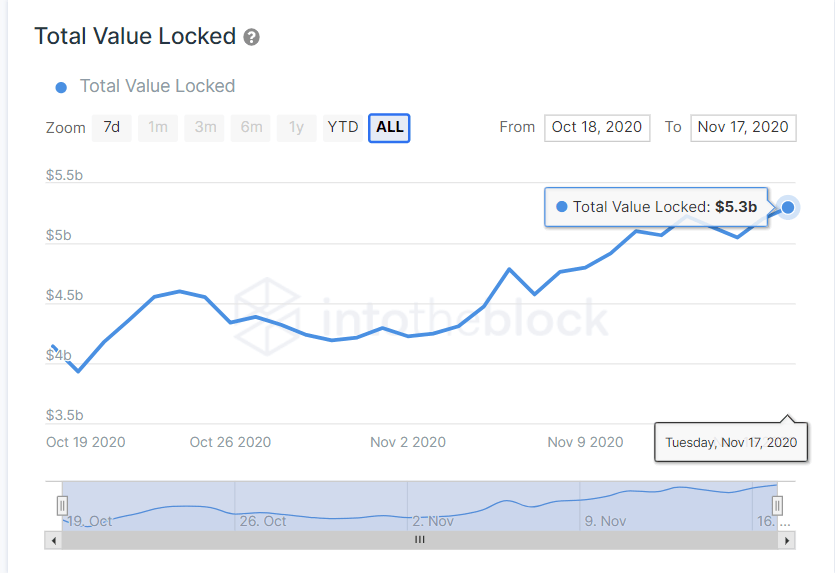
Total value locked in DeFi as shown on IntoTheBlock
Albeit, the narrative that CeFi and DeFi can coexist is not far-fetched as the latter continues to metamorphose and gain more adoption within the cryptocurrency industry.
Author

FXStreet Team
FXStreet
Composed of a group of economic journalists and FX experts, the FXStreet content team produces and oversees all content published on FXStreet. It provides a purely journalistic approach to the Forex market.