Ethereum Shanghai Upgrade is nearing, what to expect from ETH and LSD tokens
- Ethereum Shanghai upgrade will enable ETH withdrawals for users who staked their tokens from as early as December 2020.
- ETH selling pressure could be limited by reduced stakers, steady withdrawal process, and 60% of altcoin being liquid.
- LSD tokens have spiked since the announcement of the launch date, but rally could be unsustainable.

Ethereum (ETH) has over 16.3 million tokens staked on the network but cannot be withdrawn, according to Dune analytics data. The Shanghai upgrade, slated for April 12, 2023, at around 10:27:35 PM UTC will change this, allowing Ethereum stakers, including individuals and larger staking outlets to withdraw their staked ETH freely, something that is currently impossible.
The Shanghai/Capella upgrade, christened Shapella, will enable ETH withdrawals for various users who staked their Ether on the network as early as December 2020. After withdrawals are enabled, experts say it will reduce the risk of holding the staked versions of Ethereum, including Lido’s stETH and Frax’s frxETH because they will finally become redeemable.
What will happen to Ethereum price post-Shapella
Investors should expect one cohort of investors to want to cash out on their staking positions for more funds, a move that will see them exit from the Beacon Chain. Even if validators (node operators withdraw and sell their digital assets, they will want to maintain their staking balance for more yields. With reduced risk, more Ethereum holders could feel motivated to stake with liquid staking derivatives (LSD) for increased yields.
The case for selling pressure
Stakers will not be able to withdraw all staked ETH at once. There will be a withdrawal process, with holders being able to withdraw their rewards directly. This would represent $1.03 million ETH, equivalent to $1.8 billion at current rates. Given that Ethereum’s daily volume ranges between US $8-10 billion, chances of negligible selling pressure are high.
Moreover, considering the amount staked per validator cannot be withdrawn directly because of the 50,400 ETH per day limit ($85M at current rates), this is a negligible amount compared to the token’s daily volume. Chances are very high, therefore, that the price will not be too impacted given the low seller pressure that is also diluted.
The case for buying pressure
As regards buying pressure, given that staking rewards are inversely proportional to the number of validators, if the number of node operators reduces, presumably because of stakers withdrawing their ETH, rewards will surge and attract other validators. Given ETH is now deflationary, however, we expect more buying pressure compared to selling pressure.
If Ether holders refrain from selling their tokens and instead buy and hold indefinitely, the equilibrium Ethereum price could rise because the quantity supplied will reduce.
Buying pressure could therefore increase due to validators existing, which will cause rewards to increase thereby drawing in more investors. Secondly, incumbent stakers are expected to show more optimism, and finally, the idea that ETH is now deflationary will inspire buyers.
Liquid staking derivatives pumping before the Shanghai upgrade
Following the latest announcement from the Ethereum Foundation, Liquid staking derivatives like Lido DAO, Frax Shares, and Rocket Pool have spiked. These LSDs were designed to make staking easier as they do not require a minimum deposit to become a staker. The gains for the native tokens of these staking projects, LDO, FXS, and RPL, respectively, outperformed Ethereum price that surged 5.5% in the last 24 hours. LDO surged 18.6%, RPL 13.3%, and FXS 20.4%, based on data on Coingecko.
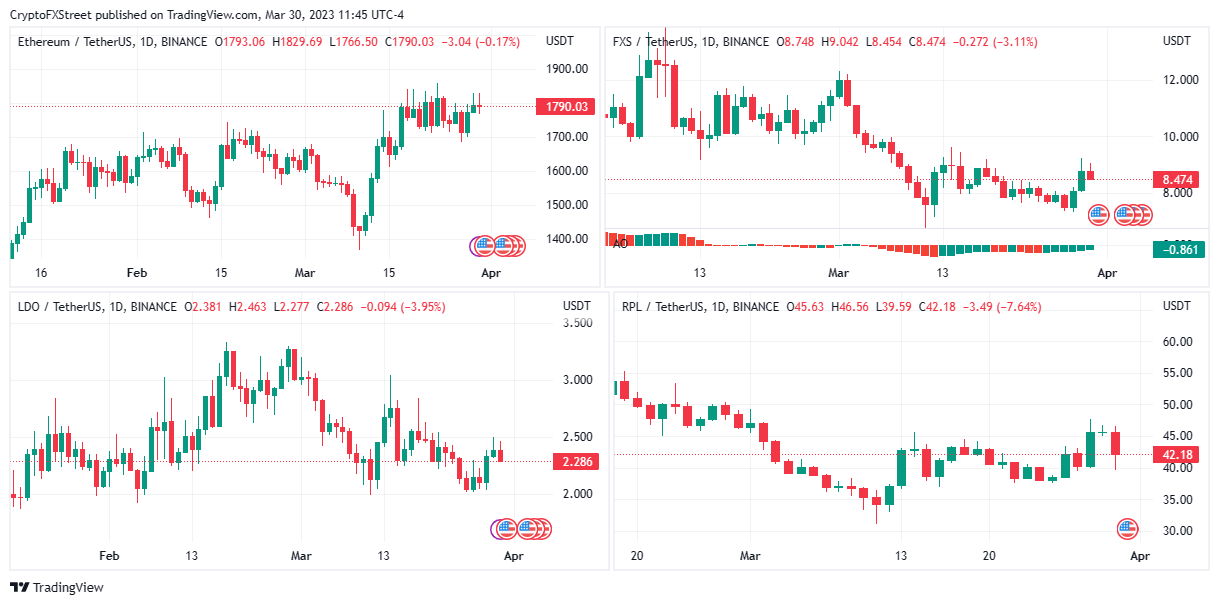
ETH/USDT 1-day chart, FXS/USDT 1-day chart, LDO/USDT 1-day chart, RPL/USDT 1-day chart
The case was different before the hype about the testnet started, with a general bearish sentiment across the market due to the 2022 crypto winter. However, the narrative started changing as the testnet launch drew near, bolstered by the alt season potential due to the declining BTC dominance.
The surge pre-upgrade comes as Shapella will help bypass high-entry barriers such as the 32 ETH threshold, the need for technical node-operating knowledge, and the withdrawal queue. After April 12, users will be able to stake easily through LSDs which could lead to a boost in total value locked (TVL), on-chain activities, and ultimately valuation of these protocols.
Notably, the above protocols allow users to deposit whichever amount of Ethereum and stake. When you deposit directly on the mainnet, you need a minimum of 32 ETH to participate. Depositing into a staking project earns you a “staked” version of ETH (stETH), which accrues staking yield and surges as a receipt of their deposit.
Possible impact of Shapella on LSDs
LSD protocols not only unlock the value of staked tokens but also gives users the opportunity to earn staking rewards. They also use the derived value of their staked tokens on other protocols. Conversely, being able to unstake your tokens post-Shapella makes the validator lose out on the staking rewards. This means that LSDs will remain relevant.
Also, with the news of regulating centralized exchanges (CEXs) and restricting them from staking, after the Shanghai upgrade, we might notice a huge withdrawal of Coinbase ETH. However, it remains to be seen whether these users will move to another LSD protocol or if they will sell off.
Moving to Lido may threaten Ethereum protocol due to centralization risks. For the meantime, investors should expect a more positive run for Ethereum-based LSDs as the Shanghai upgrade builds confidence in users that they can unstake their ETH whenever they want.
On the flipside, it is also possible that the rally will subside post-upgrade after the ‘sell-the-news’ narrative eases down. This was the case for Ethereum pre- and post-Merge. ETH rallied before the transition to Proo-of-Stake (PoS) mechanism but the tides changed after the event as Ethereum price moved in tandem with the bear market.
Nevertheless, Ethereum remains a giant in the crypto sector because of its strong fundamentals. Similarly, we expect that only the most well-balanced platform with the optimum tokenomics and appropriate fundamentals will remain promising. The rest may fade with time.
Author

Lockridge Okoth
FXStreet
Lockridge is a believer in the transformative power of crypto and the blockchain industry.