Ethereum Layer 2 networks BASE, zkSync Era make history, ETH bites the dust
- Several Layer 2 networks’ transactions per second exceeded that of Ethereum for the first time in history, according to L2Beat.
- BASE and zkSync Era left Ethereum behind with massive activity on friend.tech over the weekend.
- Ethereum price wiped out its losses from the past week, ETH climbed 6.2% from this past Monday’s intraday low of $1,531.

Ethereum recently hit a key milestone marking the one year anniversary of the Merge. In the past year, there has been an increase in activity on two Layer 2 chains: Coinbase’s BASE and zkSync Era.
Over the past weekend, the transactions per second (TPS) metric of BASE and zkSync Era exceeded that of Ethereum. This metric measures the speed and throughput of crypto networks, helping traders identify which blockchain has the ability to handle a higher volume of transactions.
Also read: What to expect from Bitcoin price as $3.4 trillion stock options set to expire on Friday
BASE and zkSync Era leave Ethereum behind in TVL
Based on data from crypto intelligence tracker L2Beat, on September 16, last weekend, the TPS of two Layer 2s exceeded Ethereum. What’s more, the total value of assets locked (TVL) on Base climbed 116% on a monthly basis, dominating other Layer 2 networks.
Base’s rising TVL can be attributed to friend.tech’s success. Between September 15 and 16, the blockchain-based social finance application on BASE raised more fees in a 24-hour period than the Ethereum and Bitcoin network. Ethereum’s TPS was recorded as 10.18 on September 17, while BASE reached 12.93 (recording an increase of 49.76% over the past week) and zkSync Era reached 12.62.
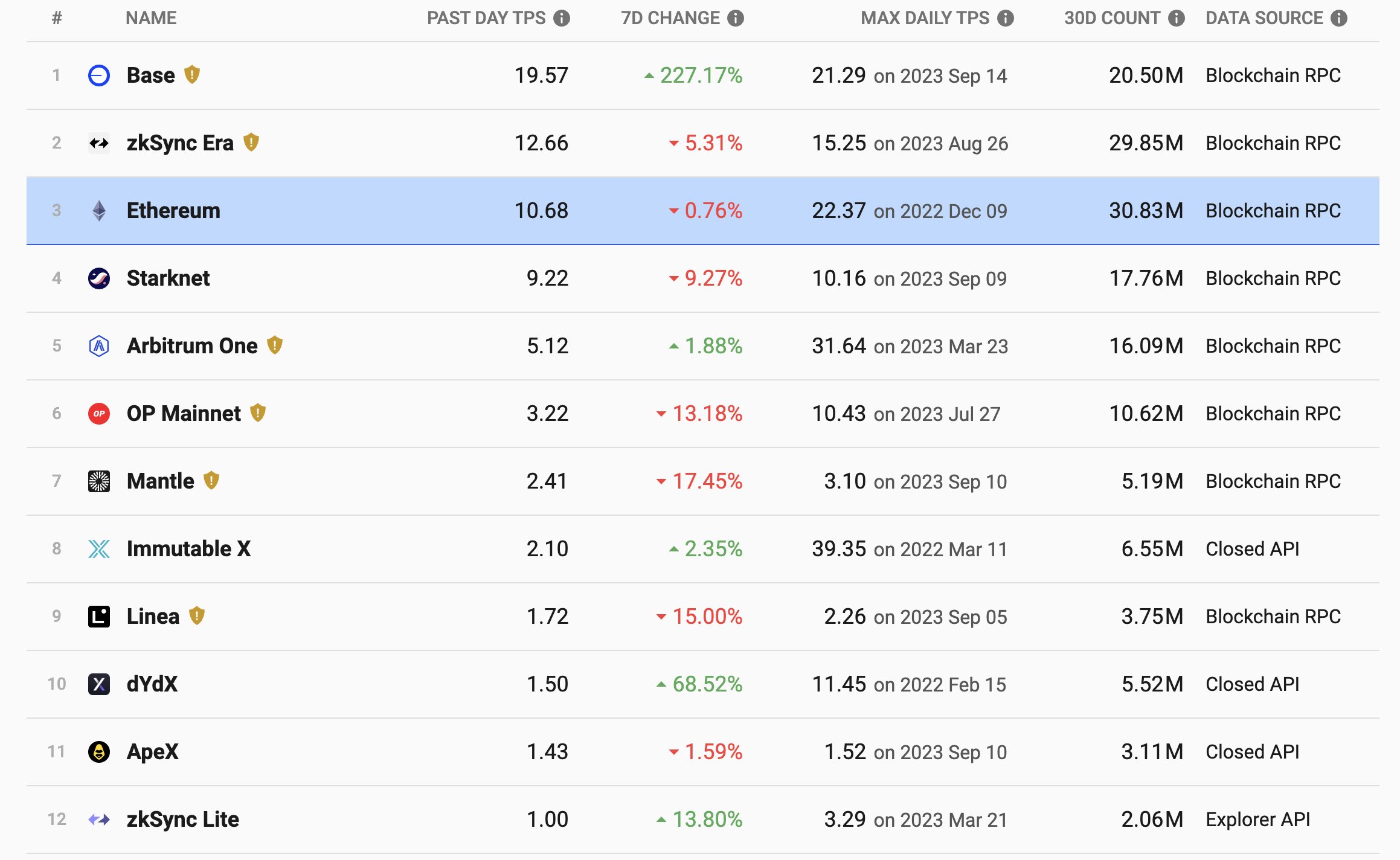
BASE and zkSync Era exceed Ethereum in TPS
Interestingly, during the same time period where the TVL of chains like Solana has declined, it has increased for BASE-based friend.tech. With the increasing interoperability of chains, analysts like Jason Chen, a builder of ThreeDAOSpace @jason_chen998 believe that Layer 2 chains have an advantage over Layer 1 chains for users.
Ethereum price wiped out losses from the past week and yielded a 0.75% gain for ETH holders on Monday. ETH price has climbed 1% over the past seven days. At the time of writing, ETH price is $1,635 on Binance.
Ethereum FAQs
What is Ethereum?
Ethereum is a decentralized open-source blockchain with smart contracts functionality. Serving as the basal network for the Ether (ETH) cryptocurrency, it is the second largest crypto and largest altcoin by market capitalization. The Ethereum network is tailored for scalability, programmability, security, and decentralization, attributes that make it popular among developers.
What blockchain technology does Ethereum use?
Ethereum uses decentralized blockchain technology, where developers can build and deploy applications that are independent of the central authority. To make this easier, the network has a programming language in place, which helps users create self-executing smart contracts. A smart contract is basically a code that can be verified and allows inter-user transactions.
What is staking?
Staking is a process where investors grow their portfolios by locking their assets for a specified duration instead of selling them. It is used by most blockchains, especially the ones that employ Proof-of-Stake (PoS) mechanism, with users earning rewards as an incentive for committing their tokens. For most long-term cryptocurrency holders, staking is a strategy to make passive income from your assets, putting them to work in exchange for reward generation.
Why did Ethereum shift from Proof-of-Work to Proof-of-Stake?
Ethereum transitioned from a Proof-of-Work (PoW) to a Proof-of-Stake (PoS) mechanism in an event christened “The Merge.” The transformation came as the network wanted to achieve more security, cut down on energy consumption by 99.95%, and execute new scaling solutions with a possible threshold of 100,000 transactions per second. With PoS, there are less entry barriers for miners considering the reduced energy demands.
Like this article? Help us with some feedback by answering this survey:
Author

Ekta Mourya
FXStreet
Ekta Mourya has extensive experience in fundamental and on-chain analysis, particularly focused on impact of macroeconomics and central bank policies on cryptocurrencies.