CFTC continues to explore digital asset policy considerations in MRAC meeting

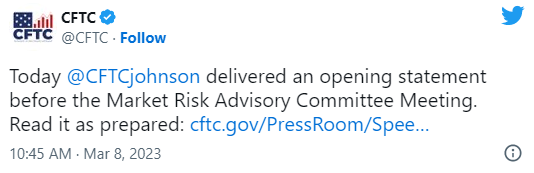
Commissioner Kristin Johnson said in prepared remarks that the U.S. digital economy was "witnessing the deployment of Web 3.0".
The United States Commodity Futures Trading Commission, or CFTC, was a part of discussions on a regulatory framework for digital assets as well as use cases for blockchain technology.
In a March 8 meeting of the CFTC’s Market Risk Advisory Committee, commissioners, regulators, and industry representatives were scheduled to discuss “critical policy considerations” as part of the commission’s efforts to develop a regulatory framework for digital assets. In addition, industry leaders including Uniswap Labs CEO Hayden Adams and Chainalysis’ global head of public policy Caroline Malcolm were part of a panel focused on use cases of DeFi, distributed ledgers, and blockchain.
“Consistent with the MRAC’s historic role in delivering first-of-its-kind or unprecedented reports and recommendations, we anticipate furthering the Commission’s focus on targeted recommendations to address climate-related risks in our markets and delivering recommendations for the regulation of digital asset markets,” said CFTC commissioner Kristin Johnson in prepared remarks.
Johnson added:
“Our economy is a digital economy. Global financial markets indisputably rely on the internet and the internet of things (IOT). We are now witnessing the deployment of Web 3.0.
Along with the U.S. Securities and Exchange Commission, the CFTC has been behind some of the recent lawsuits against high-profile figures in the crypto space. The commission has charged former FTX executives Nishad Singh and Sam Bankman-Fried for allegations related to commodities fraud. Former Alameda Research CEO Caroline Ellison and former FTX chief technology officer Gary Wang face similar charges, but have consented to stays in the CFTC’s civil cases.
Balancing the burden of digital asset regulation in the United States could be a point of contention among federal agencies and lawmakers in the current session of Congress. House Representative Tom Emmer introduced legislation aimed at limiting the Federal Reserve’s authority in issuing a central bank digital currency, while the SEC also has moved against Paxos over the Binance USD token.
Author

Cointelegraph Team
Cointelegraph
We are privileged enough to work with the best and brightest in Bitcoin.