Bitcoin trading volume in spot and derivatives market points to dwindling liquidity, limits price growth
- Bitcoin trading volume in spot and derivatives markets has witnessed a significant drop 94% and 73% respectively.
- This points to reducing market liquidity, according to Quant analytics, as trading volume often moves directly proportional to liquidity.
- The liquidity drop explains the struggling price growth as investors exercise caution.
- Experts say BTC hints at a steep correction from a big-picture view, with the $25,229 level being critical.

Bitcoin (BTC) trading volume is down by a significant margin in the last 24 hours, according to data on CoinMarketCap, with the metric showing how much BTC was traded over that timeframe. The volume of any crypto asset is the total spot trading volume reported by all exchanges over the last 24 hours for the cryptocurrency in question.
Also Read: Bitcoin profitable days shows that in the long run holding is usually a solid strategy
Bitcoin market liquidity dwindles, inhibits price growth
Data by on-chain market intelligence CryptoQuant shows that Bitcoin trading volume in spot and derivatives markets has witnessed a significant drop beginning March 2023. The derivatives or futures market is down 73% since the onset of the year whilst the spot market is down 94%.
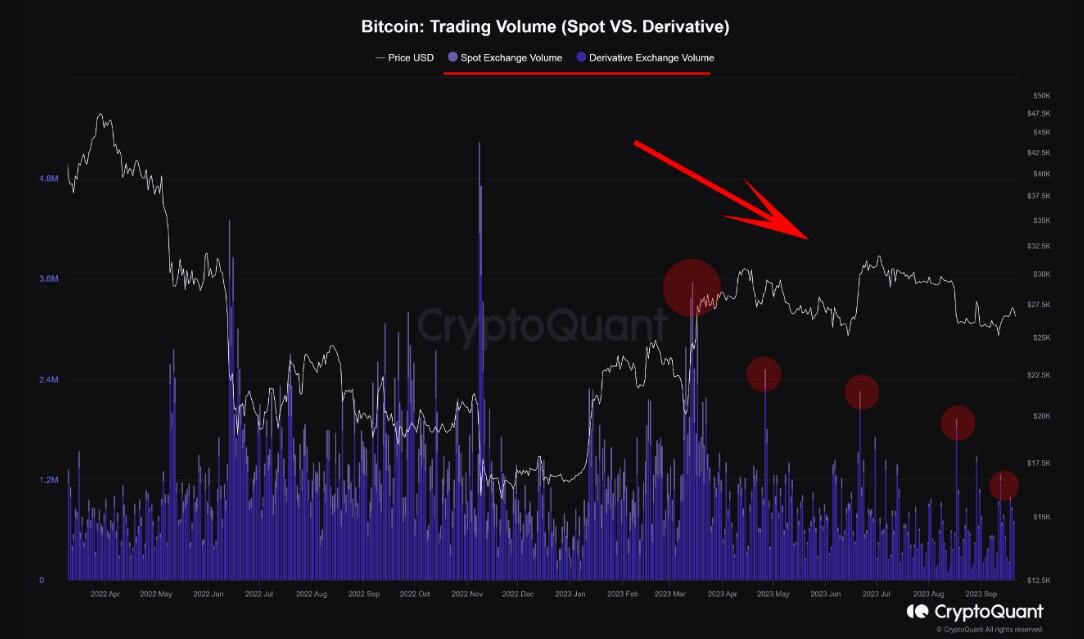
BTC trading volume: Spot vs. Derivative
The drop in trading volume over the months points to an important and unstable situation in the current market, with investors exercising extra caution. Notably, the market has displayed little volatility over the past few weeks, trading within a narrow range. The inactionable price shifts, tightly knit within a thin range, left very little opportunity for traders to act.
Data from CoinMarketCap corroborates this for the spot market, showing a 33% drop over the last day to $10.36 billion.
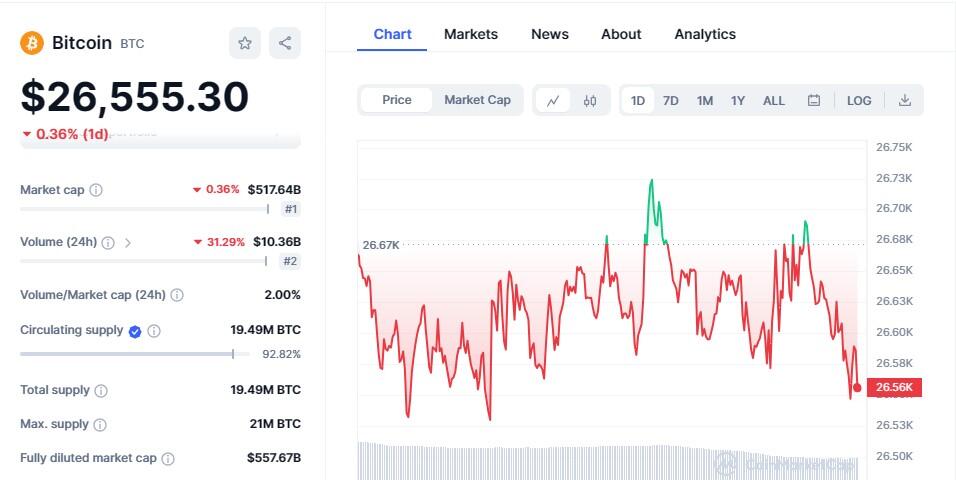
BTC Trading Volume
It is worth mentioning that trading volume in spot as well as derivatives markets is one of the most important drivers of liquidity.
The drop in trading volume on the 24-hour scale could be attributed to investors transitioning to the weekend mood, which has historically been characterized by low trading volumes as retail traders step back. Large holders tend to take control over the weekend, with low volumes and low liquidity leaving prices susceptible to big shifts even in the face of small transactions.
Another possible reason for the reduced trading volume is that traders who profited from the recent 10% surge between September 12 and 19 have taken a pause to re-evaluate the next move for the market.
Effects of limited liquidity
With little liquidity in the market, the cost and risk parameters rise because the market becomes more volatile. A shortage of buyers and sellers basically translates into more significant price swings despite the size of individual transactions. In the same way, transaction costs also go up as entering in and out of a position often entails bearing a greater ‘spread’ cost.
With the dwindling liquidity limiting the upside potential of Bitcoin price, experts say BTC hints at a steep correction from a big-picture view, with the $25,229 level being critical. A decisive break below this support level will confirm the beginning of a bearish trend for the king of crypto.

BTC/USDT 1-day chart
At the time of writing, Bitcoin price is $26,591.
Bitcoin, altcoins, stablecoins FAQs
What is Bitcoin?
Bitcoin is the largest cryptocurrency by market capitalization, a virtual currency designed to serve as money. This form of payment cannot be controlled by any one person, group, or entity, which eliminates the need for third-party participation during financial transactions.
What are altcoins?
Altcoins are any cryptocurrency apart from Bitcoin, but some also regard Ethereum as a non-altcoin because it is from these two cryptocurrencies that forking happens. If this is true, then Litecoin is the first altcoin, forked from the Bitcoin protocol and, therefore, an “improved” version of it.
What are stablecoins?
Stablecoins are cryptocurrencies designed to have a stable price, with their value backed by a reserve of the asset it represents. To achieve this, the value of any one stablecoin is pegged to a commodity or financial instrument, such as the US Dollar (USD), with its supply regulated by an algorithm or demand. The main goal of stablecoins is to provide an on/off-ramp for investors willing to trade and invest in cryptocurrencies. Stablecoins also allow investors to store value since cryptocurrencies, in general, are subject to volatility.
What is Bitcoin Dominance?
Bitcoin dominance is the ratio of Bitcoin's market capitalization to the total market capitalization of all cryptocurrencies combined. It provides a clear picture of Bitcoin’s interest among investors. A high BTC dominance typically happens before and during a bull run, in which investors resort to investing in relatively stable and high market capitalization cryptocurrency like Bitcoin. A drop in BTC dominance usually means that investors are moving their capital and/or profits to altcoins in a quest for higher returns, which usually triggers an explosion of altcoin rallies.
Author

Lockridge Okoth
FXStreet
Lockridge is a believer in the transformative power of crypto and the blockchain industry.