Bitcoin Price Outlook: Will CPI report showing inflation eased in April push BTC to $70K?
- Bitcoin price is up nearly 5% to tag $65,000, a level last tested on May 6.
- CPI report shows inflation eased in April, falling to 3.4% after March reading at 3.5%.
- Core CPI came in at 3.6% vs. 3.8% last month, both aligning with expectations and clearly bullish for BTC.

Bitcoin (BTC) price jumped by 5% on Wednesday, seeing the American session outperform the Asian session for the first time in a while. Tailwinds sprouted fron US inflation release.
Also Read: Bitcoin Price Outlook: Will GameStop stock resurgence have downstream effect on BTC and alts?
Daily digest market mover: CPI report shows inflation eased in April, Bitcoin jumps 5%
Bitcoin price showed strength on Wednesday after the April inflation reading by the US Bureau of Labor Statistics (BLS).
Per the report, inflation has declined from 3.5% to 3.4% on a yearly basis in April, measured by the change in the Consumer Price Index (CPI). This is in line with what markets expected. The annual core CPI also dropped from 3.8% to 3.6% in the same period.
#Bitcoin has pumped +3.5% since the CPI data for April revealed some slight easing by inflation. pic.twitter.com/6MuMzSTmDM
— Satoshi Stacker (@StackerSatoshi) May 15, 2024
Economist and global strategist Peter Schiff says, “…all economic and other data point to much larger CPI increases in the future,” adding, “If the Fed needs a bogus excuse to cut rates, investors are hoping this qualifies.”
There is nothing to celebrate about today's April #CPI release. Up .3% annualizes to an #inflation rate near 4%. But all economic and other data point to much larger CPI increases in the future. If the #Fed needs a bogus excuse to cut rates, investors are hoping this qualifies.
— Peter Schiff (@PeterSchiff) May 15, 2024
However, with the surge in the Bitcoin price, 53,079 traders were liquidated, Coinglass reports, adding that the total liquidations come in at $120.55 million.
The surge in Bitcoin price is ascribed to speculation and market sentiment. Traders and investors interpret the news of softened inflation as a signal that central banks may maintain loose monetary policy, which could benefit riskier assets like Bitcoin.
Inflation FAQs
Inflation measures the rise in the price of a representative basket of goods and services. Headline inflation is usually expressed as a percentage change on a month-on-month (MoM) and year-on-year (YoY) basis. Core inflation excludes more volatile elements such as food and fuel which can fluctuate because of geopolitical and seasonal factors. Core inflation is the figure economists focus on and is the level targeted by central banks, which are mandated to keep inflation at a manageable level, usually around 2%.
The Consumer Price Index (CPI) measures the change in prices of a basket of goods and services over a period of time. It is usually expressed as a percentage change on a month-on-month (MoM) and year-on-year (YoY) basis. Core CPI is the figure targeted by central banks as it excludes volatile food and fuel inputs. When Core CPI rises above 2% it usually results in higher interest rates and vice versa when it falls below 2%. Since higher interest rates are positive for a currency, higher inflation usually results in a stronger currency. The opposite is true when inflation falls.
Although it may seem counter-intuitive, high inflation in a country pushes up the value of its currency and vice versa for lower inflation. This is because the central bank will normally raise interest rates to combat the higher inflation, which attract more global capital inflows from investors looking for a lucrative place to park their money.
Formerly, Gold was the asset investors turned to in times of high inflation because it preserved its value, and whilst investors will often still buy Gold for its safe-haven properties in times of extreme market turmoil, this is not the case most of the time. This is because when inflation is high, central banks will put up interest rates to combat it. Higher interest rates are negative for Gold because they increase the opportunity-cost of holding Gold vis-a-vis an interest-bearing asset or placing the money in a cash deposit account. On the flipside, lower inflation tends to be positive for Gold as it brings interest rates down, making the bright metal a more viable investment alternative.
Technical analysis: Bitcoin price must record a stable close above $65,500 for market structure change
Bitcoin price has recorded a god candle in the one-day timeframe. This is a massive green candle, signaling a bullish trend as it represents robust buying pressure. It comes after a sequence of lower highs, which means the ongoing rally could culminate in a change in market structure.
For this to happen, however, Bitcoin price must break and close above $65,500 on the one-day time frame. The Relative Strength Index (RSI) is also posting higher lows, suggesting growing bullish momentum. This coupled with the Awesome Oscillator (AO), whose histogram bars are green and pulling toward positive territory, suggests bullish sentiment is growing.
Further, the DXY Compare indicator continues to nosedive, which is interpreted as investors being more willing to take on riskier assets like Bitcoin when they perceive less uncertainty in the US dollar (USD).
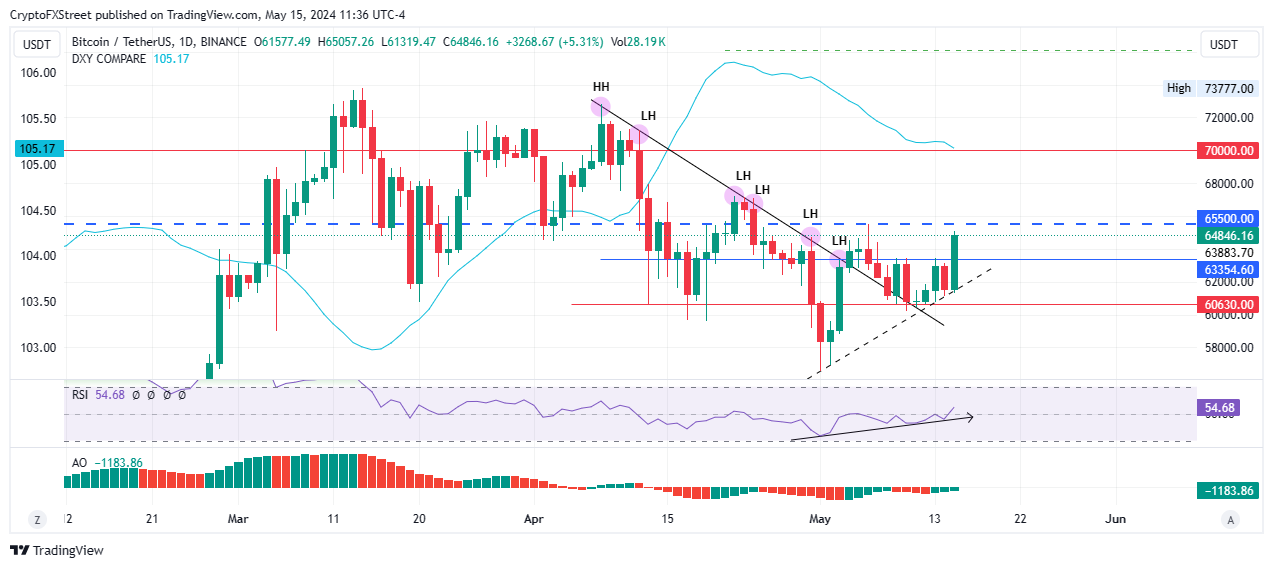
BTC/USDT 1-day chart
Conversely, a rejection from the $65,500 threshold could cause a retraction in Bitcoin price. A slip below $60,630 would encourage panic selling, potentially sending BTC lower to $58,000 or, in a dire case, the May 1 lows of $56,552. This would denote a fall of nearly 13% below current levels.
Author

Lockridge Okoth
FXStreet
Lockridge is a believer in the transformative power of crypto and the blockchain industry.