Bitcoin price likely to fall 10% from current levels this September, crypto analyst says
- Popular strategy analyst Benjamin Cowen has forecasted a bearish month for Bitcoin this September.
- In his opinion, the month has proven gloomy for BTC historically, characterized by negative averages incomparable to any other month.
- With this, Cowen predicts a 10% slump to test the $23,000 psychological level.
- Regarding altcoins, he anticipates a recovery inspired by a confluence of macro tailwinds to steer the market into 2024.

Bitcoin (BTC) price has historically hurt traders that take long positions in September, with strategy analyst Benjamin Cowen predicting double-digit losses this month, potentially testing levels last seen in February.
Also Read: Bitcoin Weekly Forecast: BTC correlation to DJIA hits 2021 peak levels amid ETF hype.
Bitcoin could fall 10% in September
Bitcoin (BTC) price could fall at least 10% in September, according to Cowen, a strategy analyst who explored the bearish outlook displayed by BTC historically during this month. With the flagship crypto back in the $25,000 range after the US Securities and Exchanges Commission (SEC) delayed decisions on spot BTC Exchange-Traded Funds (ETF) filing, the analyst says:
September just tends to not be a great month for crypto. Bitcoin – you can see – it averages negative in September, by a long shot, much worse than any other month.
The analyst retraced the “seasonality of Bitcoin,” highlighting that momentum indicators add credence to his analysis. In his opinion, the fact that BTC closed the month of August below the $27,000 psychological level increased the odds for a deep correction to $23,000 in September.
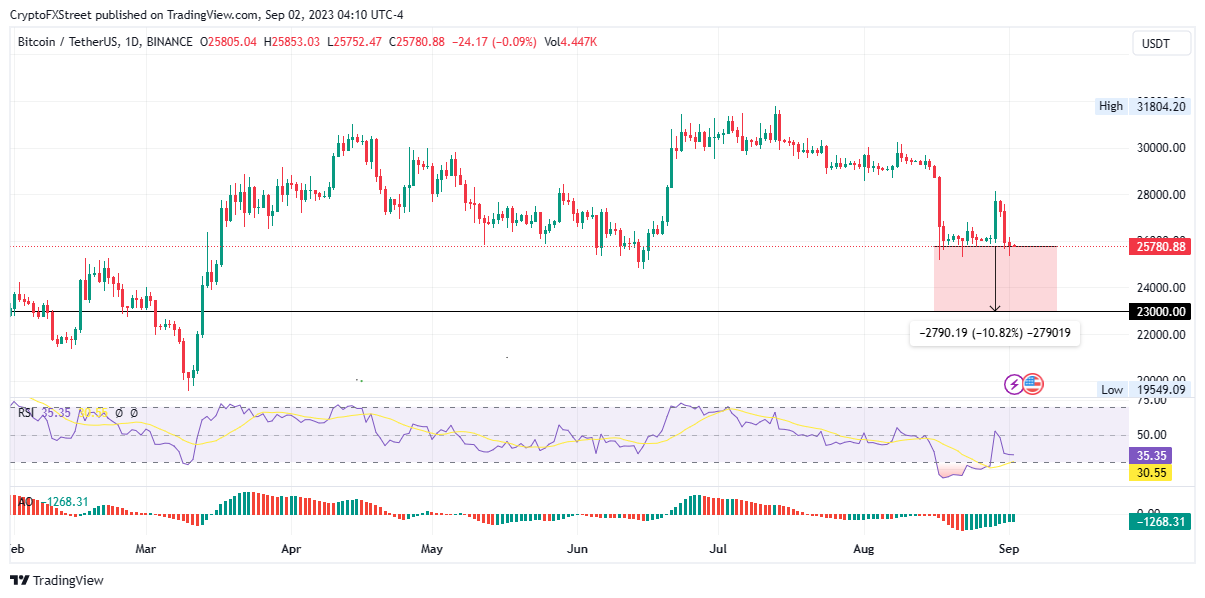
BTC/USDT 1-day chart
What about altcoins?
Regarding altcoins, the analyst predicts this class of assets “coming back to life,” possibly driven by a confluence of macro factors that would bode well for the altcoin category in 2024.
Cowen’s thesis for altcoins in 2024 sprouts from the Bitcoin halving, expected in early 2024. The halving season is characterized by volatility, which could go higher considering the US Elections, defined by massive market uncertainty. For one, incumbents looking to stay in power are likely to inject political pressure as a campaign strategy to entice voters with less stringent monetary policies, hence volatility.
The analyst also bases his postulate on the ongoing “rate-hikes,” with the Federal Reserve showing more aggression this cycle than ever.
…at this rate, we are likely to start seeing the labor market show noticeable effects from all these interest rate hikes by the end of this year, early next year.
A weakening labor market coupled with easing inflation as chatter about a recession lingers will likely influence the Fed to pause the rate hikes to help companies stay afloat. This could pave the way for a “quantitative easing return” in the market, possibly allowing altcoins to thrive.
Bitcoin, altcoins, stablecoins FAQs
What is Bitcoin?
Bitcoin is the largest cryptocurrency by market capitalization, a virtual currency designed to serve as money. This form of payment cannot be controlled by any one person, group, or entity, which eliminates the need for third-party participation during financial transactions.
What are altcoins?
Altcoins are any cryptocurrency apart from Bitcoin, but some also regard Ethereum as a non-altcoin because it is from these two cryptocurrencies that forking happens. If this is true, then Litecoin is the first altcoin, forked from the Bitcoin protocol and, therefore, an “improved” version of it.
What are stablecoins?
Stablecoins are cryptocurrencies designed to have a stable price, with their value backed by a reserve of the asset it represents. To achieve this, the value of any one stablecoin is pegged to a commodity or financial instrument, such as the US Dollar (USD), with its supply regulated by an algorithm or demand. The main goal of stablecoins is to provide an on/off-ramp for investors willing to trade and invest in cryptocurrencies. Stablecoins also allow investors to store value since cryptocurrencies, in general, are subject to volatility.
What is Bitcoin Dominance?
Bitcoin dominance is the ratio of Bitcoin's market capitalization to the total market capitalization of all cryptocurrencies combined. It provides a clear picture of Bitcoin’s interest among investors. A high BTC dominance typically happens before and during a bull run, in which investors resort to investing in relatively stable and high market capitalization cryptocurrency like Bitcoin. A drop in BTC dominance usually means that investors are moving their capital and/or profits to altcoins in a quest for higher returns, which usually triggers an explosion of altcoin rallies.
Author

Lockridge Okoth
FXStreet
Lockridge is a believer in the transformative power of crypto and the blockchain industry.