Bitcoin scratches its way to 17-month high, steered there by BTC ETF hope and April halving countdown
- Bitcoin price has doubled its value year to date, rising 110 percent from the December 31 close of $16,542.
- BTC holds above the market’s midrange, measured from the yearly low to the yearly high of $35,184.
- Bitcoin halving is slated for April 2024 and is expected to kick-start next bull cycle.

Bitcoin (BTC) price has made its way to its 17-month high, levels last seen in May 2022. The surge caught many unaware as the king of crypto steadily edges north and gives the bull run vibes. With no clear pinpoint to what is fueling the rally, all signs point to either the oncoming BTC halving, or the hope of a spot BTC exchange-traded fund (ETF) launching soon.
Also Read: Bitcoin price shakes, DTCC website crashes after BlackRock iShares BTC Trust delisting
Bitcoin halving in sight with BTC pumping hard
Bitcoin (BTC) halving is now on the horizon at barely six months out. The cryptocurrency community anticipates that the event will kick-start the next bull run cycle.
JUST IN: CNBC anchor Joe Kernen says "prepare for the halving. The halving is coming." #Bitcoin pic.twitter.com/Eyq6hdTmUF
— Bitcoin Magazine (@BitcoinMagazine) October 25, 2023
According to analysts like Michaël van de Poppe, now is the best time to invest in altcoins, with venture capitalists (VCs) already itching to get the funding going.
The #Altcoins are breaking out left and right. The bull market is here.
— Michaël van de Poppe (@CryptoMichNL) September 15, 2023
It's crucial for altcoins to start moving in this period, as we're in the worst period of the cycle.
That means, the best period to invest. But why is that? Altcoins are moving massively.
Let's see. … pic.twitter.com/Zu1GL5nt61
Meanwhile, BTC miners remain disconcerted about this event even as investors count the days before their bags start to pump. The miners’ dread comes as the event will see a 50% slash in mining rewards, reducing from 6.25 BTC to 3.125 BTC per block. For investors, the halving is value-adding as it reduces the growth in newly mined BTC.
Miners’ operating expenses have increased in cost overtime as well. Specifically, mining infrastructure has grown more complicated and expensive. Others complain about higher electricity rates, and talk of a 30% tax on US miners has caused even more consternation. This is because BTC hash power – the power requisite for computer or hardware operations in solving different hashing algorithms – is mostly concentrated in the US. .
Bitcoin price rises toward $35,000
Bitcoin price is $34,572 at the time of writing, with the potential to soar higher as momentum remains strong. It holds above the market’s midrange, measured from the yearly low to the yearly high of $35,184.
The flagship crypto has doubled its value from the December 31 close of $16,542, shuttling past the 61.8% Fibonacci at $28,067, a crucial retracement level, on its way up. The solid thrust of the rally breached the 78.6% Fibonacci at $31,197 as well.
Increased buying pressure could see Bitcoin price extend north with a bullish psychological target of $35,000 in sight. In such an event, the most logical target would be the $35,184 level at the top of the Fibo chart.
The Relative Strength Index (RSI) oriented north suggests momentum is still rising. This is corroborated by the Awesome Oscillator (AO), whose histogram bars are also gaining in positive territory.
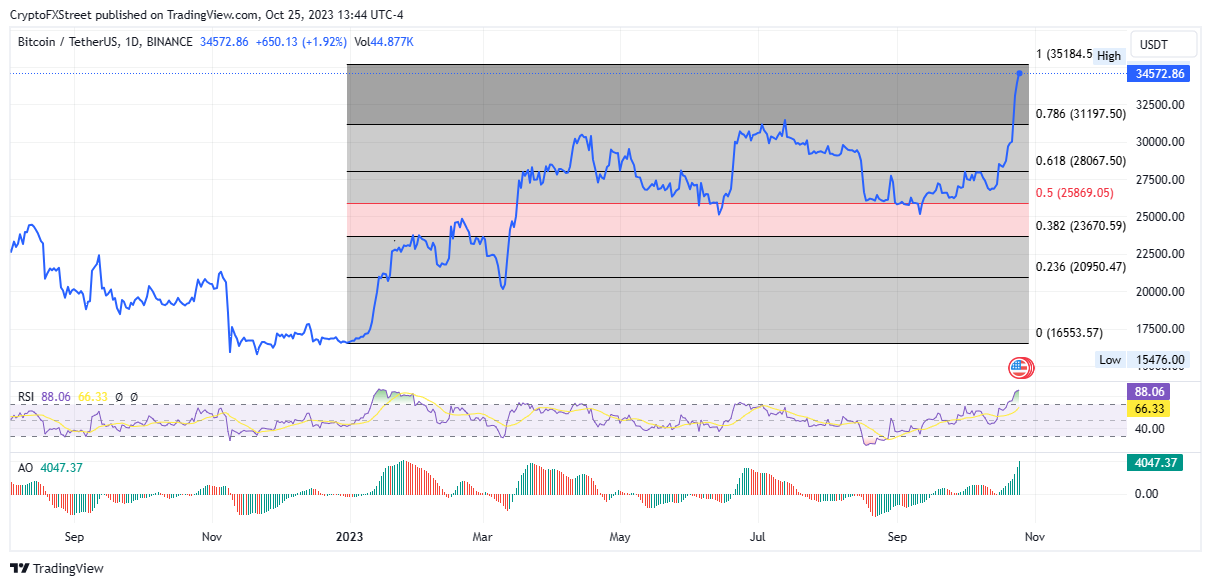
BTC/USDT 1-day chart
Nevertheless, a downtrend may still be in the cards for Bitcoin price if profit-taking begins. In such a case, BTC could find support at the $31,197 level, or more likely, around the $28,067 level. In the most dire case, the slump could send the people’s crypto to the $25,869 level.
Cryptocurrency prices FAQs
How do new token launches or listings affect cryptocurrency prices?
Token launches like Arbitrum’s ARB airdrop and Optimism OP influence demand and adoption among market participants. Listings on crypto exchanges deepen the liquidity for an asset and add new participants to an asset’s network. This is typically bullish for a digital asset.
How do hacks affect cryptocurrency prices?
A hack is an event in which an attacker captures a large volume of the asset from a DeFi bridge or hot wallet of an exchange or any other crypto platform via exploits, bugs or other methods. The exploiter then transfers these tokens out of the exchange platforms to ultimately sell or swap the assets for other cryptocurrencies or stablecoins. Such events often involve an en masse panic triggering a sell-off in the affected assets.
How do macroeconomic releases and events affect cryptocurrency prices?
Macroeconomic events like the US Federal Reserve’s decision on interest rates influence risk assets like Bitcoin, mainly through the direct impact they have on the US Dollar. An increase in interest rate typically negatively influences Bitcoin and altcoin prices, and vice versa. If the US Dollar index declines, risk assets and associated leverage for trading gets cheaper, in turn driving crypto prices higher.
How do major crypto upgrades like halvings, hard forks affect cryptocurrency prices?
Halvings are typically considered bullish events as they slash the block reward in half for miners, constricting the supply of the asset. At consistent demand if the supply reduces, the asset’s price climbs. This has been observed in Bitcoin and Litecoin.
Author

Lockridge Okoth
FXStreet
Lockridge is a believer in the transformative power of crypto and the blockchain industry.