Bitcoin bull trap or upcoming BTC price rally: Experts decode on-chain metrics
- Bitcoin circulation through the NVT model is considered a reliable indicator, and it displays a bearish divergence.
- Experts believe the divergence in on-chain metrics limits BTC’s return to highs of October and November 2021.
- The volume of unique active addresses and BTC circulation indicate that the Bitcoin bull run of 2023 was likely a bull trap.

Bitcoin price rally is largely driven by BTC utility, usage and network adoption. Experts have noted periods of divergences in on-chain metrics that signal a short-lived Bitcoin price rally or bull trap.
For Bitcoin price to rally to its 2021 peak, analysts expect growth in on-chain metrics that measure the participation of unique addresses on the BTC blockchain and the asset’s utility.
Also read: ZIL holders watch EVM implementation on Zilliqa closely, here’s what to expect
Bitcoin on-chain metrics that reveal bearish divergences and what it means
The volume of daily active addresses on the Bitcoin blockchain is considered a reliable indicator of BTC’s utility. Unlike trade volume, unique addresses interacting on the BTC network have climbed mildly, according to data from Santiment.
In 2020 and 2021 bull runs, there was a massive spike in unique addresses, while in 2023 the metric climbed 11% against a 65% price rally.
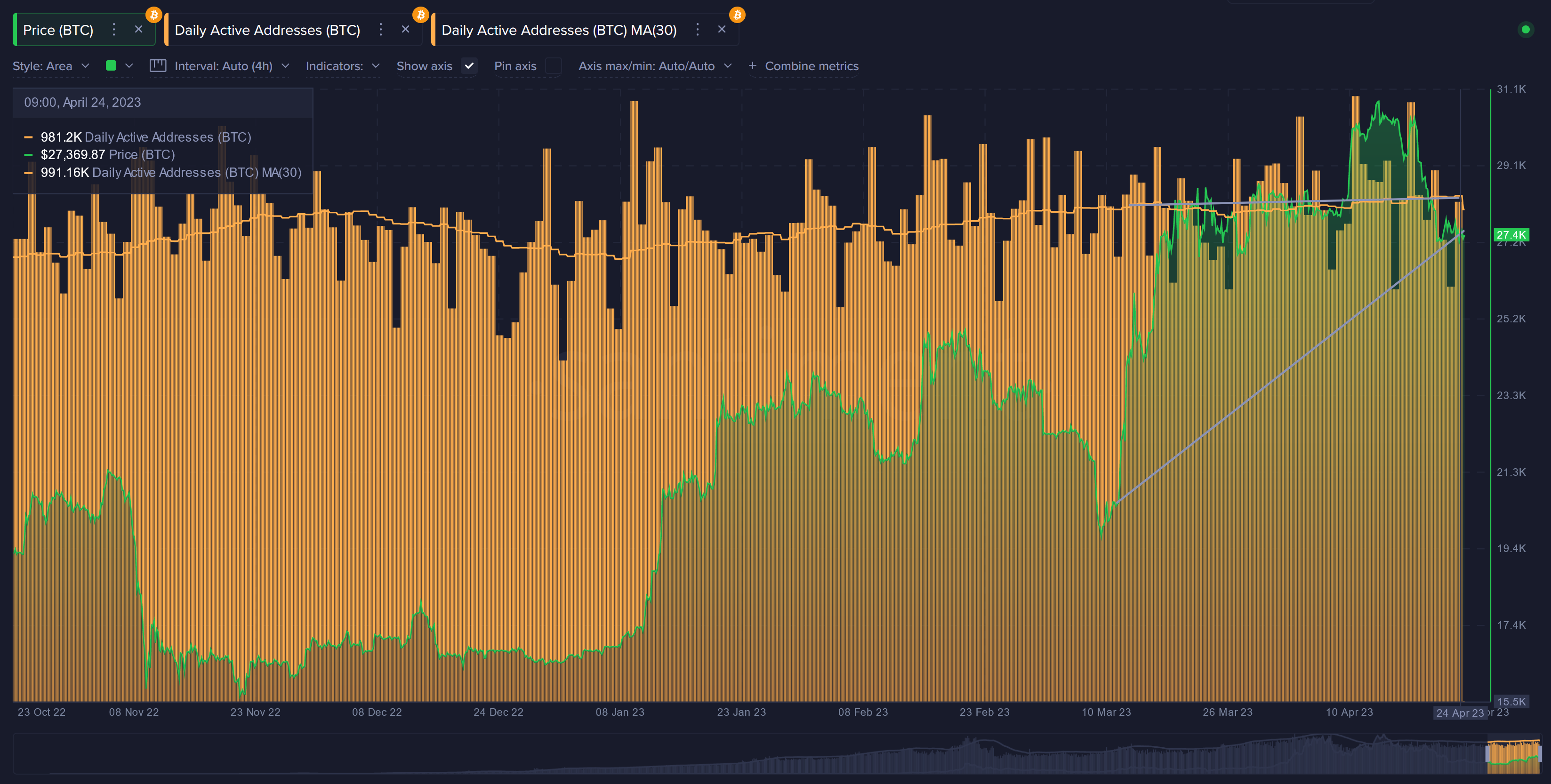
BTC daily active addresses
BTC tokens in circulation are measured by the metric “unique tokens moving per day.” This metric is down 6.4% when compared to the beginning of 2023. On January 1, BTC price was $16,700, and at press time the asset is exchanging hands at $27,399.
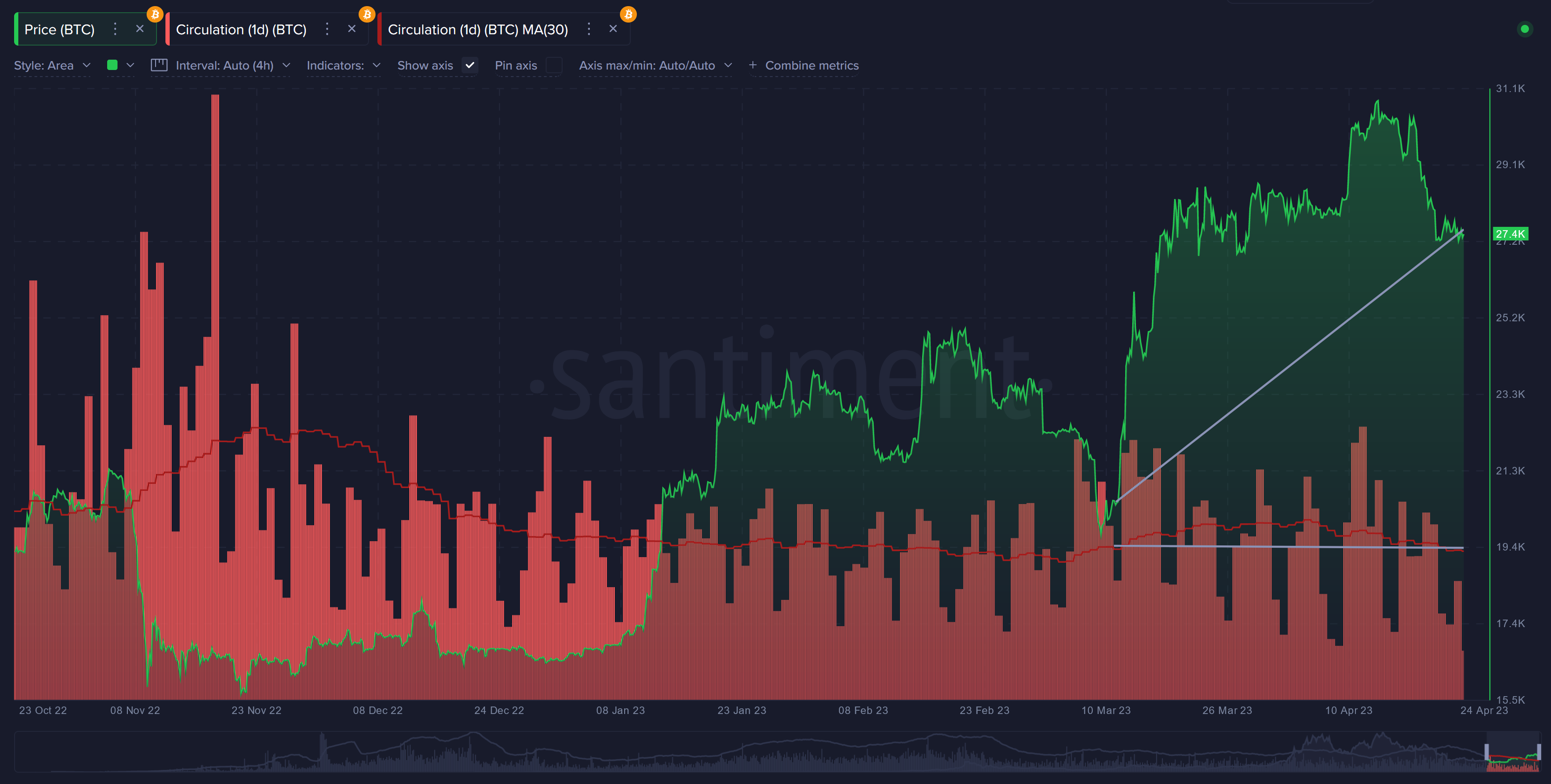
BTC circulation (unique tokens moving per day)
This reveals the bearish divergence in the unique tokens moving on the BTC blockchain per day, and there is an underlying weakness in the Bitcoin bull run of 2023.
Bitcoin’s network value measured using the NVT model by Santiment displays similar bearish divergences in its chart. The indicator compares the asset’s market capitalization against transactions and offers a reliable conclusion on whether BTC’s recent gains are sustainable or the run up to $31,000 was a bull trap.
Once the bearish divergences on these on-chain metrics are overcome, BTC price is likely to climb to its October-November 2021 peaks through sustained bullish momentum. Until then, experts recommend watching the metrics closely for shifting trends in BTC.
What’s next for Bitcoin price?
Bitcoin is currently in an uptrend ever since March 10. The uptrend remains intact as long as BTC price stays above the March 26 low at $27,329.
Applying Elliott Wave Theory to the BTC/USD four-hour price chart, it is likely that the correction from the April 14 highs at $31,000 is complete. It is possible therefore that Bitcoin price could begin the next impulse wave, which would be a bullish Wave 3 on a higher timeframe.
For confirmation of the next wave, traders should await a reversal candlestick pattern. There have been a few hammers on the four-hour chart but none of them have kickstarted a strong up move yet.
There is a bullish divergence on the Relative Strength Index (RSI) between April 22 and 24, when the price made lower lows while RSI made higher highs. This indicates bullish potential in BTC, despite the recent pullback.
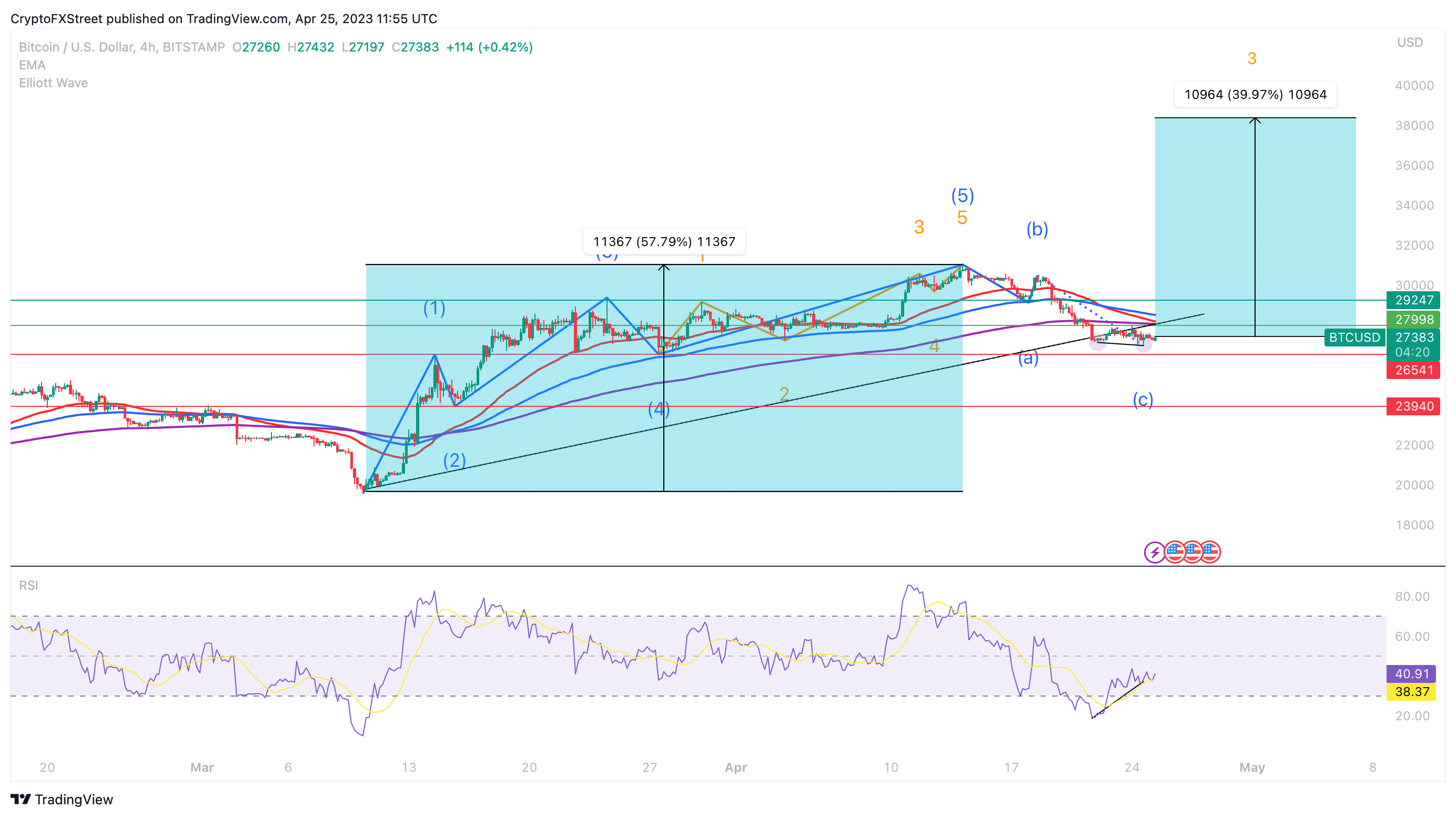
BTC/USD 4H price chart
Ideally, we want to see a reversal candle and a decisive break above April 24 highs of $27,998 for confirmation of the up move. If BTC price continues to climb higher, the initial targets are the clustering of EMAs at $28,000 and the April 18 lows at $29,247. A key sign to affirm that BTC price is in wave 3 would come from a break above the highs at $31,000.
Since Wave 3 is the strongest impulse wave of them all, the bullish target would be higher than Wave (1) to (5) in the chart below. This implies a nearly 40% upswing from the current level to $38,412.
Alternatively, if we get a break below March 26 lows at $27,329, BTC price could nosedive to the next support at $26,541, followed by $23,940.
Author

Ekta Mourya
FXStreet
Ekta Mourya has extensive experience in fundamental and on-chain analysis, particularly focused on impact of macroeconomics and central bank policies on cryptocurrencies.