US Services PMI Preview: Down but not out
- Service sector business sentiment expected to be stable in May
- Activity and optimism has declined since the third quarter of last year
- Sentiment is down but businesses are hiring

The Institute for Supply Management (ISM) will issue its non-manufacturing Purchasing Managers' Index for May at 10:00 am EDT, 14:00 GMT Wednesday June 5th.
Forecast
The overall PMI is expected to be unchanged at 55.5 in May. The business activity index is predicted to drop to 58.5 from 59.5 in April. The new orders index was 58.1 in April and 59.0 in March. The employment index was 53.7 in April and 55.9 in March. The prices paid index was 55.7 in April and 58.7 in March.
The US economy and business sentiment
Economic growth in the US has declined from its 3.1% pace in the first quarter with the Atlanta Fed GDPNow track for Q2 at 1.3% on May 31st.
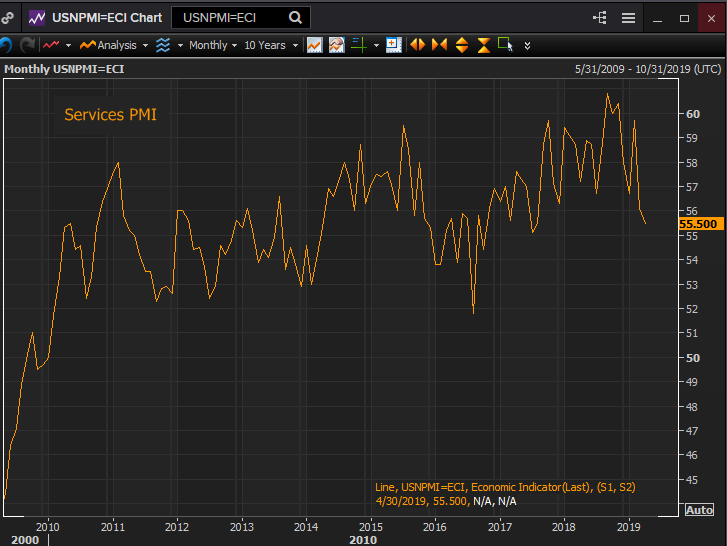
Business sentiment in the service sector peaked at the end of the third quarter last year at 60.8. Business activity topped out a few months later in February. The new orders index reached a post-recession high at 65.2 also in February and employment touched 60.4 in September, 0.1 shy of the post-recession record.
Reuters
All of these service sector business indicators have fallen substantially through the first and into the second quarters, mirroring the descent of their manufacturing cohorts.
Several possibilities can be entertained as to why business sentiment would drop sharply with the United States expanding and little indication that the trade dispute with China has seriously disrupted the economy.
The expansive run that overtook business after the election of Donald Trump to the presidency in November 2016 was as much an emotional relief rally as an acknowledgement that business conditions would improve. Growth did accelerate and the economy reached 3% in 2018.
However pleased business may have been with the new attitude in Washington, part of the economic success last year was based on a government spending a boon that ended when the Democrats took over control of the House in the November 2018 elections.
The China trade dispute, now judged a war even if not a terribly active one, has not had a major impact on US growth. But the longer the confrontation runs the greater the drag on sentiment and the possibility that a breakdown will escalate into a full-fledged tariff based conflict.
Such a development would inhibit global economic growth and roil markets.
The pessimism that has surfaced in the ISM sentiment indexes is a measure of the concern that this might happen rather than proof that it has happened.
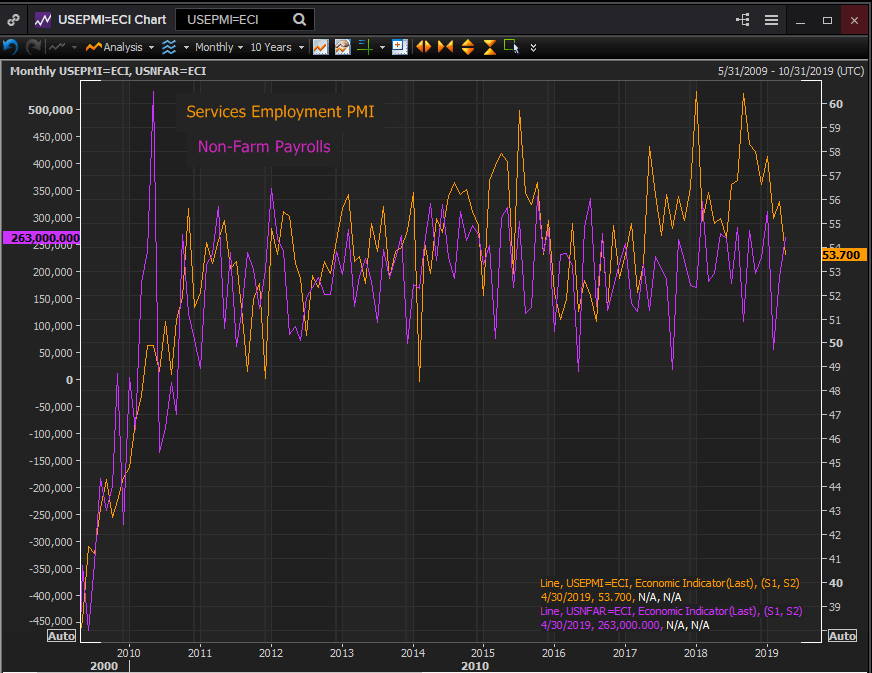
Even as the employment index saw its steepest fall in three years from 60.4 in September 2018 to 53.7 last month, business executives, presumably some of the same individuals, hired an average of 203,000 new employees each month.
Reuters
Sentiment is not an infallible predictor of economic activity, sometimes it is an elaborate set of worry beads.
Author

Joseph Trevisani
FXStreet
Joseph Trevisani began his thirty-year career in the financial markets at Credit Suisse in New York and Singapore where he worked for 12 years as an interbank currency trader and trading desk manager.
















