These Currencies Have a History of Thanksgiving Breakouts

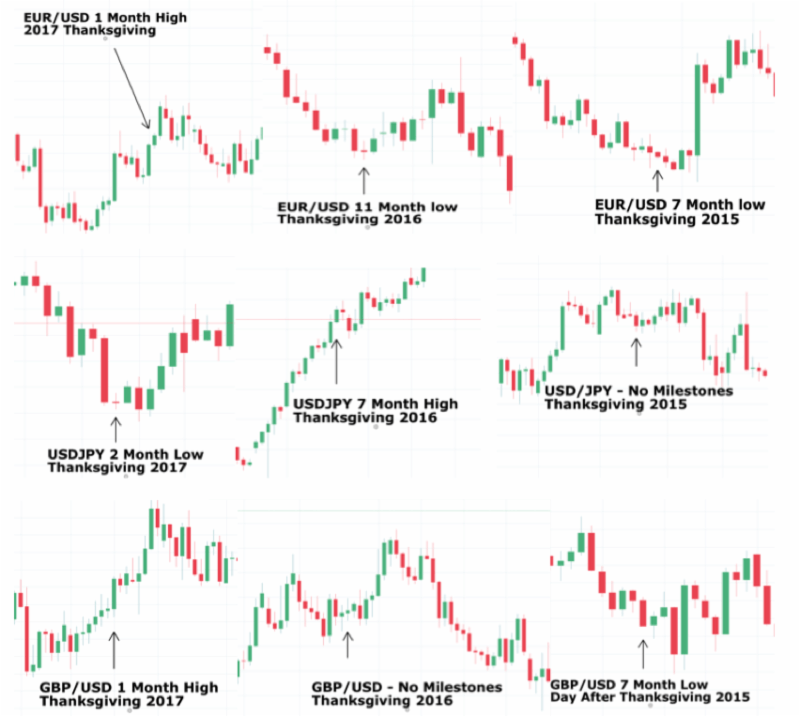
It is a holiday week in the United States but today's moves in forex shows how important it is to not mistake less participation with consolidation. The U.S. dollar fell to fresh lows against the euro, Swiss Franc, and Japanese Yen as stocks resumed their slide. The forex market will trade continuously but equity and bond markets in the U.S. will be closed on Thursday with half days for both on Friday. Currencies actually have a history of breaking out or reaching new milestones the week of Thanksgiving. Just take a look at the charts below.
Last year, EUR/USD and GBP/USD hit a 1 month high Thanksgiving day while USD/JPY fell to a 2 month low the day before Thanksgiving. In 2016, the EUR/USD dropped to an 11 month low the week of Thanksgiving while USD/JPY rose to a 7 month high. There was no meaningful movement in sterling that year. In 2015, EUR/USD and GBP/USD fell to a 7-month low the week of Thanksgiving as USD/JPY consolidated. In most cases, the trend that was in place immediately before the holidays continued. All of this implies that if the trend of continuation persists this year, we should see EUR/USD test and possibly break 1.15 and USD/JPY hit 112 this week.
Fundamentally, there's not much on the US calendar this week and it seems like any weakness in second tier reports is being used as an excuse to continue selling dollars. Today, the NAHB housing market index failed to rebound like economists anticipated and this was enough to send the dollar spiraling lower. With the momentum skewed to the downside, investors completely ignored Fed President and FOMC voter Williams' positive outlook - he described the economy as doing very well with job growth good. Tuesday's housing starts and building permits reports are not expected to alter the dollar's trend.
Meanwhile a weaker than expected Eurozone current account balance failed to stop the euro from rising. Not only did EUR/USD end Friday above the 20-day SMA for the first time since September but its now also trading above the 200-SMA on the 4 hour, something that it hasn't done in 2 months. This opens the door for a move to 1.1510, which is where the more serious resistance comes in. Of all the regions in the world, the Eurozone and Canada have the most important economic reports scheduled for release this week and they are all due on Friday. Recent evidence suggests that the Eurozone economy is slowing and there's a very good chance the PMIs will confirm that. However, the single currency could easily hit 1.1500 before the data is released.
Sterling bulls are putting up a fight as the currency trades higher for the second day in a row. The focus is Brexit - Prime Minister May is still working on getting a deal approved by Parliament while Tory MPs are focused on getting enough letters submitted for a no confidence vote. There will be intensive discussions this week according to May and its unlikely that they will amount to anything. Instead, the Tory Party has 25 of the 48 letters they need to trigger a vote. According to the TIMES, Senior Brexiters have "firm pledges," from enough MPs to submit letters for a vote this week. If that were to happen, you can expect GBP/USD to reverse lower on its way to 1.27.
Unlike the European currencies, all 3 of the commodity currencies traded lower against the greenback. AUD and NZD were hit the hardest after a dispute between the US and China prevented the issuance of a final statement ata this weekend's APEC meeting. It is the first time in its 25-year history that the leaders failed to agree on a formal joint statement because according to Canadian PM Trudeau, trade was the central problem. Unfortunately this does not bode well for the upcoming G20 meetings where Xi is scheduled to meet with Trump (he sat down with Pence this weekend). USD/CAD resumed its rise as oil prices continue to slide.
Author

Kathy Lien
BKTraders and Prop Traders Edge
Having graduated New York University’s Stern School of Business at the age of 18, Ms. Kathy Lien has more than 13 years of experience in the financial markets with a specific focus on currencies.