Gold Weekly Forecast: XAU/USD technicals are yet to point to a bullish tilt in near term
- Gold gathered bullish momentum but erased its weekly gains heading into the weekend.
- The near-term technical is yet to highlight a buildup of bullish momentum.
- Investors will keep a close eye on geopolitics and US data next week.

After a calm start to the week, Gold (XAU/USD) broke out of its tight trading range on Thursday and climbed to a two-week-high above $2,360. The persistent USD strength ahead of the weekend, however, caused the pair to erase its gains. Investors will remain focused on geopolitical headlines and key data releases from the US next week.
Gold sellers remain active
Following the previous week’s decline, the benchmark 10-year US Treasury bond yield edged higher on Monday as Federal Reserve (Fed) officials adopted a cautious tone on policy easing, not allowing Gold to stretch higher. Minneapolis Fed President Neel Kashkari said over the weekend that it would be a “reasonable prediction” that the Fed will wait until December to cut interest rates, adding that the central bank is in a very good position to get more data before making any decisions. Additionally, Philadelphia Fed President Patrick Harker noted that the Fed may need to keep rates where they are for longer than markets currently hope.
On Tuesday, disappointing macroeconomic data releases from the US made it difficult for the US Dollar (USD) to gather strength and helped XAU/USD hold its ground. The US Census Bureau reported that Retail Sales rose only 0.1% in May, while Retail Sales ex Autos declined 0.1%. Both of these readings fell short of market expectations.
With the US markets remaining closed in observance of the Juneteenth Holiday on Wednesday, trading volumes thinned out and Gold failed to make a noticeable move in either direction, closing the day virtually unchanged.
Geopolitical tensions re-escalated on Thursday on reports of Israel’s army approving an offensive against Lebanon and stating that they are ready for an ‘all-out war’ in response to increasing cross-border fire. In turn, Gold gathered bullish momentum and advanced to its highest level in two weeks, above $2,360. Meanwhile, the data from the US showed that the weekly Initial Jobless Claims edged lower to 238,000 in the week ending June 15 from 243,000 in the previous week.
On Friday, the USD stood resilient against its peers on the back of upbeat data and caused XAU/USD to erase Thursday’s gains. S&P Global Manufacturing PMI in the US rose to 51.7 in June’s flash estimate from 51.3 in May, while the Services PMI advanced to 55.1 from 54.8, showing an ongoing expansion in private sector’s business activity at a robust pace.
Gold investors await US data while assessing geopolitics
In the first half of next week, the US economic calendar will not offer any high-impact data releases that could potentially impact Gold’s valuation in a significant way. Hence, investors will remain focused on headlines surrounding the Middle East conflict. A further escalation of geopolitical tensions could allow Gold to gather bullish momentum.
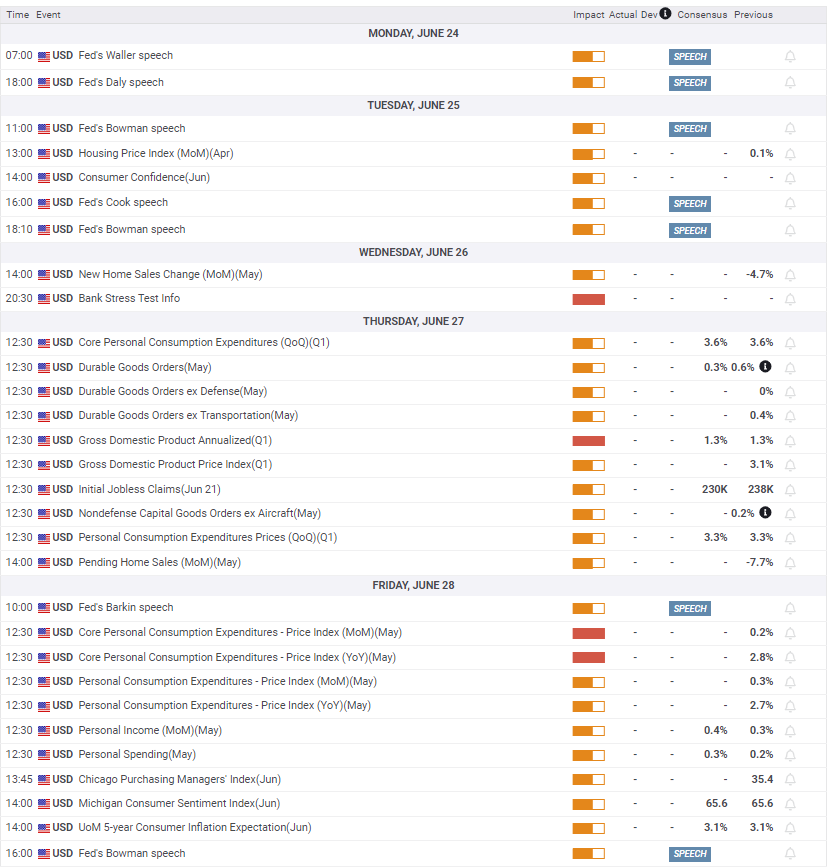
On Thursday, the US Bureau of Economic Analysis (BEA) will release the final revision to the first-quarter Gross Domestic Product growth. On Friday, the BEA will publish the Personal Consumption Expenditures (PCE) Price Index data for May, the Fed’s preferred gauge of inflation.
Investors are likely to react to the monthly core PCE inflation reading, which excludes prices for volatile items, such as food and energy, and is not distorted by base effects. In April, the core PCE Price Index rose 0.2%. A reading of 0.2%, or lower, could revive expectations for a Fed rate cut in September and cause the USD to come under selling pressure. On the other hand, a reading of 0.3%, or higher, could trigger a rally in the US Treasury bond yields and force XAU/USD to push lower heading into the weekend.
Gold technical outlook
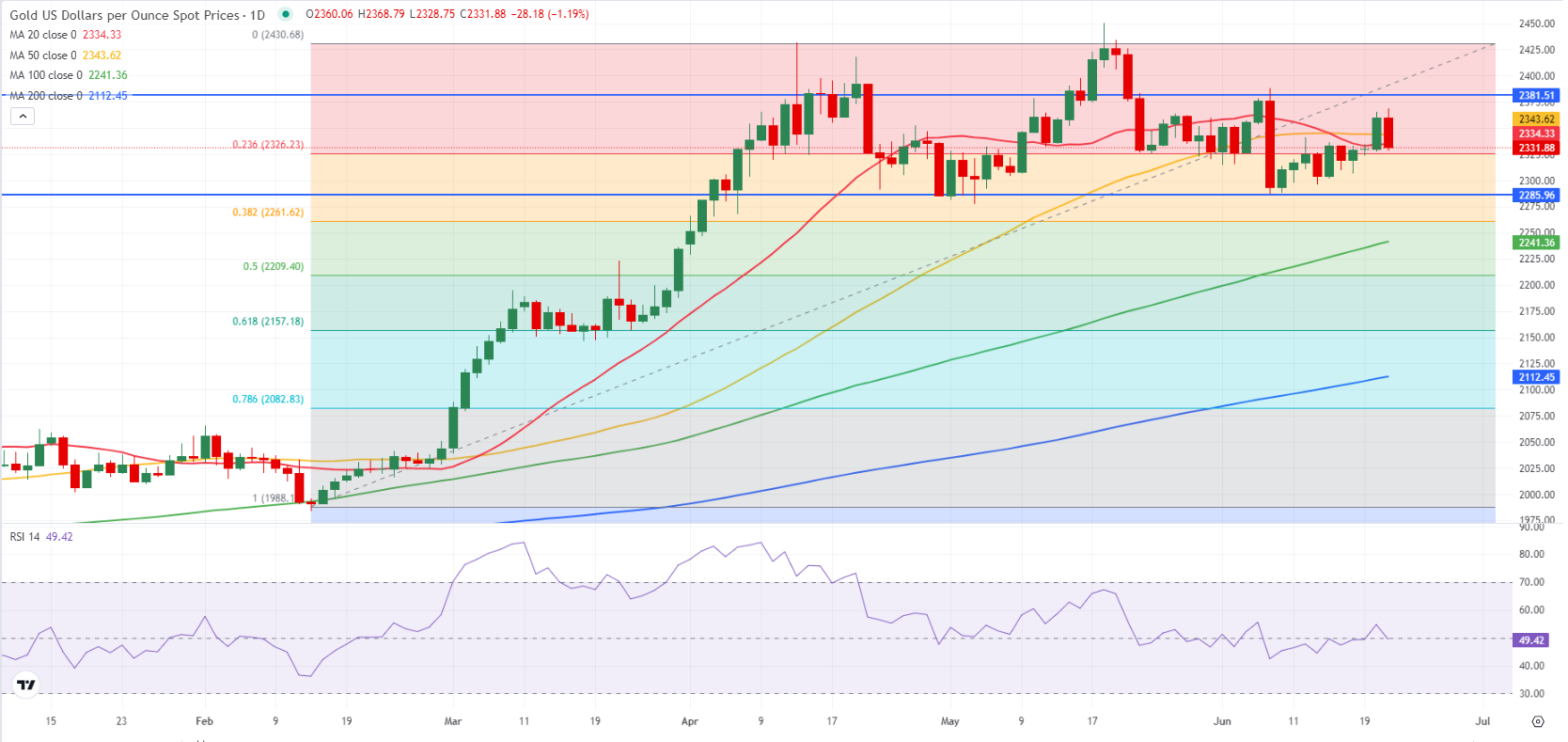
The Relative Strength Index (RSI) indicator on the daily chart climbed above 50 for the first time in two weeks on Thursday but retreated back toward this level on Friday. Additionally, Gold failed to push higher despite closing above the 20-day and the 50-day Simple Moving Averages (SMA) on Thursday, reflecting the lack of bullish momentum.
$2,340-$2,345 (20-day SMA, 50-day SMA) aligns as a pivot area for XAU/USD. In case Gold stabilizes above this area, $2,380 (static level) could be seen as next resistance before $2,400 (psychological level, static level).
On the downside, sellers could target $2,300 (psychological level, static level) and $2,285 (static level) if Gold starts using $2,340-$2,345 as resistance.
Gold FAQs
Gold has played a key role in human’s history as it has been widely used as a store of value and medium of exchange. Currently, apart from its shine and usage for jewelry, the precious metal is widely seen as a safe-haven asset, meaning that it is considered a good investment during turbulent times. Gold is also widely seen as a hedge against inflation and against depreciating currencies as it doesn’t rely on any specific issuer or government.
Central banks are the biggest Gold holders. In their aim to support their currencies in turbulent times, central banks tend to diversify their reserves and buy Gold to improve the perceived strength of the economy and the currency. High Gold reserves can be a source of trust for a country’s solvency. Central banks added 1,136 tonnes of Gold worth around $70 billion to their reserves in 2022, according to data from the World Gold Council. This is the highest yearly purchase since records began. Central banks from emerging economies such as China, India and Turkey are quickly increasing their Gold reserves.
Gold has an inverse correlation with the US Dollar and US Treasuries, which are both major reserve and safe-haven assets. When the Dollar depreciates, Gold tends to rise, enabling investors and central banks to diversify their assets in turbulent times. Gold is also inversely correlated with risk assets. A rally in the stock market tends to weaken Gold price, while sell-offs in riskier markets tend to favor the precious metal.
The price can move due to a wide range of factors. Geopolitical instability or fears of a deep recession can quickly make Gold price escalate due to its safe-haven status. As a yield-less asset, Gold tends to rise with lower interest rates, while higher cost of money usually weighs down on the yellow metal. Still, most moves depend on how the US Dollar (USD) behaves as the asset is priced in dollars (XAU/USD). A strong Dollar tends to keep the price of Gold controlled, whereas a weaker Dollar is likely to push Gold prices up.
Author

Eren Sengezer
FXStreet
As an economist at heart, Eren Sengezer specializes in the assessment of the short-term and long-term impacts of macroeconomic data, central bank policies and political developments on financial assets.

















