Gold Price Forecast: XAU/USD takes a breather before the US CPI inflation storm
- Gold price consolidates near $2,350 as traders await strong catalysts.
- Gold price cheers surge in central banks’ buying despite fading June Fed rate cut bets.
- Gold price correction is long due amid extremely overbought RSI, ahead of US CPI data.

Gold (XAU/USD) price is holding the fort near $2,350 early Tuesday, having witnessed good two-way movement on Monday. Gold price now awaits key US fundamental data for a fresh directional move. In the absence of any top-tier US economic data later on Tuesday, the focus will remain on the speeches from the US Federal Reserve (Fed) policymakers.
Gold price hangs near record highs, correction in the offing?
Gold price has entered a phase of upside consolidation in the Asian session on Tuesday, as the US Dollar licks its wounds while the US Treasury bond yields hold their corrective downside amid a negative shift in risk sentiment.
Asian stock markets pare early gains, led by the decline in Chinese indices even as markets stay hopeful of a worldwide manufacturing rebound. Markets are trading more cautiously, as nervousness sets in ahead of Wednesday’s all-important US Consumer Price Index (CPI) data release. The US inflation data will affirm the recent pullback in the market expectations of a likely rate cut by the Fed in June.
Strong US Nonfarm Payrolls data and hawkish Fed commentaries have weighed on the Fed rate cut bets, with markets now pricing in a roughly 50% chance of another hold in June. The hawkish shift in the market expectations has underpinned the recent upsurge in the US Treasury bond yields.
Early Asia, Minneapolis Fed President Neel Kashkari (2024 non-voter) said that “the inflation rate is running around 3% and the Fed has to get back down to 2%", adding that “the bank cannot 'stop short' on the inflation fight.”
However, Gold price continues to show resilience to rising US Treasury bond yields and easing geopolitical tensions in the Middle East, in the wake of a Gold buying spree by global central banks, especially by the People’s Bank of China (PBoC).
A Chinese official reported on Sunday that the Chinese central bank purchased Gold for its reserves for the 17th straight month in March. Bullion held by the PBoC rose to 72.74 million fine troy ounces last month, the official said. Turkey, India, Kazakhstan and some eastern European countries have also been buying gold this year, per Reuters.
Renewed central bank demand for the bright metal sent the Gold price to another record high above $2,350 on Monday, extending its record-setting rally.
Looking ahead, Gold traders will take account of Fedspeak amid a lack of top-tier US economic data. Meanwhile, position adjustment and profit-taking in Gold price cannot be ruled out, as traders gear up for key US inflation report due on Wednesday.
Gold price technical analysis: Daily chart
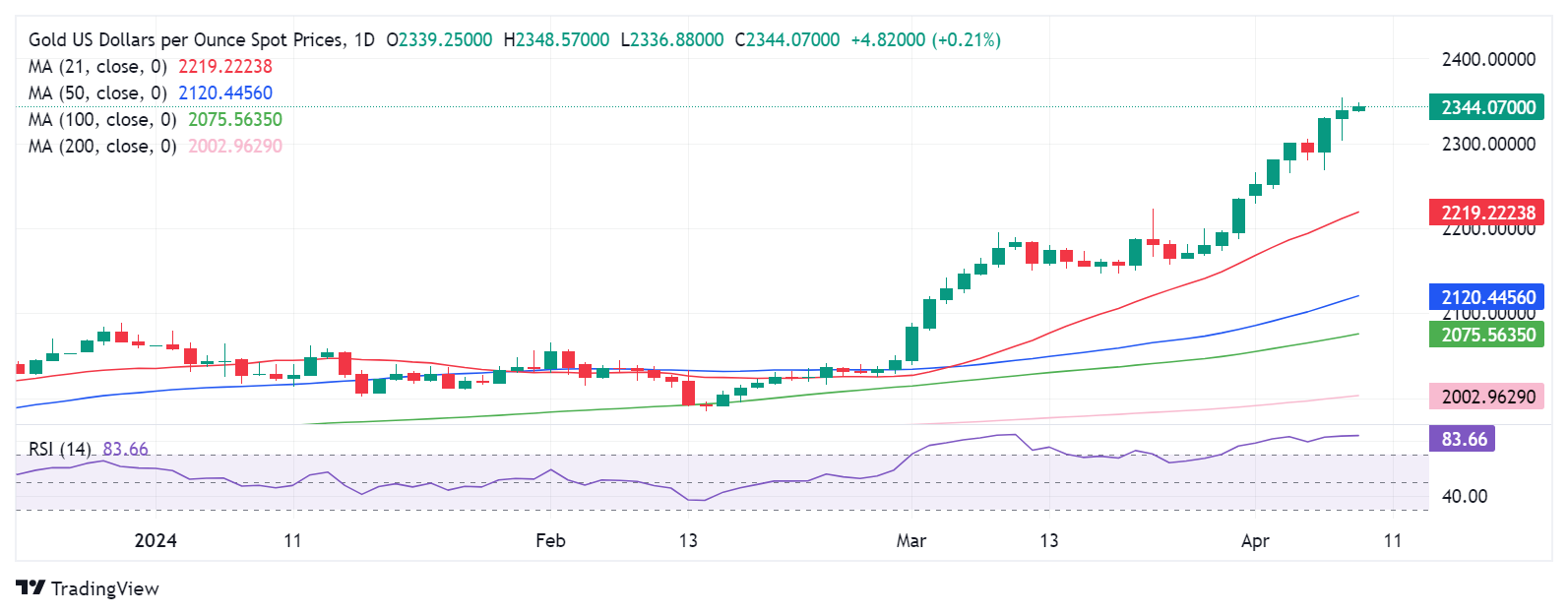
A further upside in Gold price appears elusive, as the extremely overbought 14-day Relative Strength Index (RSI) conditions continue to threaten a correction.
If Gold buyers give up, a correction toward the previous record high of $2,331 will be in the offing.
The extension of the Gold price pullback could test the April 4 high at $2,305, below which the April 5 low of $2,268 will be tested.
However, if Gold buyers retain control, the all-time high at $2,354 will be the first resistance to scale.
A fresh rally toward the $2,370 round figure will be seen only on acceptance above the $2,350 psychological level.
Gold FAQs
Gold has played a key role in human’s history as it has been widely used as a store of value and medium of exchange. Currently, apart from its shine and usage for jewelry, the precious metal is widely seen as a safe-haven asset, meaning that it is considered a good investment during turbulent times. Gold is also widely seen as a hedge against inflation and against depreciating currencies as it doesn’t rely on any specific issuer or government.
Central banks are the biggest Gold holders. In their aim to support their currencies in turbulent times, central banks tend to diversify their reserves and buy Gold to improve the perceived strength of the economy and the currency. High Gold reserves can be a source of trust for a country’s solvency. Central banks added 1,136 tonnes of Gold worth around $70 billion to their reserves in 2022, according to data from the World Gold Council. This is the highest yearly purchase since records began. Central banks from emerging economies such as China, India and Turkey are quickly increasing their Gold reserves.
Gold has an inverse correlation with the US Dollar and US Treasuries, which are both major reserve and safe-haven assets. When the Dollar depreciates, Gold tends to rise, enabling investors and central banks to diversify their assets in turbulent times. Gold is also inversely correlated with risk assets. A rally in the stock market tends to weaken Gold price, while sell-offs in riskier markets tend to favor the precious metal.
The price can move due to a wide range of factors. Geopolitical instability or fears of a deep recession can quickly make Gold price escalate due to its safe-haven status. As a yield-less asset, Gold tends to rise with lower interest rates, while higher cost of money usually weighs down on the yellow metal. Still, most moves depend on how the US Dollar (USD) behaves as the asset is priced in dollars (XAU/USD). A strong Dollar tends to keep the price of Gold controlled, whereas a weaker Dollar is likely to push Gold prices up.
Author

Dhwani Mehta
FXStreet
Residing in Mumbai (India), Dhwani is a Senior Analyst and Manager of the Asian session at FXStreet. She has over 10 years of experience in analyzing and covering the global financial markets, with specialization in Forex and commodities markets.