Gold Price Forecast: XAU/USD struggles with $2,300, not out of the woods yet
- Gold price attempts a bounce from two-week lows below $2,300 early Thursday.
- The US Dollar tracks the USD/JPY retreat, despite firmer Treasury bond yields and softer risk tone.
- Gold price appears ‘sell the bounce’ trade amid bearish daily RSI, having breached $2,300 on Wednesday.

Gold price is languishing in two-week lows just shy of the $2,300 level early Thursday, with buyers lacking conviction due to the sustained strength in the US Treasury bond yields.
Gold price looks to top-tier US economic data
The US Dollar (USD), however, fails to hold near two-month highs against its major currency rivals, despite a dour market mood and firmer US Treasury bond yields higher, as it follows a moderate pullback in the USD/JPY pair from near multi-decade highs of 160.87.
The renewed selling seen around the US Dollar is helping Gold price stall the downtrend. Further, a broader market risk-off sentiment ahead of Friday’s US PCE inflation data and Sunday’s French election could also cushion the downside in Gold price.
However, all eyes turn to the US first-quarter final Gross Domestic Product (GDP) revision, Pending Home Sales and Durable Goods Orders data for fresh hints on the health of the economy, which could offer fresh cues on the timing of the US Federal Reserve (Fed) first interest rate-cut this year.
Data on Wednesday showed that “sales of new US single-family homes dropped to a six-month low in May as a jump in mortgage rates weighed on demand,” per Reuters. The reading failed to derail the ongoing US Dollar upswing, as US Treasury bond yields continued to capitalize on the recent hawkish commentaries from Fed officials.
in the second half of Tuesday’s trading, in the face of US Federal Reserve (Fed) Governor Michelle Bowman’s hawkish comments.
Fed Governor Michelle Bowman said earlier this week that “we are still not yet at the point where it is appropriate to lower the policy rate.” Meanwhile, Governor Lisa Cook argued that the timing of the rate cut is unclear even though “Inflation has slowed, and the labor market tightness has eased.”
Markets are now pricing in about a 62% chance of a Fed rate cut in September, a tad lower than the 68% seen on Monday, according to CME FedWatch Tool.
Additionally, the Greenback gathered strength on a cautious market mood after US tech companies fell in late trading in the last American session. US tech giants took a hit in late US hours after Micron Technology Inc.’s outlook failed to meet the lofty industry expectations.
Gold price technical analysis: Daily chart
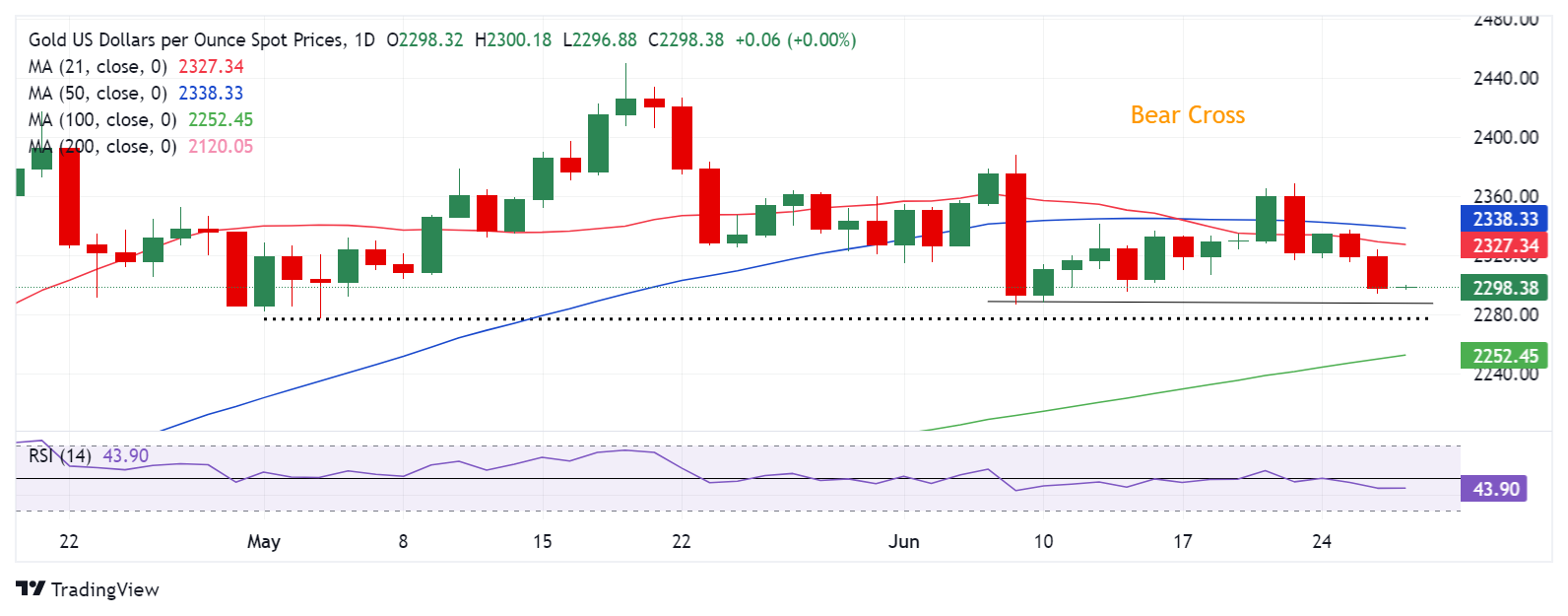
Despite the pause in the recent decline, Gold price remains exposed to downside risks, as the 14-day Relative Strength Index (RSI) remains below the 50 level.
Therefore, any rebound in Gold price could be seen as a dead cat bounce, suggesting that the bright metal remains a good selling opportunity.
Adding credence to the bearish potential, the previous week’s 21-day Simple Moving Average (SMA) and the 50-day SMA bearish crossover continue acting as a headwind.
If sellers gather strength, a test of the June low at $2,287 will be inevitable, below which the May 3 low at $2,277 will be in the spotlight.
The last line of defense for Gold buyers is seen at the upward-sloping 100-day SMA at $2,252.
Conversely, Gold price needs to take out the 21-day SMA at $2,327 on a daily closing basis to revive the recovery from the monthly low of $2,287. Before that upside hurdle, Gold buyers must regain the $2,300 threshold.
Further up, the 50-day SMA at $2,338 will be eyed, followed by the two-week high of $2,366.
Risk sentiment FAQs
In the world of financial jargon the two widely used terms “risk-on” and “risk off'' refer to the level of risk that investors are willing to stomach during the period referenced. In a “risk-on” market, investors are optimistic about the future and more willing to buy risky assets. In a “risk-off” market investors start to ‘play it safe’ because they are worried about the future, and therefore buy less risky assets that are more certain of bringing a return, even if it is relatively modest.
Typically, during periods of “risk-on”, stock markets will rise, most commodities – except Gold – will also gain in value, since they benefit from a positive growth outlook. The currencies of nations that are heavy commodity exporters strengthen because of increased demand, and Cryptocurrencies rise. In a “risk-off” market, Bonds go up – especially major government Bonds – Gold shines, and safe-haven currencies such as the Japanese Yen, Swiss Franc and US Dollar all benefit.
The Australian Dollar (AUD), the Canadian Dollar (CAD), the New Zealand Dollar (NZD) and minor FX like the Ruble (RUB) and the South African Rand (ZAR), all tend to rise in markets that are “risk-on”. This is because the economies of these currencies are heavily reliant on commodity exports for growth, and commodities tend to rise in price during risk-on periods. This is because investors foresee greater demand for raw materials in the future due to heightened economic activity.
The major currencies that tend to rise during periods of “risk-off” are the US Dollar (USD), the Japanese Yen (JPY) and the Swiss Franc (CHF). The US Dollar, because it is the world’s reserve currency, and because in times of crisis investors buy US government debt, which is seen as safe because the largest economy in the world is unlikely to default. The Yen, from increased demand for Japanese government bonds, because a high proportion are held by domestic investors who are unlikely to dump them – even in a crisis. The Swiss Franc, because strict Swiss banking laws offer investors enhanced capital protection.
Premium
You have reached your limit of 3 free articles for this month.
Start your subscription and get access to all our original articles.
Author
Dhwani Mehta
FXStreet
Residing in Mumbai (India), Dhwani is a Senior Analyst and Manager of the Asian session at FXStreet. She has over 10 years of experience in analyzing and covering the global financial markets, with specialization in Forex and commodities markets.

















