Gold Price Forecast: XAU/USD struggle extends above $2,300, with Fedspeak on tap
- Gold price reverses Monday’s rebound as sentiment remains upbeat early Tuesday.
- The US Dollar keeps losses amid sluggish US Treasury bond yields, dovish Fed commentary.
- The path of least resistance appears down for the Gold price even after the triangle breakout.
- The daily RSI stays below 50, all eyes turn to more Fedspeak and mid-tier US data.


Gold price is reversing a part of Monday’s rebound, as sellers fight back early Tuesday amid a risk-on market profile. The US Dollar (USD) nurses losses alongside the US Treasury bond yields, undermined by the dovish commentaries from Federal Reserve (Fed) policymakers.
Gold price awaits more Fedspeak for fresh policy cues
Speaking in a CNBC interview on Monday, Chicago Fed President Austan Goolsbee said that the Fed's monetary policy is restrictive while adding that slowing inflation data would open the door to an easier policy. San Francisco Fed President Mary Daly noted that “recent inflation readings are more encouraging, but it's hard to know if we're on track to sustainable price stability.”
The return of risk flows also weighed down the US dollar, which sent Wall Street higher. Dow Jones rallied to a one-month high even as Nasdaq tumbled over 1%. Broader portfolio rebalancing helped lift the broader market sentiment, helping Gold price recover some ground at the expense of the US Dollar.
The Greenback also bore the brunt of position readjustments in the Euro ahead of the French election on Sunday, which lifted the EUR/USD pair from six-day lows near 0.6670. Gold price, therefore, defied the bearish odds and rose back to near $2,335.
However, Gold sellers continue to lurk at that level, fuelling a renewed downside so far this Tuesday. Despite the sustained US Dollar weakness and negative US Treasury bond yields, Gold price has turned on the back foot, as traders eagerly await Friday’s US inflation data for fresh clues on how soon the Fed can cut interest rates.
Big banks are pushing back their expectations for a Fed rate cut to December from September, weighing negatively on the non-interest-bearing Gold price. Markets, however, continue pricing in about a 68% chance of a Fed rate cut in September, according to CME FedWatch Tool.
Concerns over China’s economic recovery also dent the appeal of Gold price. China is the world’s top Gold consumer.
Investors now look forward to comments from Fed officials set to speak later this Tuesday, including Fed Governors Lisa Cook and Michelle Bowman. Besides, the US Conference Board Consumer Confidence data will also entertain Gold traders.
Meanwhile, the half-year-end flows could also remain in play, significantly affecting the Gold price movement.
Gold price technical analysis: Daily chart
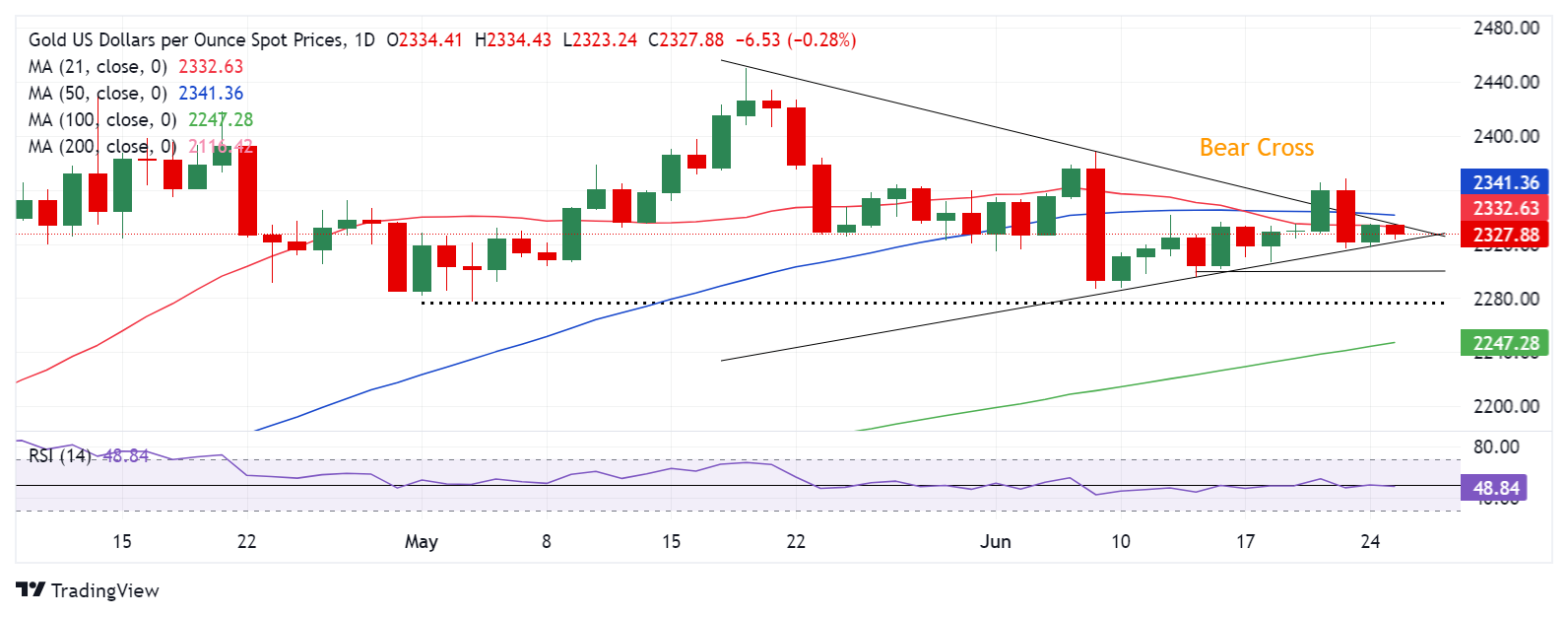
Gold price continues to hold the symmetrical triangle pattern confirmed last week, having bounced off the triangle support, then at $2,317, on Monday.
However, sellers have returned to retest that level, as the 14-day Relative Strength Index (RSI) sits beneath the 50 level.
Also, the 21-day Simple Moving Average (SMA) and the 50-day SMA bearish crossover continues to exert bearish pressures on the Gold price.
A daily candlestick close below the triangle support line, now at $2,320, would confirm the pattern failure, reinforcing selling interests.
If sellers flex their muscles then the initial demand area is seen at the $2,310 round level. The next relevant support is seen at the $2,300 threshold.
Acceptance below the latter will put the May 3 low at $2,277 back in the spotlight.
On the other hand, Gold price needs to recapture the confluence zone near $2,335, where the 21-day SMA and the 50-day SMA close in.
Further up, the two-week high of $2,366 will be challenged, as buyers aim for the June 7 high of $2,388.
Gold FAQs
Gold has played a key role in human’s history as it has been widely used as a store of value and medium of exchange. Currently, apart from its shine and usage for jewelry, the precious metal is widely seen as a safe-haven asset, meaning that it is considered a good investment during turbulent times. Gold is also widely seen as a hedge against inflation and against depreciating currencies as it doesn’t rely on any specific issuer or government.
Central banks are the biggest Gold holders. In their aim to support their currencies in turbulent times, central banks tend to diversify their reserves and buy Gold to improve the perceived strength of the economy and the currency. High Gold reserves can be a source of trust for a country’s solvency. Central banks added 1,136 tonnes of Gold worth around $70 billion to their reserves in 2022, according to data from the World Gold Council. This is the highest yearly purchase since records began. Central banks from emerging economies such as China, India and Turkey are quickly increasing their Gold reserves.
Gold has an inverse correlation with the US Dollar and US Treasuries, which are both major reserve and safe-haven assets. When the Dollar depreciates, Gold tends to rise, enabling investors and central banks to diversify their assets in turbulent times. Gold is also inversely correlated with risk assets. A rally in the stock market tends to weaken Gold price, while sell-offs in riskier markets tend to favor the precious metal.
The price can move due to a wide range of factors. Geopolitical instability or fears of a deep recession can quickly make Gold price escalate due to its safe-haven status. As a yield-less asset, Gold tends to rise with lower interest rates, while higher cost of money usually weighs down on the yellow metal. Still, most moves depend on how the US Dollar (USD) behaves as the asset is priced in dollars (XAU/USD). A strong Dollar tends to keep the price of Gold controlled, whereas a weaker Dollar is likely to push Gold prices up.
Premium
You have reached your limit of 3 free articles for this month.
Start your subscription and get access to all our original articles.
Author
Dhwani Mehta
FXStreet
Residing in Mumbai (India), Dhwani is a Senior Analyst and Manager of the Asian session at FXStreet. She has over 10 years of experience in analyzing and covering the global financial markets, with specialization in Forex and commodities markets.