Gold Price Forecast: XAU/USD sellers keep lurking at $2,530, range breakout likely?
- Gold price turns positive while above $2,500, as US PPI and Jobless Claims data loom.
- The US Dollar holds rebound alongside Treasury bond yields on fading outsized Fed rate cut bets.
- Gold price appears primed for a range breakout, with buyers still hopeful amid a bullish RSI.

Gold price is making a minor recovery attempt early Thursday, as buyers stay hopeful above $2,500. With the US Consumer Price Index (CPI) data out of the way, the focus now turns toward the US Producers Price Index (PPI) and Jobless Claims data for fresh trading incentives.
Gold price looks to US PPI data for fresh impetus
Gold traders bide time and assess the critical US CPI inflation data released on Wednesday, which poured cold water on increased bets of an outsized interest rate cut by the US Federal Reserve (Fed) interest rate cut next week.
Data published by the US Bureau of Labour Statics (BLS) showed Wednesday that the CPI rose 0.2% MoM in August, aligning with the expected 0.2% print. US August core CPI jumped 0.3% MoM vs. estimates of 0.2%. The headline annual CPI inflation ticked a tad lower to 2.5% in August while the core CPI grew 3.2% YoY versus forecasts of 3.2%.
Despite the headline annual CPI figure cooling off, the sticky monthly and yearly core figures prompted markets to rule out an outsized Fed rate cut this month. Markets are currently pricing in an 85% chance of a 25 basis points (bps) cut, compared to 71% before the data, the CME Group’s FedWatch tool shows.
Gold price tested the key $2,530 topside barrier before witnessing a steep decline on the sticky US inflation data, which triggered a fresh recovery rally in the US Dollar (USD) and the US Treasury bond yields.
Despite the pullback, Gold price managed to defend the critical short-term support level near $2,505, keeping it in its three-week-long consolidative range.
In Thursday’s trading so far, Gold buyers seem to have fought back control but lack bullish conviction amid persistent US Dollar strength and an upbeat market mood. However, Gold price could draw support from gains in other precious metals and industrial metals, including Palladium, Nickel, etc, in the face of potential export curbs under consideration from Russia.
Also, traders look to a fresh batch of top-tier US economic data due later on Thursday for further hints on the Fed’s policy, eventually impacting the value of the US Dollar and Gold price.
Gold price technical analysis: Daily chart
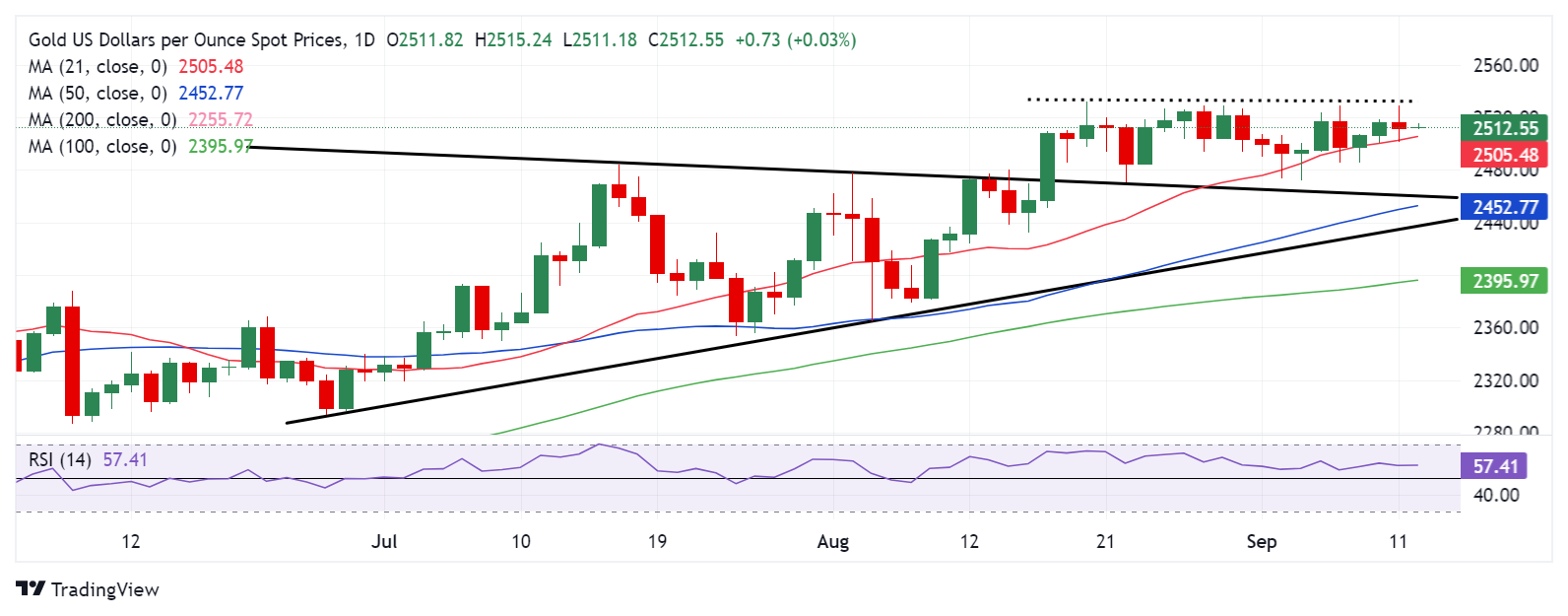
Nothing seems to have changed for Gold price from a short-term technical perspective. Buyers continue to stay hopeful as Gold price manages to yield daily closings above the 21-day Simple Moving Average (SMA), now at $2,505.
The 14-day Relative Strength Index (RSI) has turned flat but still holds firm above the 50 level, backing the case for the bullish potential.
Gold buyers yearn for a sustained breakthrough the record high of $2,532, above which the $2,550 psychological level will come into play.
If Gold price faces rejection once again near the $2,530 supply zone, a correction would ensue, with a daily closing below the 21-day SMA at $2,503 needed to negate the bullish outlook in the near term.
A breach of the latter will challenge the previous week’s low of $2,472, followed by the symmetrical triangle resistance-turned-support at $2,462.
Gold FAQs
Gold has played a key role in human’s history as it has been widely used as a store of value and medium of exchange. Currently, apart from its shine and usage for jewelry, the precious metal is widely seen as a safe-haven asset, meaning that it is considered a good investment during turbulent times. Gold is also widely seen as a hedge against inflation and against depreciating currencies as it doesn’t rely on any specific issuer or government.
Central banks are the biggest Gold holders. In their aim to support their currencies in turbulent times, central banks tend to diversify their reserves and buy Gold to improve the perceived strength of the economy and the currency. High Gold reserves can be a source of trust for a country’s solvency. Central banks added 1,136 tonnes of Gold worth around $70 billion to their reserves in 2022, according to data from the World Gold Council. This is the highest yearly purchase since records began. Central banks from emerging economies such as China, India and Turkey are quickly increasing their Gold reserves.
Gold has an inverse correlation with the US Dollar and US Treasuries, which are both major reserve and safe-haven assets. When the Dollar depreciates, Gold tends to rise, enabling investors and central banks to diversify their assets in turbulent times. Gold is also inversely correlated with risk assets. A rally in the stock market tends to weaken Gold price, while sell-offs in riskier markets tend to favor the precious metal.
The price can move due to a wide range of factors. Geopolitical instability or fears of a deep recession can quickly make Gold price escalate due to its safe-haven status. As a yield-less asset, Gold tends to rise with lower interest rates, while higher cost of money usually weighs down on the yellow metal. Still, most moves depend on how the US Dollar (USD) behaves as the asset is priced in dollars (XAU/USD). A strong Dollar tends to keep the price of Gold controlled, whereas a weaker Dollar is likely to push Gold prices up.
Author

Dhwani Mehta
FXStreet
Residing in Mumbai (India), Dhwani is a Senior Analyst and Manager of the Asian session at FXStreet. She has over 10 years of experience in analyzing and covering the global financial markets, with specialization in Forex and commodities markets.