Gold Price Forecast: XAU/USD eyes $2,740 and beyond on the renewed upside
- Gold price bounces back toward record highs of $2,741 on tepid risk tone.
- The US Dollar pulls back, as Treasury bond yields pause and earnings season unfold.
- The daily RSI sits just above the overbought territory, further upside in the offing?

Gold price is picking up fresh bids to revert toward a new record high of $2,741 early Tuesday. The US Dollar (USD) buyers catch their breath, assessing the ‘Trump trade’ while gearing up for the US earnings season.
Gold price remains at the mercy of the US Dollar
The Greenback pulls back from the highest level in nearly three months against its major rivals in Asian trading on Tuesday, as the US Treasury bond yields consolidate their previous rally. A pause in the US Dollar and the Treasury bond yield upsurge allow Gold buyers to find some foothold after Monday’s sharp reversal from the all-time peak.
A tepid risk tone, uncertainty around the US presidential election and the market’s caution heading into the key US earnings reports revive the demand for the traditional safe-haven Gold price. However, it remains to be seen whether the Gold price sustains its upswing and refreshes a lifetime high as Chinese equities buck the broad downtrend and advance on China’s recent stimulus efforts.
Further, increased expectations of less aggressive easing by the US Federal Reserve (Fed) could also infuse fresh demand into the US Treasury bond yields and the USD, capping the bright metal’s bullish momentum.
On Monday, the benchmark 10-year US Treasury bond yields spiked nearly 11 basis points (bps) and lifted the Greenback across the board, following the commentary from Kansas City Fed President Jeffrey Schmid.
Schmid said in his prepared remarks that "lowering rates in a gradual fashion would provide time to observe the economy's reaction to our interest rate adjustments and give us the space to assess at what level interest rates are neither restricting nor boosting the economy."
Meanwhile, San Francisco Fed President Mary Daly noted late Monday that while she expects the Fed to continue slowly easing interest rates lower in the coming quarters, the Fed is still maintaining a data-dependent approach.
Against this backdrop, Gold price corrected sharply from a record high even though Wall Street indices tumbled, as investors resorted to profit-booking after recording their best performance last week.
Looking ahead, the US data docket remains dry and devoid of multiple speeches from Fed policymakers. Therefore, Gold traders will take cues from the broad market sentiment and any policies and trade developments from the three-day BRICS Summit, beginning on Tuesday.
Gold price technical analysis: Daily chart
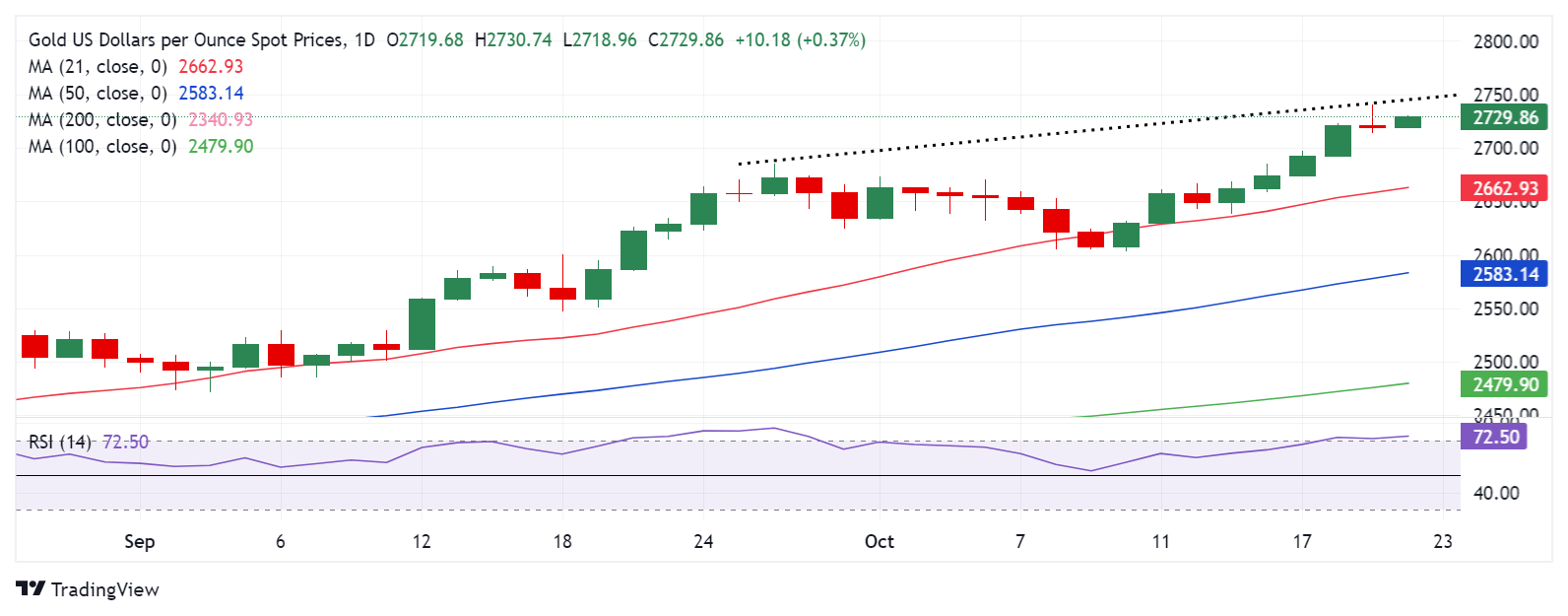
Gold price is looking to retest the record high of $2,741, as buyers fight back control.
The 14-day Relative Strength Index (RSI) is pointing north while above the 70 level – the overbought zone. The leading indicator justifies the latest uptick in Gold price.
A firm break of the all-time high at $2,741 could challenge the rising trendline resistance at $2,746.
The next bullish target is seen at the $2,750 psychological barrier, which will likely be a tough nut to crack for Gold optimists.
Alternatively, the immediate support at $2,700, below which the October 18 low of $2,692 will be threatened.
A deeper correction could put the previous resistance now turned support at $2,670 to the test.
Gold FAQs
Gold has played a key role in human’s history as it has been widely used as a store of value and medium of exchange. Currently, apart from its shine and usage for jewelry, the precious metal is widely seen as a safe-haven asset, meaning that it is considered a good investment during turbulent times. Gold is also widely seen as a hedge against inflation and against depreciating currencies as it doesn’t rely on any specific issuer or government.
Central banks are the biggest Gold holders. In their aim to support their currencies in turbulent times, central banks tend to diversify their reserves and buy Gold to improve the perceived strength of the economy and the currency. High Gold reserves can be a source of trust for a country’s solvency. Central banks added 1,136 tonnes of Gold worth around $70 billion to their reserves in 2022, according to data from the World Gold Council. This is the highest yearly purchase since records began. Central banks from emerging economies such as China, India and Turkey are quickly increasing their Gold reserves.
Gold has an inverse correlation with the US Dollar and US Treasuries, which are both major reserve and safe-haven assets. When the Dollar depreciates, Gold tends to rise, enabling investors and central banks to diversify their assets in turbulent times. Gold is also inversely correlated with risk assets. A rally in the stock market tends to weaken Gold price, while sell-offs in riskier markets tend to favor the precious metal.
The price can move due to a wide range of factors. Geopolitical instability or fears of a deep recession can quickly make Gold price escalate due to its safe-haven status. As a yield-less asset, Gold tends to rise with lower interest rates, while higher cost of money usually weighs down on the yellow metal. Still, most moves depend on how the US Dollar (USD) behaves as the asset is priced in dollars (XAU/USD). A strong Dollar tends to keep the price of Gold controlled, whereas a weaker Dollar is likely to push Gold prices up.
Author

Dhwani Mehta
FXStreet
Residing in Mumbai (India), Dhwani is a Senior Analyst and Manager of the Asian session at FXStreet. She has over 10 years of experience in analyzing and covering the global financial markets, with specialization in Forex and commodities markets.
















