Gold Price Forecast: XAU/USD closes below key $2,318 support, US GDP holds the key
- Gold price pauses losing streak, as focus shifts to the high-impact US Q1 GDP data.
- US Dollar decline offers comfort to Gold price amid ebbing Middle East tensions.
- Gold price closes Wednesday below 21-day SMA but RSI stays bullish.

Gold price is breathing a sigh of relief early Thursday after testing offers near $2,315 once again. Broad risk-aversion seems to be helping Gold price find a floor, as traders refrain from placing any fresh directional bets on the bright metal ahead of the preliminary reading of the US first-quarter Gross Domestic Product (GDP) due later on Thursday.
Will US GDP data rescue Gold price?
Risk-off sentiment remains in full swing in Asia this Thursday, as market participants sulk following Meta’s weak revenue guidance even though the company’s first-quarter earnings results topped estimates. Meta shares plunged 16% in post-market trading after the company said it expects sales in the second quarter of $36.5 billion to $39 billion, below analysts’ estimate of $38.3 billion. Meanwhile, Meta’s net income more than doubled to $12.37 billion from $5.71 billion over the year.
Investors also stay risk-averse amid mounting risks of a Japanese forex market intervention, as the USD/JPY pair renews fresh 34-year highs near 155.50. Additionally, a sense of caution also prevails, as the upcoming quarterly US GDP and PCE inflation prints could shed more light on the US economic resilience, as well as, on the Federal Reserve (Fed) interest rate outlook.
Weak S&P Global US business PMI data already cast doubt on the US economic prospects amid increased expectations that the Fed could maintain interest rates ‘higher for longer’. Markets price in the first Fed rate cut in September, according to the CME Group’s FedWatch Tool. Meanwhile, the total easing expected this year would just be 40 basis points (bps), a sea change from about 150 basis points of cuts priced in at the beginning of the year, per Reuters.
Meanwhile, the latest data from the UK’s Office for National Statistics (ONS) showed early Thursday that shipping traffic through the Suez Canal artery in Egypt has plunged by 66%, in the face of the Iran-backed Houthi attacks, flagging higher inflation risks.
Amidst a risk-off mood and worries over inflation resurgence worldwide, Gold price is attempting a tepid recovery. Although any upside attempts are likely to remain limited ahead of the key US data flow.
Gold price technical analysis: Daily chart
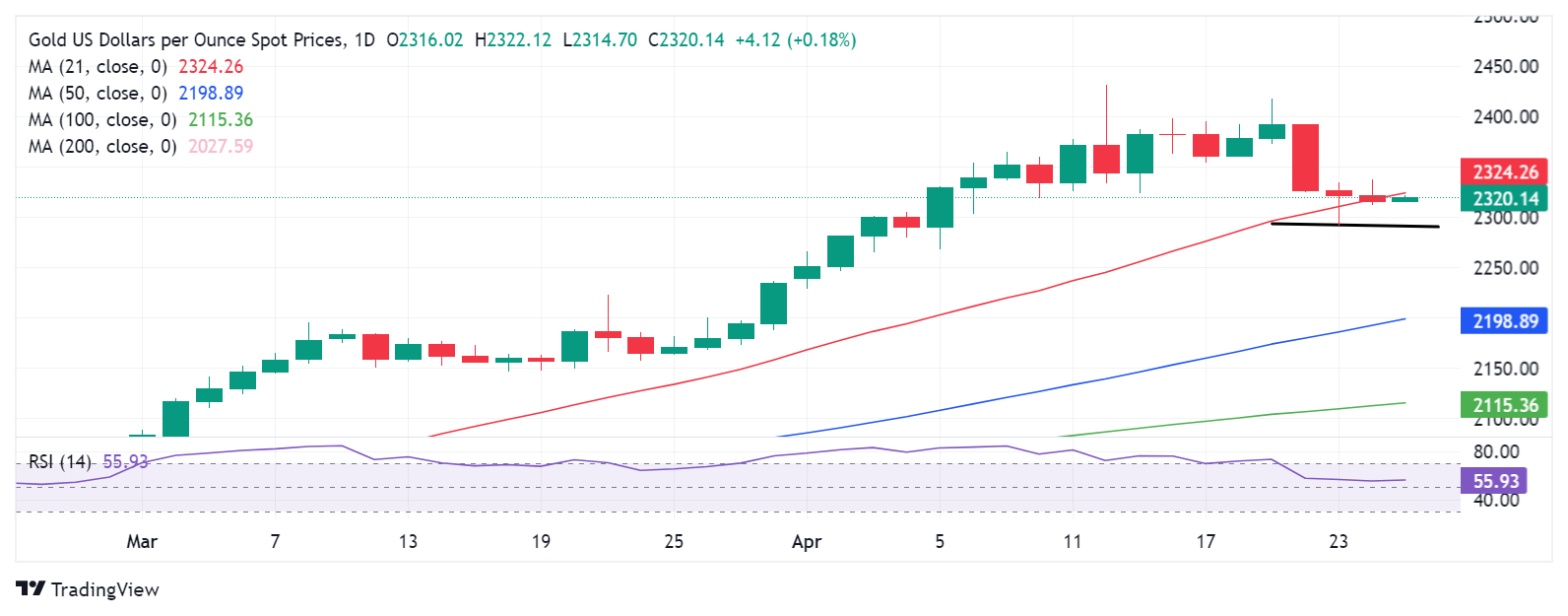
As observed on the daily chart, Gold price settled Wednesday below the key 21-day Simple Moving Average (SMA), then at $2,318, reinforcing bearish interests.
However, the 14-day Relative Strength Index (RSI), a leading indicator, still holds well above the midline, near 56.00, indicating that a renewed downside in Gold price could be seen as a good entry position for buyers.
If Gold sellers regain control, Gold price could challenge the $2,300 threshold again, below which Tuesday’s low of $2,291 will be targetted. The last line of defense for Gold buyers could be the early April low near $2,265.
On the flip side, a sustained recovery above the 21-day SMA support-turned-resistance, now at $2,324, could revive bullish commitments for a test of the $2,350 psychological level.
Further up, Gold buyers will target the static resistance near $2,360-$2,365.
Gold FAQs
Gold has played a key role in human’s history as it has been widely used as a store of value and medium of exchange. Currently, apart from its shine and usage for jewelry, the precious metal is widely seen as a safe-haven asset, meaning that it is considered a good investment during turbulent times. Gold is also widely seen as a hedge against inflation and against depreciating currencies as it doesn’t rely on any specific issuer or government.
Central banks are the biggest Gold holders. In their aim to support their currencies in turbulent times, central banks tend to diversify their reserves and buy Gold to improve the perceived strength of the economy and the currency. High Gold reserves can be a source of trust for a country’s solvency. Central banks added 1,136 tonnes of Gold worth around $70 billion to their reserves in 2022, according to data from the World Gold Council. This is the highest yearly purchase since records began. Central banks from emerging economies such as China, India and Turkey are quickly increasing their Gold reserves.
Gold has an inverse correlation with the US Dollar and US Treasuries, which are both major reserve and safe-haven assets. When the Dollar depreciates, Gold tends to rise, enabling investors and central banks to diversify their assets in turbulent times. Gold is also inversely correlated with risk assets. A rally in the stock market tends to weaken Gold price, while sell-offs in riskier markets tend to favor the precious metal.
The price can move due to a wide range of factors. Geopolitical instability or fears of a deep recession can quickly make Gold price escalate due to its safe-haven status. As a yield-less asset, Gold tends to rise with lower interest rates, while higher cost of money usually weighs down on the yellow metal. Still, most moves depend on how the US Dollar (USD) behaves as the asset is priced in dollars (XAU/USD). A strong Dollar tends to keep the price of Gold controlled, whereas a weaker Dollar is likely to push Gold prices up.
Author

Dhwani Mehta
FXStreet
Residing in Mumbai (India), Dhwani is a Senior Analyst and Manager of the Asian session at FXStreet. She has over 10 years of experience in analyzing and covering the global financial markets, with specialization in Forex and commodities markets.