Gold Price Forecast: Will solid US Nonfarm Payrolls trigger a XAU/USD correction?
- Gold price consolidates the rally to monthly highs on US NFP Friday.
- US Dollar and Treasury bond yields attempt a bounce amid risk-on mood.
- Gold price remains a ‘buy the dips’ trade after the triangle breakout, as the daily RSI stays bullish.

Gold price is taking a breather early Friday, having rallied 1% to hit fresh monthly highs at $2,065 on Thursday. A modest uptick in the US Dollar (USD), tracking the US Treasury bond yields rebound, is acting as a headwind for Gold price ahead of the highly-anticipated US Nonfarm Payrolls (NFP) data release.
US Nonfarm Payrolls to spike up Gold Price Volatility
Gold traders brace for a volatility spike on the release of the critical US labor market data, with the NFP figure expected to come in at 180K for January while Average Hourly Earnings are seen rising at an annual pace of 4.1% in the same period. A stronger-than-expected NFP print combined with a surprise upside in the wage inflation data is likely to affirm the US Federal Reserve’s (Fed) pushback against early rate cuts, infusing a new life into the US Treasury bond yields while driving the US Dollar back toward multi-week highs against its major peers.
In such a case, Gold price could witness a correction from the monthly high. On the contrary, Gold price could resume its uptrend toward the $2,100 threshold, if the US employment data disappoints and revives the odds of a March Fed rate cut. Renewed dovish Fed expectations are likely to reinforce the bearish sentiment around the US Treasury bond yields, as well as, the US Dollar. However, the end-of-the-week-flows are also expected to play a pivotal role, as markets readjust their positions in the Fed aftermath.
Gold price remains on track to book the best week in seven, especially after posting a solid rally on Thursday. The US Dollar reversed its gains and fell steeply after the US Labor Department showed Initial Jobless Claims rose more than expected last week. The risk-on rally on the US indices, thanks to the impressive tech results, also hit the safe-haven demand for the US Dollar, helping Gold price regain its lost footing.
Heading into the US NFP showdown, markets are pricing a 39% chance that the Fed will cut interest rates in March while that for a May rate cut stands at about 85%.
Gold price technical analysis: Daily chart
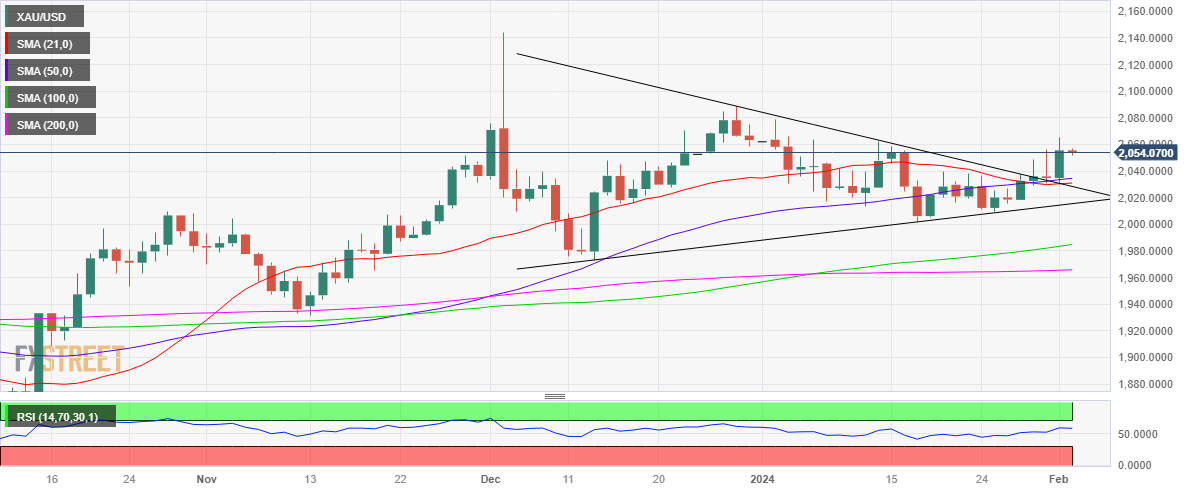
As observed on the daily chart, Gold price remains on track for further upside due to a triangle breakout and a bullish Relative Strength Index (RSI) indicator.
The 14-day RSI continues to hold firmer above the midline, despite the latest downtick, suggesting that Gold price remains a good buying opportunity on pullbacks.
Gold buyers are likely to stay hopeful so long as they defend the critical support in the $2,030-$2,035 region, where the triangle resistance-turned-support, 21-day and 50-day Simple Moving Averages (SMA) align.
On the upside, the immediate strong resistance is seen at the monthly top of $2,065. Further up, the $2,070 round figure could challenge bearish commitments, as Gold optimists target at $2,100 threshold.
Conversely, if the abovementioned strong support around $2,030 is breached, a fresh downside could open up, targeting the triangle support at $2,015.
The next relevant cushion is seen at $2,000 barrier, which will be the line in the sand for Gold buyers.
Gold FAQs
Why do people invest in Gold?
Gold has played a key role in human’s history as it has been widely used as a store of value and medium of exchange. Currently, apart from its shine and usage for jewelry, the precious metal is widely seen as a safe-haven asset, meaning that it is considered a good investment during turbulent times. Gold is also widely seen as a hedge against inflation and against depreciating currencies as it doesn’t rely on any specific issuer or government.
Who buys the most Gold?
Central banks are the biggest Gold holders. In their aim to support their currencies in turbulent times, central banks tend to diversify their reserves and buy Gold to improve the perceived strength of the economy and the currency. High Gold reserves can be a source of trust for a country’s solvency. Central banks added 1,136 tonnes of Gold worth around $70 billion to their reserves in 2022, according to data from the World Gold Council. This is the highest yearly purchase since records began. Central banks from emerging economies such as China, India and Turkey are quickly increasing their Gold reserves.
How is Gold correlated with other assets?
Gold has an inverse correlation with the US Dollar and US Treasuries, which are both major reserve and safe-haven assets. When the Dollar depreciates, Gold tends to rise, enabling investors and central banks to diversify their assets in turbulent times. Gold is also inversely correlated with risk assets. A rally in the stock market tends to weaken Gold price, while sell-offs in riskier markets tend to favor the precious metal.
What does the price of Gold depend on?
The price can move due to a wide range of factors. Geopolitical instability or fears of a deep recession can quickly make Gold price escalate due to its safe-haven status. As a yield-less asset, Gold tends to rise with lower interest rates, while higher cost of money usually weighs down on the yellow metal. Still, most moves depend on how the US Dollar (USD) behaves as the asset is priced in dollars (XAU/USD). A strong Dollar tends to keep the price of Gold controlled, whereas a weaker Dollar is likely to push Gold prices up.
Author

Dhwani Mehta
FXStreet
Residing in Mumbai (India), Dhwani is a Senior Analyst and Manager of the Asian session at FXStreet. She has over 10 years of experience in analyzing and covering the global financial markets, with specialization in Forex and commodities markets.

















