Gold Price Forecast: Focus on weekly close above $2,400 amid heightened geopolitical tensions
- Gold price records another historic level just shy of $2,400 early Friday.
- US Dollar consolidates with US Treasury bond yields, as a Fed rate cut is now priced for September.
- Middle East Geopolitical tensions will keep refueling Gold buyers even as RSI stays heavily overbought.

Gold price is challenging yet another lifetime high just a hairline short of the $2,400 threshold in Friday’s Asian session. Gold price remains on track to book the third weekly gain in a row, extending its record-setting rally.
Gold price glitters as geopolitical concerns intensify
The buying interest around the Gold price remains unabated, as investors continue to run for cover in the ultimate traditional safe-haven amid intensifying geopolitical tensions between Israel and Iran.
Russia, Germany and Britain came together on Thursday and appealed to countries in the Middle East to show restraint, especially over the imminent risks of an Iranian threat to strike Israel. Israel said it was preparing to "meet all its security needs" in a region on a potential airstrike by Iran.
This comes after Iran vowed revenge for the April 1 airstrike on its embassy compound in Damascus (Syria) that killed a top Iranian general and six other Iranian military officers, escalating the tensions already heightened by the Gaza conflict.
Israeli Defence Minister Yoav Gallant warned US Secretary of Defense Lloyd Austin that Israel would respond directly to any attack by Iran.
Gold price stood resilient to the pushback in the US Federal Reserve (Fed) interest cut expectations from June to September after hot US Consumer Price Index (CPI) and Core Producer Price Index (PPI) data. The inflation data kept the US Dollar underpinned alongside the US Treasury bond yields.
However, the tech rally on Wall Street overnight fuelled a sharp US Dollar retracement, collaborating with the further upside in Gold price.
From a broader perspective, Gold price stays supported by the surge in Gold purchases by global central banks, including Turkey, Kazakhstan and China.
Later in the day, Gold price will continue to take cues from the geopolitical developments unfolding in the Middle East. At the same time, traders will also keep an eye on the US Consumer Sentiment data and speeches from Fed policymakers.
Conflicting messages from Fed officials Barkin and Williams on Thursday failed to deter Gold buyers. Markets could also witness some profit-taking on their Gold longs, as the end-of-the-week flows come into play.
Gold price technical analysis: Four-hour chart
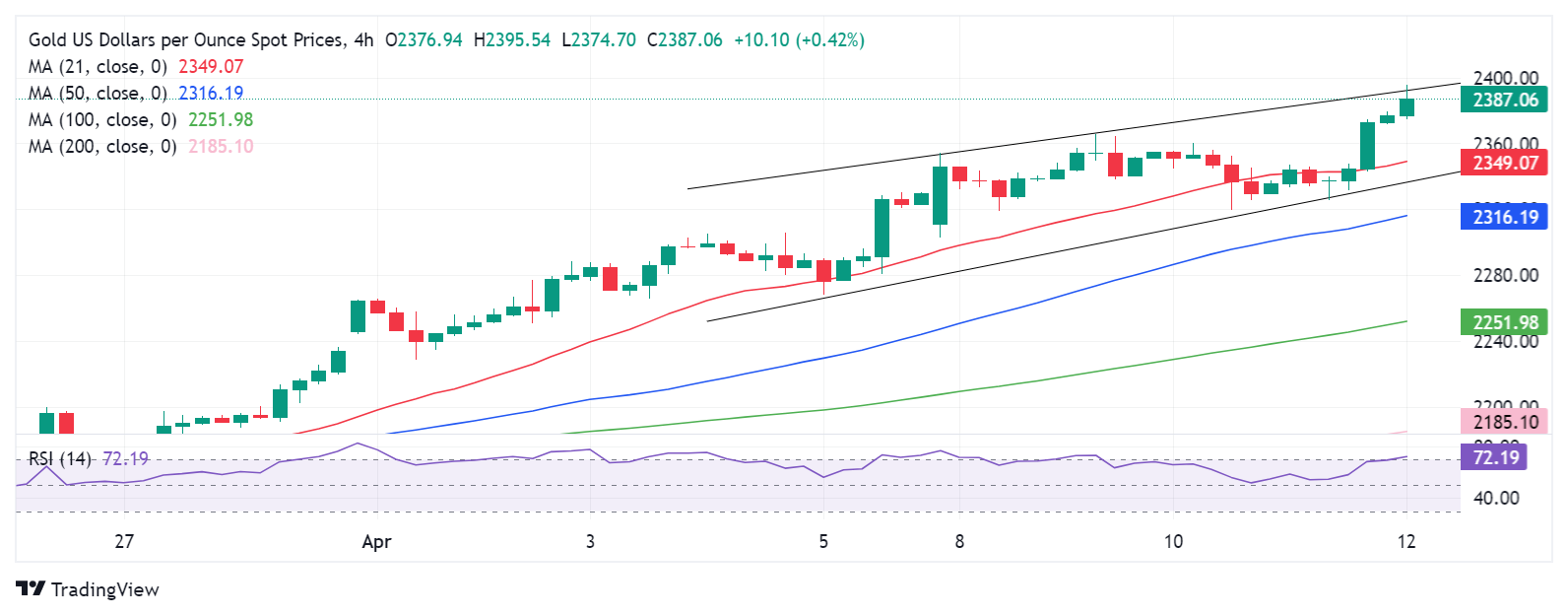
As observed on the four-hour chart, Gold price is battling the upper boundary of the rising wedge formation at $2,392, having hit a fresh record high just above it at $2,396.
If Gold buyers manage to seek a four-hour candlestick closing above that level, a fresh run toward the $2,450 psychological level will be in the offing.
However, acceptance above the $2,400 mark on a weekly closing basis is critical to unleashing further upside.
The Relative Strength Index (RSI) is sitting just above the overbought threshold, near 72.50, suggesting that there is more room for buyers to flex their muscles.
If the Gold price faces rejection at the abovementioned hurdle at $2,392, it could correct toward the previous day’s high of $2,378.
Failure to defend the latter will reinforce sellers toward the $2,370 static support. Further down, the April 10 high of $2,360 will be challenged.
Gold FAQs
Gold has played a key role in human’s history as it has been widely used as a store of value and medium of exchange. Currently, apart from its shine and usage for jewelry, the precious metal is widely seen as a safe-haven asset, meaning that it is considered a good investment during turbulent times. Gold is also widely seen as a hedge against inflation and against depreciating currencies as it doesn’t rely on any specific issuer or government.
Central banks are the biggest Gold holders. In their aim to support their currencies in turbulent times, central banks tend to diversify their reserves and buy Gold to improve the perceived strength of the economy and the currency. High Gold reserves can be a source of trust for a country’s solvency. Central banks added 1,136 tonnes of Gold worth around $70 billion to their reserves in 2022, according to data from the World Gold Council. This is the highest yearly purchase since records began. Central banks from emerging economies such as China, India and Turkey are quickly increasing their Gold reserves.
Gold has an inverse correlation with the US Dollar and US Treasuries, which are both major reserve and safe-haven assets. When the Dollar depreciates, Gold tends to rise, enabling investors and central banks to diversify their assets in turbulent times. Gold is also inversely correlated with risk assets. A rally in the stock market tends to weaken Gold price, while sell-offs in riskier markets tend to favor the precious metal.
The price can move due to a wide range of factors. Geopolitical instability or fears of a deep recession can quickly make Gold price escalate due to its safe-haven status. As a yield-less asset, Gold tends to rise with lower interest rates, while higher cost of money usually weighs down on the yellow metal. Still, most moves depend on how the US Dollar (USD) behaves as the asset is priced in dollars (XAU/USD). A strong Dollar tends to keep the price of Gold controlled, whereas a weaker Dollar is likely to push Gold prices up.
Author

Dhwani Mehta
FXStreet
Residing in Mumbai (India), Dhwani is a Senior Analyst and Manager of the Asian session at FXStreet. She has over 10 years of experience in analyzing and covering the global financial markets, with specialization in Forex and commodities markets.

















