Gold Price Forecast: $2,277 support appears at risk, as XAU/USD sellers refuse to give up
- Gold price hovers around $2,300 early Tuesday, remains vulnerable.
- The US Dollar holds firm alongside Treasury bond yields, following strong US Nonfarm Payrolls data.
- Gold price’s daily technical setup leans in favor of sellers but $2,277 support holds the key.


Gold price is off the four-week troughs but trades with a modest downside bias early Tuesday, battling the $2,300 level. The US Dollar pauses its uptrend amid a retreat in the US Treasury bond yields, courtesy of a risk-aversion wave.
Gold price holds the downside, awaits US CPI and Fed outcome
Gold price attempted a dead cat bounce on Monday, helped by a pullback in the US Dollar across its major rivals, as risk tone improved in the latter part of the day. US stocks witnessed a positive close after a day of despair in Europe due to renewed political tensions.
In the first half of Monday’s trading, Gold price consolidated near four-week lows of $2,287 after the US Dollar received a double booster shot, with the EUR/USD sell-off offering a fresh leg higher while broad risk-aversion also helped the safe-haven Greenback.
The Euro was sold off into mounting political tension in the Euro area, especially after French President Emmanuel Macron announced snap elections on Sunday, dissolving parliament after exit polls showed his alliance suffered a heavy defeat in European elections to Marine Le Pen’s far-right National Rally (RN) party.
Further, Gold price bore the brunt of robust US employment data published on Friday, which showed Nonfarm Payrolls increased by 272,000 jobs last month, against a job gain of 185K predicted. Average Hourly Earnings, a measure of wage inflation, rose 4.1% in the same period when compared to the 4% increase in April, beating expectations for a 3.9% growth.
Markets are now pricing in a 46% probability that the US Federal Reserve (Fed) will lower rates by 25 basis points in September, slightly up from 43% seen following the NFP data release, the CME Group’s FedWatch Tool showed Tuesday.
All eyes now turn toward Wednesday’s big events - the US Consumer Price Index (CPI) data and the Fed policy announcements, which will significantly impact the value of the US Dollar and determine the next directional move for Gold price.
Meanwhile, Gold price fails to take advantage of the persisting risk-on mood after China and Hong Kong stock markets reopened on Tuesday deep in the red, catching up with the EU political uncertainty.
It remains to be seen how far Gold price can extend the weakness, induced by delayed Fed rate cut bets and China stalling its Gold reserves purchases after an 18-month long stretch.
David Tait, CEO of the World Gold Council (WGC), told Reuters on the sidelines of the Asia Pacific Precious Metals Conference in Singapore, "China's data did show a pause. (But) they are just waiting and watching. If prices correct to the $2,200 per ounce level, they will resume again."
Gold price technical analysis: Daily chart
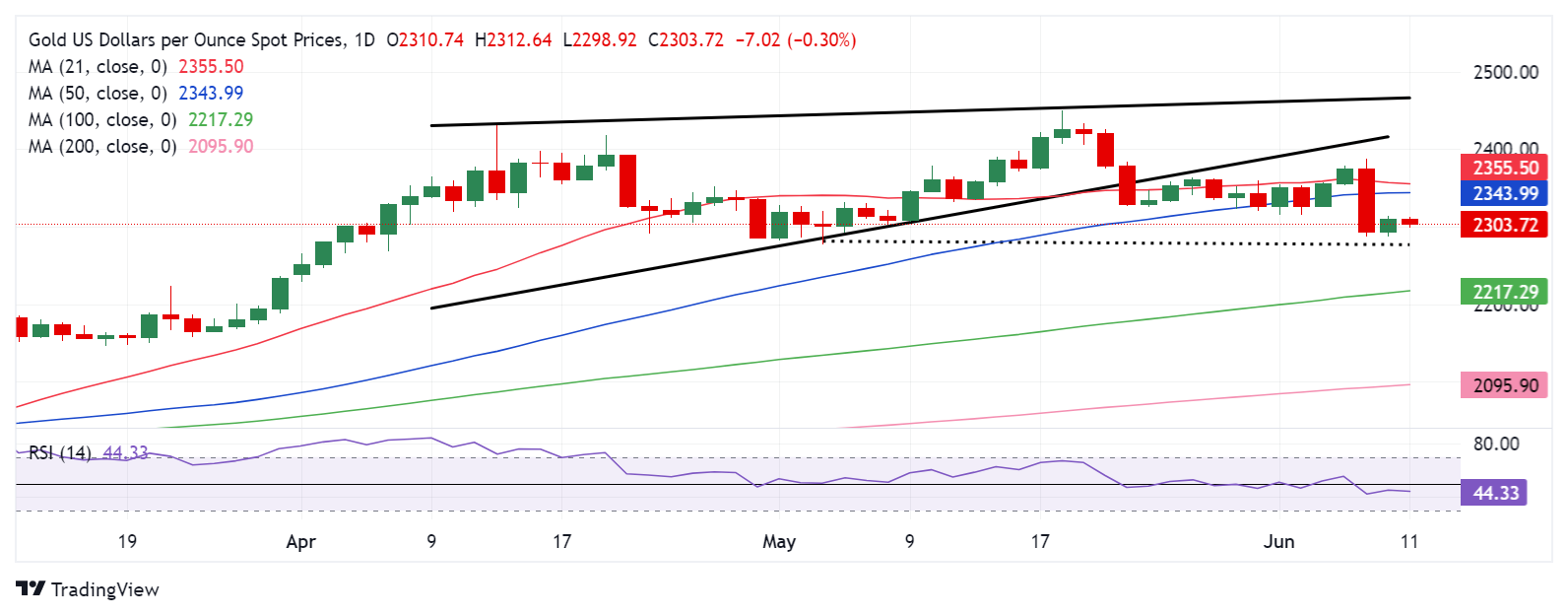
As observed on the daily chart, the Gold price extends its downside consolidative phase following the rising wedge breakdown.
Gold price remains vulnerable to further downside risks on a firm break below the May 3 low of $2,277.
The 14-day Relative Strength Index (RSI) points lower below the 50 level, near 44, suggesting more Gold price declines in the offing.
The next relevant support is seen at the $2,250 psychological barrier, below which a test of the 100-day SMA at $2,217 will be inevitable.
Alternatively, any recovery in Gold price will need acceptance above the 50-day SMA support-turned-resistance at $2,344. Further up, recapturing the 21-day SMA at $2,355 will be critical to negating the near-term bearish bias.
Gold buyers will then flex their muscles toward the May 24 high of $2,364.
Gold FAQs
Gold has played a key role in human’s history as it has been widely used as a store of value and medium of exchange. Currently, apart from its shine and usage for jewelry, the precious metal is widely seen as a safe-haven asset, meaning that it is considered a good investment during turbulent times. Gold is also widely seen as a hedge against inflation and against depreciating currencies as it doesn’t rely on any specific issuer or government.
Central banks are the biggest Gold holders. In their aim to support their currencies in turbulent times, central banks tend to diversify their reserves and buy Gold to improve the perceived strength of the economy and the currency. High Gold reserves can be a source of trust for a country’s solvency. Central banks added 1,136 tonnes of Gold worth around $70 billion to their reserves in 2022, according to data from the World Gold Council. This is the highest yearly purchase since records began. Central banks from emerging economies such as China, India and Turkey are quickly increasing their Gold reserves.
Gold has an inverse correlation with the US Dollar and US Treasuries, which are both major reserve and safe-haven assets. When the Dollar depreciates, Gold tends to rise, enabling investors and central banks to diversify their assets in turbulent times. Gold is also inversely correlated with risk assets. A rally in the stock market tends to weaken Gold price, while sell-offs in riskier markets tend to favor the precious metal.
The price can move due to a wide range of factors. Geopolitical instability or fears of a deep recession can quickly make Gold price escalate due to its safe-haven status. As a yield-less asset, Gold tends to rise with lower interest rates, while higher cost of money usually weighs down on the yellow metal. Still, most moves depend on how the US Dollar (USD) behaves as the asset is priced in dollars (XAU/USD). A strong Dollar tends to keep the price of Gold controlled, whereas a weaker Dollar is likely to push Gold prices up.
Premium
You have reached your limit of 3 free articles for this month.
Start your subscription and get access to all our original articles.
Author
Dhwani Mehta
FXStreet
Residing in Mumbai (India), Dhwani is a Senior Analyst and Manager of the Asian session at FXStreet. She has over 10 years of experience in analyzing and covering the global financial markets, with specialization in Forex and commodities markets.