GBP/USD Outlook: Bears trying to seize control amid Brexit/Covid woes, US CPI in focus
- GBP/USD witnessed an intraday turnaround and retreated 80 pips on Wednesday.
- Comments by BoE’s Haldane were overshadowed by the negative Brexit headlines.
- The market focus remains glued to the release of the US consumer inflation figures.

The GBP/USD pair struggled to capitalize on its intraday positive move and witnessed a dramatic turnaround on Wednesday in the wake of fresh Brexit jitters. The pair gained some traction after the Bank of England Chief Economist, Andy Haldane warned about rising inflationary pressures and added that the central bank might need to turn off the tap of its huge monetary stimulus. Bulls, however, struggle to capitalize on the move and failed ahead of the 1.4200 mark amid concerns about souring UK-EU relations.
In a further escalation of a dispute over the Northern Ireland protocol, the European Union warned of swift and firm action if the UK fails to implement its post-Brexit obligations. This comes on the back of speculations that the UK may delay plans to end restrictions fully on June 21 in light of the spread of the so-called Delta variant. The combination of factors weighed heavily on the British pound, which, along with a late US dollar rebound dragged the pair to fresh weekly lows during the Asian session on Thursday.
Despite the negative developments, the pair, so far, has managed to defend the 1.4100 mark. Investors seemed reluctant to place any aggressive bets, rather preferred to wait on the sidelines ahead of the US consumer inflation figures. The data will be another piece of important macro data that would set the tone for the upcoming FOMC meeting on June 15-16. This, in turn, will play a key role in influencing the near-term USD price dynamics and help determine the next leg of a directional move for the GBP/USD pair.
Given that talks to resolve differences over the Brexit deal broke up without a breakthrough, worries about the third wave of coronavirus infections favours bearish traders. Hence, any meaningful positive move might still be seen as a selling opportunity and runs the risk of fizzling out rather quickly.
Short-term technical outlook
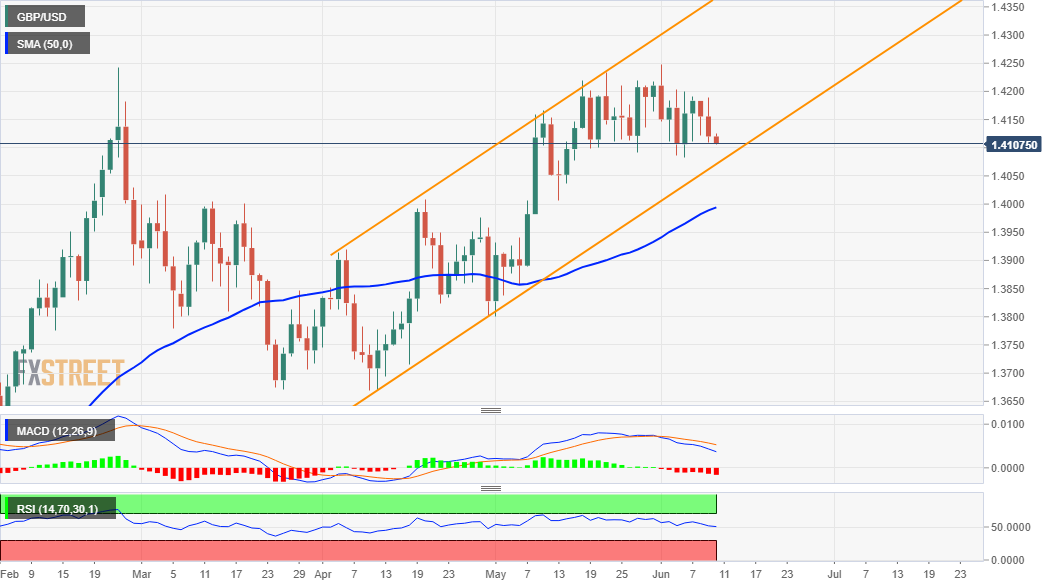
From a technical perspective, repeated failures at higher levels might have shifted the near-term bias in favour of bearish traders. That said, it will still be prudent to wait for some strong follow-through selling before positioning for any further near-term depreciating move. From current levels, monthly swing lows, around the 1.4080 region might protect the immediate downside. This is closely followed by the lower boundary of a two-month-old ascending channel, currently near the 1.4065-60 region.
A convincing break below will reaffirm the negative bias and prompt some aggressive selling. The pair might then accelerate the fall towards challenging the key 1.4000 psychological mark. The downward trajectory could further get extended towards intermediate support near the 1.3940 horizontal support en-route the 1.3900 round figure.
On the flip side, any meaningful recovery attempt might now confront stiff resistance near mid-1.4100s ahead of the 1.4175-80 supply zone and the 1.4200 mark. The next relevant hurdle is pegged near the 1.4230-35 area, above which the pair seems all set to surpass YTD tops and aim to reclaim the 1.4300 mark. Bulls could further push the pair towards challenging the trend-channel hurdle, currently near the 1.4335 region, which if cleared decisively will set the stage for additional gains.
Author

Haresh Menghani
FXStreet
Haresh Menghani is a detail-oriented professional with 10+ years of extensive experience in analysing the global financial markets.