GBP/USD Forecast: Struggles near 1.30 handle, remains vulnerable amid no-deal Brexit fears
- GBP/USD edges higher on the back of a subdued USD demand.
- The uptick lacks bullish conviction amid fears of no-deal Brexit.
- Investors now look forward to US macro data for some impetus.


The GBP/USD pair traded with a mild positive bias through the early European session on Monday and held steady above the key 1.30 psychological mark, albeit lacked any strong follow-through. The pair once again showed some resilience below the mentioned handle and was being supported by a subdued US dollar demand.
As investors looked past Friday's mostly upbeat US economic data, a modest pullback in the US Treasury bond yields undermined the USD demand and turned out to be one of the key factors lending some support to the major. The USD bulls seemed rather unimpressed by the lastest optimism over an interim US-China trade agreement.
It is worth recalling that the US President Donald Trump said on Saturday that the US and China would sign their so-called phase one trade pact very shortly. Adding to this, China announced on Monday that it would lower import tariffs from January 1 on around 850 US products – ranging from frozen pork to some type of semiconductors.
Meanwhile, the uptick lacked any strong bullish conviction amid fears of a no-deal Brexit. In the latest development, MPs voted 358-234 on Friday to pass the second reading of the UK Prime Minister Boris Johnson's tougher version of the Withdrawal Agreement Bill, which now ensures that Britain will leave the EU on January 31. Given the Tories' majority, the Commons is expected to approve the legislation by January 9, then pass to the Lords, and then for Royal Assent.
In absence of any major market-moving economic releases from the UK, investors now seemed reluctant to place any aggressive bets. Later during the early North-American session, the US economic docket – highlighting the release of Durable Goods Orders data – will now be looked upon for some meaningful trading impetus.
Short-term technical outlook
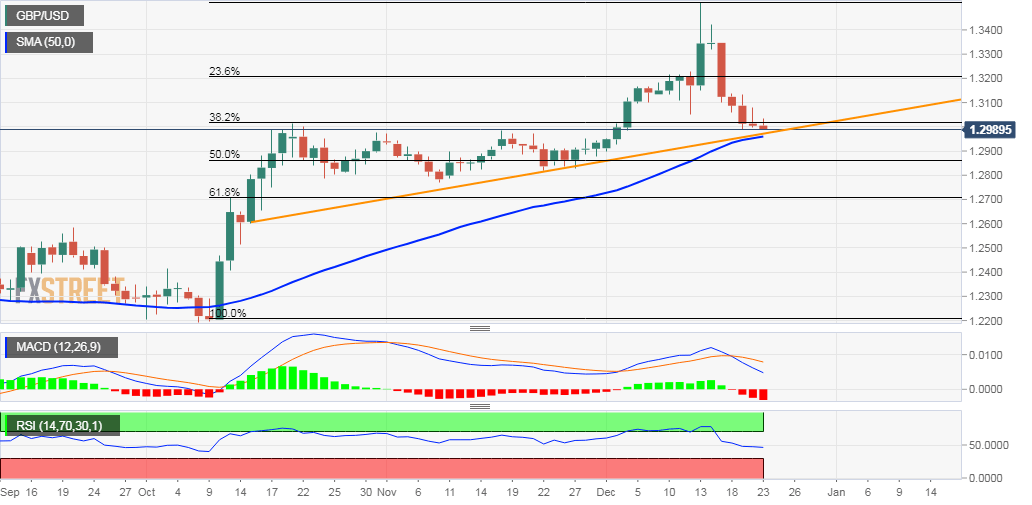
From a technical perspective, the pair has been consolidating in a range near confluence support comprising of a two-month-old ascending trend-line and 38.2% Fibonacci level of the 1.2204-1.3422 positive move. This is closely followed by 50-day SMA, around the 1.2960-55 region, which if broken might be seen as a key trigger for bearish traders. Below the mentioned support, the pair is likely to turn vulnerable and accelerate the fall further towards the 1.2900 handle. The downward trajectory could further get extended towards 50% Fibo. level support near mid-1.2800s.
On the flip side, any subsequent recovery is likely to confront some fresh supply near the 1.3060-65 region, above which a bout of short-covering could lift the pair further towards the 1.3100 round-figure mark. Some follow-through buying has the potential to further fuel the recovery move towards 1.3125-30 horizontal zone en-route 23.6% Fibo. level near the 1.3200 round figure mark.
Author
Haresh Menghani
FXStreet
Haresh Menghani is a detail-oriented professional with 10+ years of extensive experience in analysing the global financial markets.