GBP/USD Forecast: Sellers ignore oversold conditions after BoE Governor Bailey remarks
- GBP/USD stays under heavy bearish pressure and falls toward 1.3100.
- BoE Governor Bailey's comments triggered a Pound Sterling selloff early Thursday.
- The pair's near-term technical outlook points to oversold conditions.

GBP/USD came under heavy bearish pressure and slumped toward 1.3100 in the European morning on Thursday, touching its weakest level in three weeks in the process. The near-term technical outlook points to oversold conditions but the pair could have a difficult time staging a decisive correction.
The US Dollar preserved its strength and forced GBP/USD to stays on the back foot on Wednesday after the data published by the Automatic Data Processing (ADP) showed that employment in the private sector rose by 143,000, surpassing the market expectation of 120,000.
In an interview with the Guardian newspaper, Bank of England Governor Andrew Bailey said that they could become "a bit more activist on rate cuts if there’s further good news on inflation." These comments triggered a Pound Sterling selloff in the early European session on Thursday. Reflecting the broad-based GBP weakness, the EUR/GBP pair is up more than 1% on the day.
Later in the day, the US economic calendar will feature the weekly Initial Jobless Claims and the September ISM Services PMI data. Markets expect the number of first-time applications for unemployment benefits to come in at 220,000 in the week ending September 28, up slightly from 218,000 in the previous week. A print at or below 200,000 could boost the USD and further weigh on the pair. On the other hand, an unexpected drop below 50 in the headline ISM Services PMI could revive concerns over an economic slowdown in the US and make it difficult for the USD to outperform its rivals.
GBP/USD Technical Analysis
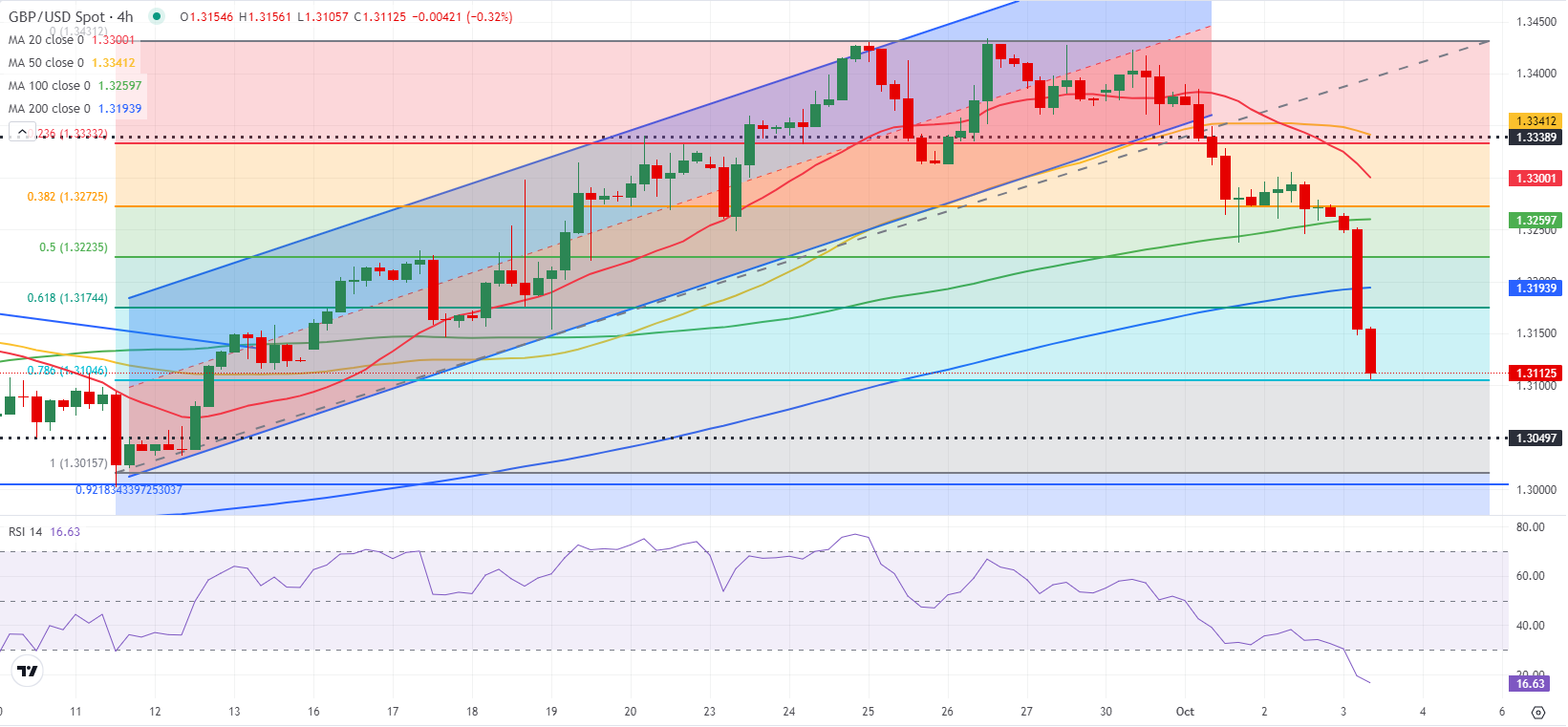
The Relative Strength Index (RSI) indicator on the 4-hour chart slumped below 20 early Thursday, reflecting oversold conditions for GBP/USD. In case the pair stages a technical correction, 1.3175 (Fibonacci 61.8% retracement of the latest uptrend) could be seen as first resistance before 1.3200, where the 200-period Simple Moving Average (SMA) is located.
On the downside, 1.3100 (Fibonacci 78.6% retracement) could be seen as next support before 1.3050 (static level) and 1.3000 (static level).
BoE FAQs
The Bank of England (BoE) decides monetary policy for the United Kingdom. Its primary goal is to achieve ‘price stability’, or a steady inflation rate of 2%. Its tool for achieving this is via the adjustment of base lending rates. The BoE sets the rate at which it lends to commercial banks and banks lend to each other, determining the level of interest rates in the economy overall. This also impacts the value of the Pound Sterling (GBP).
When inflation is above the Bank of England’s target it responds by raising interest rates, making it more expensive for people and businesses to access credit. This is positive for the Pound Sterling because higher interest rates make the UK a more attractive place for global investors to park their money. When inflation falls below target, it is a sign economic growth is slowing, and the BoE will consider lowering interest rates to cheapen credit in the hope businesses will borrow to invest in growth-generating projects – a negative for the Pound Sterling.
In extreme situations, the Bank of England can enact a policy called Quantitative Easing (QE). QE is the process by which the BoE substantially increases the flow of credit in a stuck financial system. QE is a last resort policy when lowering interest rates will not achieve the necessary result. The process of QE involves the BoE printing money to buy assets – usually government or AAA-rated corporate bonds – from banks and other financial institutions. QE usually results in a weaker Pound Sterling.
Quantitative tightening (QT) is the reverse of QE, enacted when the economy is strengthening and inflation starts rising. Whilst in QE the Bank of England (BoE) purchases government and corporate bonds from financial institutions to encourage them to lend; in QT, the BoE stops buying more bonds, and stops reinvesting the principal maturing on the bonds it already holds. It is usually positive for the Pound Sterling.
Author

Eren Sengezer
FXStreet
As an economist at heart, Eren Sengezer specializes in the assessment of the short-term and long-term impacts of macroeconomic data, central bank policies and political developments on financial assets.