|

EUR/USD Forecast: The 1.10 area is seen holding the downside

  • EUR/USD stays in the area of YTD lows just above 1.10.
  • Developments from the Chinese coronavirus dictate the mood in markets.
  • Markets’ focus now shifted to US data and upcoming FOMC meeting.

EUR/USD remains under pressure amidst the current environment of risk-off sentiment, where the safe havens remain broadly supported on the back of the developments from the Wuhan coronavirus and its potential implications on global growth, most particularly in China.

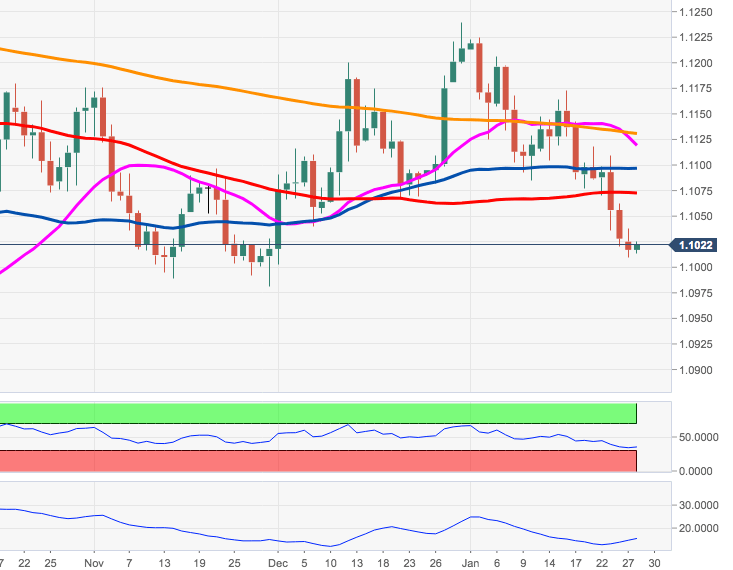
The pair has intensified the downside after breaking below key support levels, namely the 55-day and 100-day SMAs in past sessions, exposing the move to a deeper retracement. In addition, further weakness in the single currency came after the ECB delivered a somewhat dovish message at its meeting last Thursday.

Later in the day, US key data should keep the attention on the buck, while market participants warm up for the FOMC meeting due on Wednesday, as well as German/EMU advanced inflation figures, expected on Thursday and Friday, respectively.
Short-term technical outlook

The ongoing leg lower in EUR/USD appears to have met some contention in the 1.10 neighbourhood for the time being. However, if the selling impetus regains steam, then the 1.0980 region – where is located November’s low – should return to the traders’ radar. In the broader picture, as long as the 55-day SMA - today at 1.1089 - caps the upside, the bearish stance on the spot is seen unchanged. Although not favoured in the short-term view, if bulls regain the upper hand, interim resistance is seen at the 100-day SMA at 1.1068. This area of resistance is reinforced by the proximity of the 3-month resistance line. Something to keep in mind: the RSI is close to the oversold territory, while the ADX at around 15, shows the current downtrend lacks (proper?) strength.

Author

Pablo Piovano

Born and bred in Argentina, Pablo has been carrying on with his passion for FX markets and trading since his first college years.


More from Pablo Piovano
Share:

Editor's Picks

EUR/USD flirts with daily highs, retargets 1.1900

EUR/USD regains upside traction, returning to the 1.1880 zone and refocusing its attention to the key 1.1900 barrier. The pair’s slight gains comes against the backdrop of a humble decline in the US Dollar as investors continue to assess the latest US CPI readings and the potential Fed’s rate path.

GBP/USD remains well bid around 1.3650

GBP/USD maintains its upside momentum in place, hovering around daily highs near 1.3650 and setting aside part of the recent three-day drop. Cable’s improved sentiment comes on the back of the Greenback’s  irresolute price action, while recent hawkish comments from the BoE’s Pill also collaborate with the uptick.

Gold clings to gains just above $5,000/oz

Gold is reclaiming part of the ground lost on Wednesday’s marked decline, as bargain-hunters keep piling up and lifting prices past the key $5,000 per troy ounce. The precious metal’s move higher is also underpinned by the slight pullback in the US Dollar and declining US Treasury yields across the curve.

Crypto Today: Bitcoin, Ethereum, XRP in choppy price action, weighed down by falling institutional interest 

Bitcoin's upside remains largely constrained amid weak technicals and declining institutional interest. Ethereum trades sideways above $1,900 support with the upside capped below $2,000 amid ETF outflows.

Week ahead – Data blitz, Fed Minutes and RBNZ decision in the spotlight

US GDP and PCE inflation are main highlights, plus the Fed minutes. UK and Japan have busy calendars too with focus on CPI. Flash PMIs for February will also be doing the rounds. RBNZ meets, is unlikely to follow RBA’s hawkish path.

Ripple Price Forecast: XRP potential bottom could be in sight

Ripple edges up above the intraday low of $1.35 at the time of writing on Friday amid mixed price actions across the crypto market. The remittance token failed to hold support at $1.40 the previous day, reflecting risk-off sentiment amid a decline in retail and institutional sentiment.













