EUR/USD Forecast: Euro could target 1.0700 on a soft US inflation reading
- EUR/USD continued to edge higher after posting gains on Wednesday.
- Investors await September inflation data from the US.
- Buyers are likely to remain interested as long as the Euro holds above 1.0570-1.0580.

EUR/USD continued to stretch higher toward 1.0650 early Thursday after posting small daily gains on Wednesday. The near-term technical outlook suggests that the pair is close to turning overbought but investors could ignore this condition in case US inflation data come in softer than forecast.
Risk flows continued to dominate the financial markets mid-week and the US Dollar found it difficult to hold its ground. Additionally, dovish comments from Federal Reserve (Fed) officials triggered another leg lower in US Treasury bond yields and further weighed on the currency.
Euro price this week
The table below shows the percentage change of Euro (EUR) against listed major currencies this week. Euro was the strongest against the US Dollar.
| USD | EUR | GBP | CAD | AUD | JPY | NZD | CHF | |
| USD | -0.59% | -0.76% | -0.55% | -0.72% | -0.03% | -0.57% | -0.97% | |
| EUR | 0.57% | -0.17% | 0.05% | -0.14% | 0.55% | 0.01% | -0.36% | |
| GBP | 0.75% | 0.17% | 0.21% | 0.00% | 0.71% | 0.16% | -0.20% | |
| CAD | 0.54% | -0.04% | -0.22% | -0.17% | 0.50% | -0.04% | -0.41% | |
| AUD | 0.72% | 0.17% | 0.00% | 0.22% | 0.72% | 0.16% | -0.20% | |
| JPY | 0.03% | -0.53% | -0.72% | -0.46% | -0.74% | -0.59% | -0.91% | |
| NZD | 0.59% | 0.01% | -0.16% | 0.06% | -0.16% | 0.56% | -0.37% | |
| CHF | 0.93% | 0.37% | 0.20% | 0.41% | 0.21% | 0.89% | 0.33% |
The heat map shows percentage changes of major currencies against each other. The base currency is picked from the left column, while the quote currency is picked from the top row. For example, if you pick the Euro from the left column and move along the horizontal line to the Japanese Yen, the percentage change displayed in the box will represent EUR (base)/JPY (quote).
Early Thursday, US stock index futures trade in positive territory, pointing to an upbeat market mood.
In the second half of the day, September Consumer Price Index (CPI) data from the US will be watched closely by market participants. Investors expect the CPI and the Core CPI, which excludes volatile food and energy prices, to rise 0.3% on a monthly basis.
According to the CME Group FedWatch Tool, markets are pricing in a 72% probability that the Fed will leave the policy rate unchanged this year. In case the monthly Core CPI comes in weaker than expected, dovish Fed bets could continue to drive the market action. In that scenario, US stocks could extend the weekly rally and the USD could further weaken. On the other hand, the USD could stage a correction on a strong Core CPI reading of 0.5% or above and cause EUR/USD to erase a large portion of its weekly gains.
EUR/USD Technical Analysis
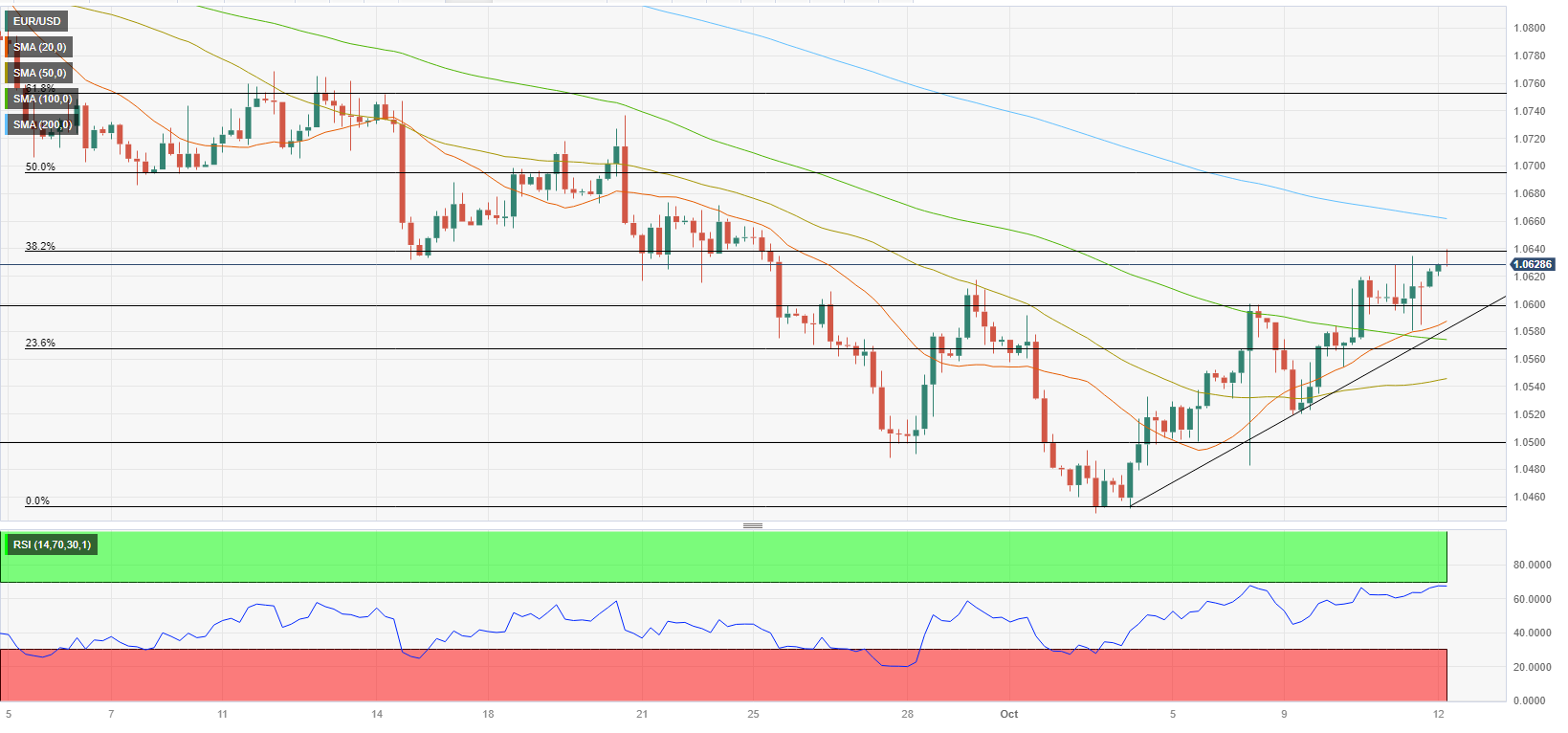
The Relative Strength Index (RSI) indicator on the four-hour chart climbed to 70 early Thursday. In case the pair makes a technical correction, 1.0600 (psychological level, static level, ascending trend line) aligns as first support before the 1.0570-1.0580 area (Fibonacci 23.6% retracement, 20-period Simple Moving Average, 100-period SMA). A 4-hour close below the latter could discourage buyers and open the door for further losses toward 1.0540 (50-period SMA).
On the upside, immediate resistance is located at 1.0640 (Fibonacci 38.2% retracement of the latest downtrend) before 1.0670, where the 200-period Simple Moving Average (SMA) is located, and 1.0700 (Fibonacci 50% retracement, psychological level).
Author

Eren Sengezer
FXStreet
As an economist at heart, Eren Sengezer specializes in the assessment of the short-term and long-term impacts of macroeconomic data, central bank policies and political developments on financial assets.