EUR/USD Forecast: Euro could extend recovery on a soft US jobs report
- EUR/USD continues to edge higher following Thursday's rally.
- Nonfarm Payrolls in the US are forecast to rise by 180,000.
- The pair could encounter stiff resistance at around 1.0900.

After touching its lowest level since December 13 at 1.0780 in the European session on Thursday, EUR/USD reversed its direction in the second half of the day and closed in positive territory. The pair holds comfortably above 1.0850 early Friday and the near-term outlook points to a bullish tilt.
The US Dollar (USD) came under selling pressure in the American session on Thursday as US Treasury bond yields continued to push lower following disappointing employment-related data releases. Weekly Initial Jobless Claims rose to 224,000, the highest reading since early November, and the Employment Index of the ISM Manufacturing PMI survey declined to 47.1 in January from 47.5 in December.
Euro price this week
The table below shows the percentage change of Euro (EUR) against listed major currencies this week. Euro was the strongest against the US Dollar.
| USD | EUR | GBP | CAD | AUD | JPY | NZD | CHF | |
| USD | -0.37% | -0.42% | -0.60% | -0.25% | -1.09% | -0.93% | -0.86% | |
| EUR | 0.37% | -0.04% | -0.21% | 0.13% | -0.69% | -0.56% | -0.48% | |
| GBP | 0.41% | 0.05% | -0.18% | 0.16% | -0.65% | -0.52% | -0.43% | |
| CAD | 0.59% | 0.21% | 0.16% | 0.34% | -0.48% | -0.34% | -0.26% | |
| AUD | 0.25% | -0.13% | -0.17% | -0.35% | -0.82% | -0.67% | -0.61% | |
| JPY | 1.07% | 0.69% | 0.79% | 0.47% | 0.81% | 0.13% | 0.21% | |
| NZD | 0.92% | 0.56% | 0.50% | 0.34% | 0.66% | -0.16% | 0.09% | |
| CHF | 0.85% | 0.48% | 0.42% | 0.25% | 0.60% | -0.21% | -0.08% |
The heat map shows percentage changes of major currencies against each other. The base currency is picked from the left column, while the quote currency is picked from the top row. For example, if you pick the Euro from the left column and move along the horizontal line to the Japanese Yen, the percentage change displayed in the box will represent EUR (base)/JPY (quote).
The Bureau of Labor Statistics will release the January jobs report later in the day. Nonfarm Payrolls are forecast to rise by 180,000. In the post-meeting press conference on Wednesday, "if we saw unexpected weakening in the labor market, that would make us cut rates sooner," Federal Reserve Chairman Jerome Powell said.
Hence, an NFP reading below 150,000 could revive expectations for a rate cut in March and force the USD to continue to weaken against its rivals ahead of the weekend. On the other hand, a print above 200,000 could be seen as 'good enough' to delay the policy pivot to May and help the USD stage a rebound in the American session.
According to CME FedWatch Tool, the probability of the Fed lowering the policy rate by 25 bps to 5%-5.25% in March stands at 37.5% and it's 60% for May.
EUR/USD Technical Analysis
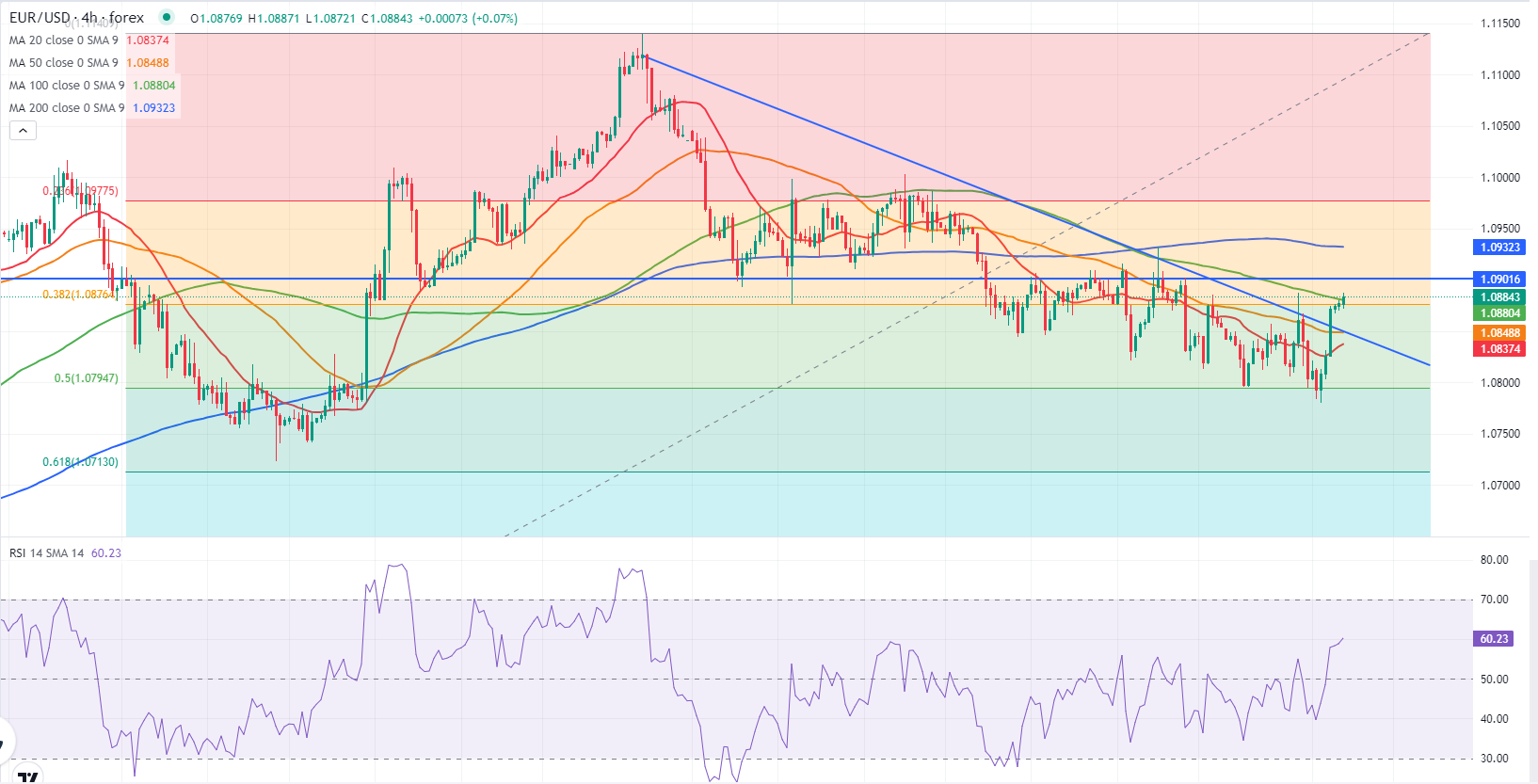
The Relative Strength Index (RSI) indicator on the 4-hour chart climbed to 60 and EUR/USD broke above the descending trend channel, reflecting the bullish tilt in the near-term bias.
On the upside, stiff resistance seems to have formed at 1.0900-1.0910 (psychological level, 20-day Simple Moving Average (SMA), 50-day SMA). A daily close above that level could attract buyers and open the door for an extended recovery toward 1.0930 (200-period SMA on the 4-hour chart) and 1.0970 (Fibonacci 23.6% retracement of the latest uptrend).
1.0875 (Fibonacci 38.2% retracement) aligns as immediate support before 1.0850 (50-period SMA, broken descending trend line) and 1.0800 (Fibonacci 50% retracement).
Author

Eren Sengezer
FXStreet
As an economist at heart, Eren Sengezer specializes in the assessment of the short-term and long-term impacts of macroeconomic data, central bank policies and political developments on financial assets.