EUR/USD Forecast: Correction time? Overbought conditions and ECB uncertainty may trigger a downfall
- EUR/USD has hit the highest levels since February in response to weak US labor figures.
- Contradicting messages from ECB members on the next moves may weigh on the euro.
- Monday's four-hour chart shows that the pair still in overbought territory.

A currency war of sorts – that is what may limit EUR/USD's gains. The US Federal Reserve is set to keep the dollar depressed, but the European Central Bank could pressure the euro. Uncertainty is unhelpful to the common currency.
The currency pair shot higher on Friday after the US reported bitterly disappointing Nonfarm Payrolls figures. The world's largest economy gained only 266,000 in April, far below around one million expected. Is COVID-19 responsible for skewing the data? Without seasonal adjustments, America did gain over a million positions and unskewing the data is hard in these abnormal times.
April Nonfarm Payrolls fall far short of forecast but markets hardly notice
Nevertheless, for markets, the result is clear – the Fed's message that the economy has a long way to go has been vindicated, and that means no urge to reduce bond-buying. If the central bank continues printing dollars, the greenback has more room to fall. If inflation figures beat estimates later this week, the picture could change, and the same goes for retail sales statistics. For now, the greenback remains pressured.
On the other side of the pond, there is no clear answer to the ECB's next moves. The Frankfurt-based institution pledged to ramp up the pace of its bond-buying scheme in the second quarter but may announce it is already unwinding this policy in June when it convenes again. That is, according to Martin Kazaks, one of the bank's members. Markets would see that as tightening and boost the euro.
On the other hand, Olli Rehn, another ECB member, wants to adopt the Fed's approach of allowing inflation to rise above the 2% target to compensate for past misses. That would mean keeping the policy looser for longer, thus weakening the euro.
With a light economic calendar and improving coronavirus statistics on both sides of the Atlantic, speculation about central banks' moves is set to dominate trading.
EUR/USD Technical Analysis
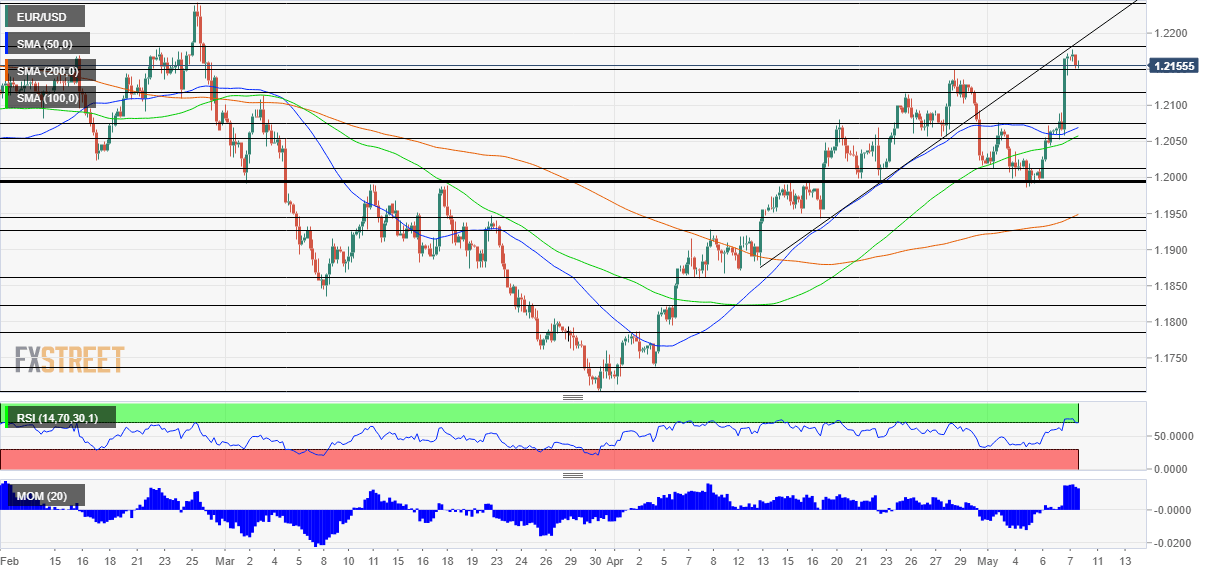
The Relative Strength Index (RSI) on the four-hour chart is just above 70 – reflecting overbought conditions. Moreover, the currency pair has failed to recapture the uptrend support line that accompanied until late April, another bearish sign. On the other hand, it benefits from upside momentum and trades above the 50, 100 and 200 SMAs.
Some support awaits at 1.2150, the daily low and the April's peak. It is followed by 1.2120, 1.2080 and 1.2050, which all played a role on the way up.
The fresh May peak 1.2176 is the immediate line of resistance. It is followed by 1.2240, which was a high point in February, and then by 1.23.
NFP Analysis: Terrible figures show overheating theory remains relevant only for stocks
Author

Yohay Elam
FXStreet
Yohay is in Forex since 2008 when he founded Forex Crunch, a blog crafted in his free time that turned into a fully-fledged currency website later sold to Finixio.