|

EUR/USD analysis: down within range, US CPI now takes center stage

EUR/USD Current price: 1.1385

The EUR/USD pair is down for a second consecutive day, having posted a daily low of 1.1370 and closing not far above it, despite the greenback also remained under pressure, ending the day mixed among the G10 bloc. The common currency got some limited intraday support on news indicating that the ECB will likely announce in its September policy meeting a plan to gradually unwind its bond-buying program starting next year, but surprisingly that was not enough to keep the pair above 1.1400, somehow anticipating buyers may have paused and that profit taking could be around the corner.
In the macroeconomic front, Germany released June inflation figures, which came in line with expectations  and previous month numbers, failing to motivate investors. In the US, the producer price index for final demand rose by 0.1% in June, beating expectations of a flat reading, and by 2.0% from a year before, above the expected 1.9% but below previous 2.4%. The core readings, excluding food and energy, came slightly below expected, while weekly unemployment claims fell by less-than-expected, down to 247K from a previously revised 250K and above the expected 245K. On Friday, the US will release its final June inflation and retail sales figures, pretty much the reason of the limited action seen this Thursday.

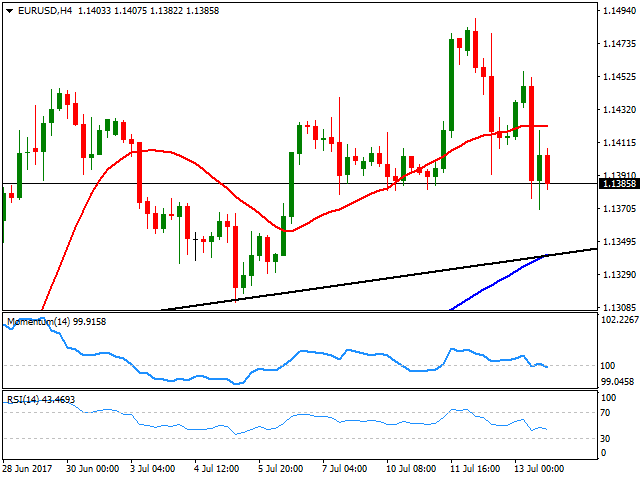
From a technical point of view, the 4 hours chart shows that the price settled below a flat 20 SMA, whilst the Momentum indicator hovers around its mid-line and the RSI indicator turned marginally lower around 45, not enough to confirm additional slides ahead. The same chart shows that a daily ascendant trend line converges with a bullish 100 SMA around 1.1340, a strong support that once broken will open doors for a steeper decline that will turn into a bearish movement only on an extension below 1.1290.

Support levels: 1.1340 1.1290 1.1250

Resistance levels: 1.1420 1.1460 1.1490

View Live Chart for the EUR/USD

Author

Valeria Bednarik

Valeria Bednarik was born and lives in Buenos Aires, Argentina. Her passion for math and numbers pushed her into studying economics in her younger years.


More from Valeria Bednarik
Share:

Editor's Picks

GBP/USD slips back below 1.3200

GBP/USD remains well on the defensive, sliding to the sub-1.3200 area once again on Tuesday. Cable’s decline comes as investors assess the political uncertainty in the UK, coupled with softer-than-expected UK PMI data and the better tone in the Greenback.

EUR/USD breaks below 1.1400 to hit fresh 2026 lows

EUR/USD comes under fresh and strong selling pressure on Tuesday, slipping below 1.1400 to its weakest level since June 2025. Mixed PMIs readings from Germany and the Eurozone offered little support to the single currency, while a risk-off tone across markets and stronger-than-expected US data boosted demand for the US Dollar.

Gold drops to multi-day lows, focus is now on $4,000

Gold rapidly reverses Monday's bounce and is trading sharply lower on Tuesday. The yellow metal, however, manages well to keep business above the $4,100 mark per troy ounce despite a firmer US Dollar and expectations that the Fed will keep rates higher for longer.

MiCA regulations could be the next bullish catalyst for crypto – Georg Harer, co-CEO at Bybit EU

The cryptocurrency market is losing momentum and liquidity due to the lack of a bullish catalyst. In an exclusive interview with FXStreet, Georg Harer, co-CEO at Bybit EU, says that the Markets in Crypto-Assets (MiCA) regulations could inject liquidity into the crypto market from traditional fund houses.

"Rearranging the deckchairs on the Titanic": UK's fiscal crisis outlasts another Prime Minister

Keir Starmer's resignation as the UK Prime Minister comes ten years after the Brexit referendum vote, a coincidence that financial markets have been quick to note. The British Pound trades around 1.3220 against the US Dollar on Thursday.

Regime change: Inside Kevin Warsh's first move to make the Fed unreadable on purpose

The rate did not move. That was the least interesting thing about Kevin Warsh's first meeting in charge of the Fed. The FOMC held its benchmark at 3.50%-3.75% for the fourth straight meeting, exactly as priced, and then the new chair used his first press conference to dismantle the machinery the market has leaned on for a decade.