|

WTI sinks beneath $78.00 on global recession fears, upbeat USD

  • Western Texas Intermediate erases last Friday’s gains, tumbles more than 3%.
  • Technical factors and China’s Covid-19 crisis increased traders’ worries about diminishing oil demand.
  • WTI Price Analysis: A daily close below the 20-DMA to pave the way towards $75.00.

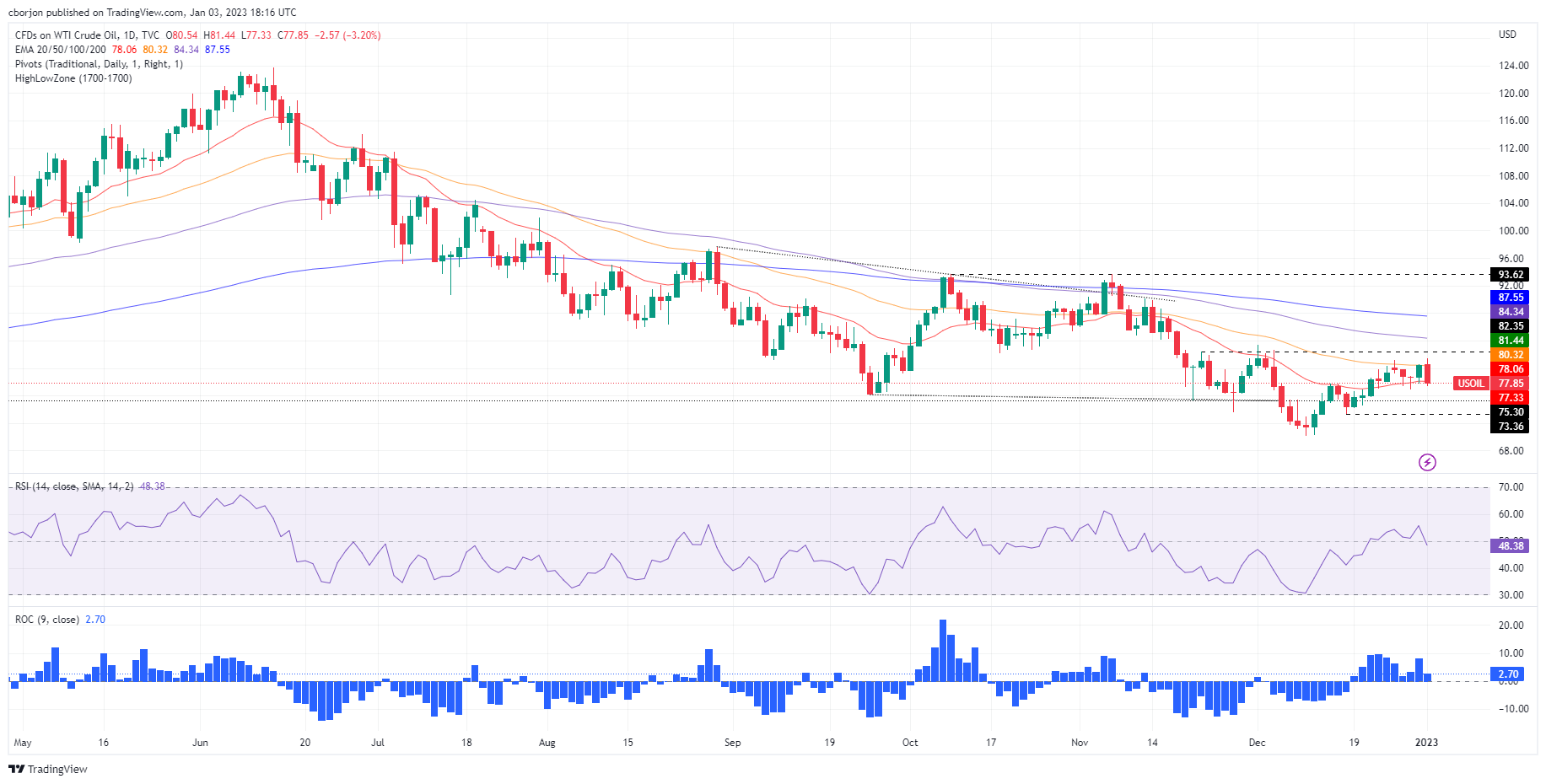
Western Texas Intermediate (WTI), the US crude oil benchmark tanks more than 3% on Tuesday, due to increased concerns of diminishing demand from China, as the country battles spurring Covid-19 cases amidst increasing worries for a worldwide recession. At the time of writing, WTI is trading at $77.78 per barrel, below its opening price, after reaching a high of $81.44.

WTI halted its upward trajectory at the 50-day Exponential Moving Average (EMA) at $80.32 a barrel. An increase of Covid-19 cases in China threatens to dampen demand in the second-largest economy and the world’s leading oil importer.

On Sunday, the International Monetary Fund (IMF) Director Kristalina Georgieva said that the global economy faces “a tough year, tougher than the year we leave behind.” Additional central bank tightening and weaker growth expected by the worldwide economy keep recessionary risk skewed to the upside.

Saxo Bank analysts wrote, “Another volatile year undoubtedly lies ahead with multiple uncertainties still impacting supply and demand. The two biggest that potentially will weigh against each other in the short term remain the prospect for a bumpy recovery in Chinese demand being offset by worries about a global economic slowdown.”

WTI Price Analysis: Technical outlook

From the daily chart perspective, WTI is neutral-to-downward biased. The 50-day EMA, around $80.31, capped the rally, while Tuesday’s price action is witnessing sellers stepping aggressively, dragging WTI’s price below $78.06, leaving the 20-day EMA above. If WTI achieves a daily close below the latter, it will exacerbate a fall toward the December 16 low at 73.36, ahead of the December 9 swing low of $70.10.
WTI US OIL

Overview
Today last price78.08
Today Daily Change-2.47
Today Daily Change %-3.07
Today daily open80.55
 
Trends
Daily SMA2076.65
Daily SMA5080.95
Daily SMA10083.64
Daily SMA20093.59
 
Levels
Previous Daily High80.55
Previous Daily Low80.55
Previous Weekly High81.19
Previous Weekly Low76.86
Previous Monthly High83.3
Previous Monthly Low70.27
Daily Fibonacci 38.2%80.55
Daily Fibonacci 61.8%80.55
Daily Pivot Point S180.55
Daily Pivot Point S280.55
Daily Pivot Point S380.55
Daily Pivot Point R180.55
Daily Pivot Point R280.55
Daily Pivot Point R380.55

Author

Christian Borjon Valencia

Markets analyst, news editor, and trading instructor with over 14 years of experience across FX, commodities, US equity indices, and global macro markets.


More from Christian Borjon Valencia
Share:

Editor's Picks

GBP/USD clings to daily gains near 1.3350

GBP/USD holds just in positive territory around 1.3350 on Friday as the Greenback keeps a vacillating price action. With Fed rate hike expectations easing and US markets closed for the Independence Day holiday, Cable remains on track to post solid weekly gains.

EUR/USD remains sidelined around 1.1440

EUR/USD holds on to its recent gains and consolidates around 1.1440 at the end of the week as the US Dollar lacks clear direction. In the meantime, trading conditions remain subdued, with volatility constrained by the closure of US markets for the Independence Day holiday.

Gold flirts with two-week highs, targets $4,200

Gold extends its recovery for a third straight day, advancing toward the $4,200 mark per troy ounce on Friday. The precious metal looks set to snap a four-week losing streak as softer-than-expected June US NFP data prompt investors to scale back expectations of further Fed tightening.

Crypto Today: Bitcoin, Ethereum, XRP advance amid renewed capital inflows

Bitcoin maintains its upward momentum, holding above the $61,000 mark at the time of writing on Friday. Major altcoins such as Ethereum and Ripple are also posting gains, signaling a modest uptick in market sentiment and renewed risk appetite among investors.

The Iran war failed to trigger a recession. Can the US economy keep defying expectations?

Nearly four months after the start of the Iran war, the US economy remains remarkably resilient. While the conflict initially triggered a severe disruption to global energy markets and a sharp rise in Oil prices, recent diplomatic progress between Washington and Tehran has eased concerns about a prolonged supply shock.

Kevin Warsh offers no policy clues: Why markets still got their answer

Financial markets came to Sintra looking for clues about the Federal Reserve's (Fed) next move. They largely left with confirmation that Fed Chair Kevin Warsh intends to make those clues much harder to find.













