|

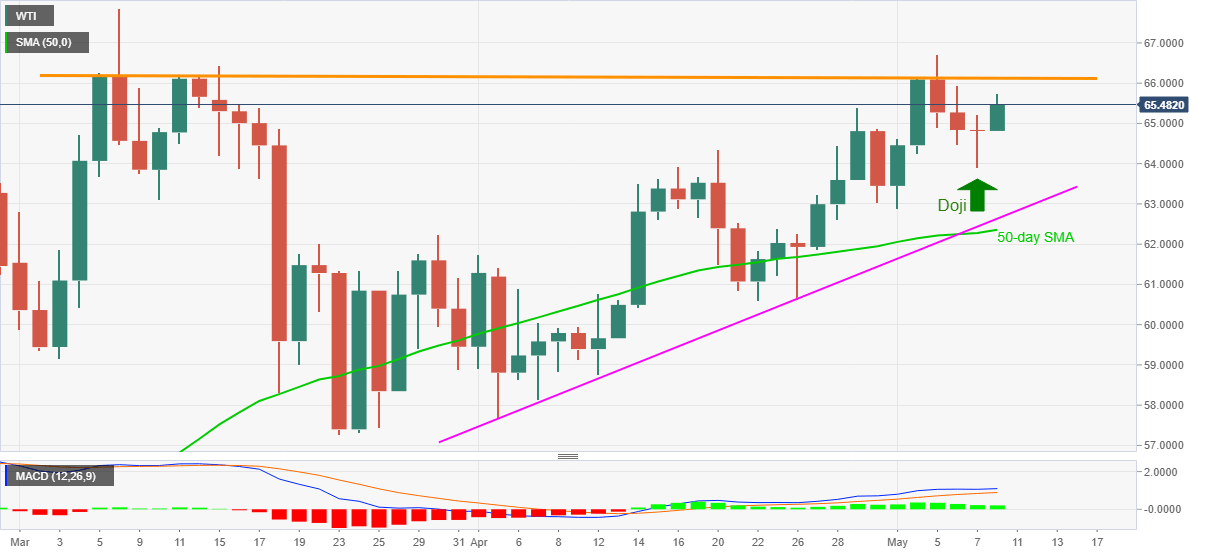
WTI Price Analysis: Looks set to revisit $66.20-30 resistance on Friday’s bullish Doji

  • WTI picks up bids, rises the most in four days.
  • Bullish candlestick, upbeat MACD direct traders to the key hurdle.
  • Monthly support line, 50-day SMA restrict short-term downside.

WTI remains on the front foot, up 0.89% intraday near $65.40, as traders in Brussels brace for Monday’s bell. In doing so, the oil benchmark justifies Friday’s bullish Doji candlestick as well as upbeat MACD signals.

Although the latest run-up is set for cross the $66.00 round figure resistance, a horizontal area comprising multiple tops marked since early March around $66.20-30 will be a tough nut to crack for the oil bulls.

Should the barrel of black gold costs more than $66.30, the yearly high surrounding $67.85 will return to the chart.

During the pullback, $64.00 may entertain the short-term WTI sellers ahead of directing them to an ascending support line from April 05, near $62.60.

However, any further weakness past-$62.60 will be tested by a 50-day SMA level of $62.35, if not then the odds of the commodity’s gradual declines to $60.00 psychological magnet can’t be ruled out.

WTI daily chart
Trend: Bullish

Additional important levels

Overview
Today last price65.35
Today Daily Change0.54
Today Daily Change %0.83%
Today daily open64.81
 
Trends
Daily SMA2063.12
Daily SMA5062.28
Daily SMA10058.04
Daily SMA20049.82
 
Levels
Previous Daily High65.21
Previous Daily Low63.9
Previous Weekly High66.7
Previous Weekly Low62.88
Previous Monthly High65.4
Previous Monthly Low57.66
Daily Fibonacci 38.2%64.4
Daily Fibonacci 61.8%64.71
Daily Pivot Point S164.07
Daily Pivot Point S263.32
Daily Pivot Point S362.75
Daily Pivot Point R165.38
Daily Pivot Point R265.95
Daily Pivot Point R366.7

Author

Anil Panchal

Anil Panchal

FXStreet

Anil Panchal has nearly 15 years of experience in tracking financial markets. With a keen interest in macroeconomics, Anil aptly tracks global news/updates and stays well-informed about the global financial moves and their implications.


More from Anil Panchal
Share:

Editor's Picks

AUD/USD sticks to positive bias above 0.7100; lacks bullish conviction

AUD/USD trades with a positive bias for the second straight day, holding above 0.7100 in the Asian session on Friday as softer US bond yields keep US Dollar bulls on the back foot. Furthermore, hawkish RBA Governor Bullock's comments boost rate hike bets and support the Aussie. However, the Fed's hawkish outlook, along with geopolitical uncertainties, limits USD losses and caps the pair.

USD/JPY approaches 158.00 as Japanese Yen resumes decline

USD/JPY is resuming its upside in the European session on Friday, refreshing two-week highs and nearing 158.00. The Japanese Yen extends losses, despite the Bank of Japan's (BoJ) expected rate hike to 1.25% and hawkish Governor Ueda's comments, as two surprise dissents against the rate hike weigh on it.

Gold keeps the bid tone in place; still below $4,400

Gold adds to the optimism seen in the second half of the week, trading with decent gains just below the $4,400 mark per troy ounce on Friday. The precious metal’s advance finds traction in declining crude oil prices and fresh selling pressure on the US Dollar.

Why altcoin season isn't coming back — and what stole its capital
If, after two years of being frozen in ice, Katara and Sokka woke you up to the crypto market, it would seem like 100 years have passed. With Bitcoin soaring to record highs just over a year ago, everyone expected a routine altcoin season, where investors take profits from the top crypto to chase higher returns in altcoins.
BoJ Recap: Not as hawkish as expected

The BoJ raised its short-term interest-rate target to 1.25% from 1.00% in a 7-2 vote, marking another step in the normalisation of monetary policy and widely matching what everyone has been expecting for weeks. Governor Kazuo Ueda said the policy phase had changed.

BoJ Recap: Not as hawkish as expected

The Bank of Japan (BoJ) raised its short-term interest-rate target to 1.25% from 1.00% in a 7-2 vote, marking another step in the normalisation of monetary policy and widely matching what everyone has been expecting for weeks.












