|

WTI bears taking control below the gap on demand concerns

  • WTI bears are in the market below the gap. 
  • Demand concerns are driving the oil price lower.

West Texas Intermediate, WTI, is up by some 0.6% and has traveled within a range of between $75.24 and $74.08 so far. Following two days of losses that cut prices to the lowest since late March, the black gold is back on the mend in a mini short squeeze.

WTi has closed the gap that was put on the charts after OPEC+'s surprise 1.1-million barrel per day production cut. However, demand fears played in on Thursday after the United States reported its first-quarter Gross Domestic Product rose less than expected.

Real Gross Domestic Product advanced at a slower 1.1% QoQ AR clip in the first quarter with activity posting its first below-trend expansion since the second quarter of 2022, analysts at TD Securities noted. ´´First-quarter growth fell below consensus expectations at 1.9%, but it was largely in line with our 1.2% forecast. Under a context of rising uncertainty, we continue to look for activity to advance at a below-trend pace through the end of the year, with a recession likely starting in Q4 2023.´´

´´Still,´´ the analysts explained, ´´strong consumer-price data continue to underscore the stickiness of underlying inflation.´´

Nevertheless, the weak economic data continues to raise demand concerns and a recession in the United States could spark demand worries in other OECD nations. Meanwhile, the OPEC+ cuts will take effect on May 1. Today OPEC Secretary-General Haitham al-Ghais said the group was not looking to manage prices but is focusing on market fundamentals, according to reports.

Next up will be a weekly Baker Hughes rig-count report tomorrow at 1 pm ET. 

WTI technical analysis
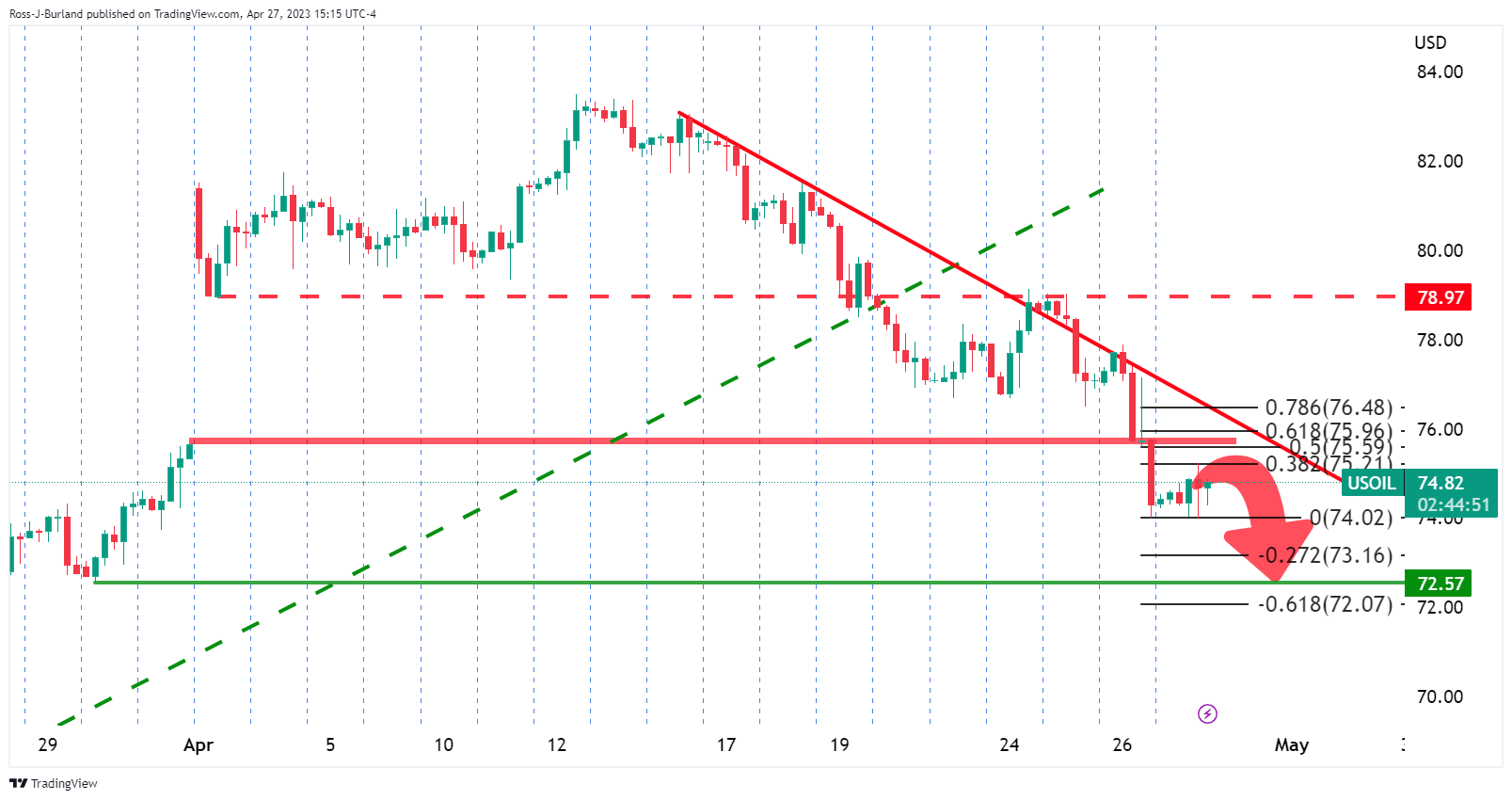
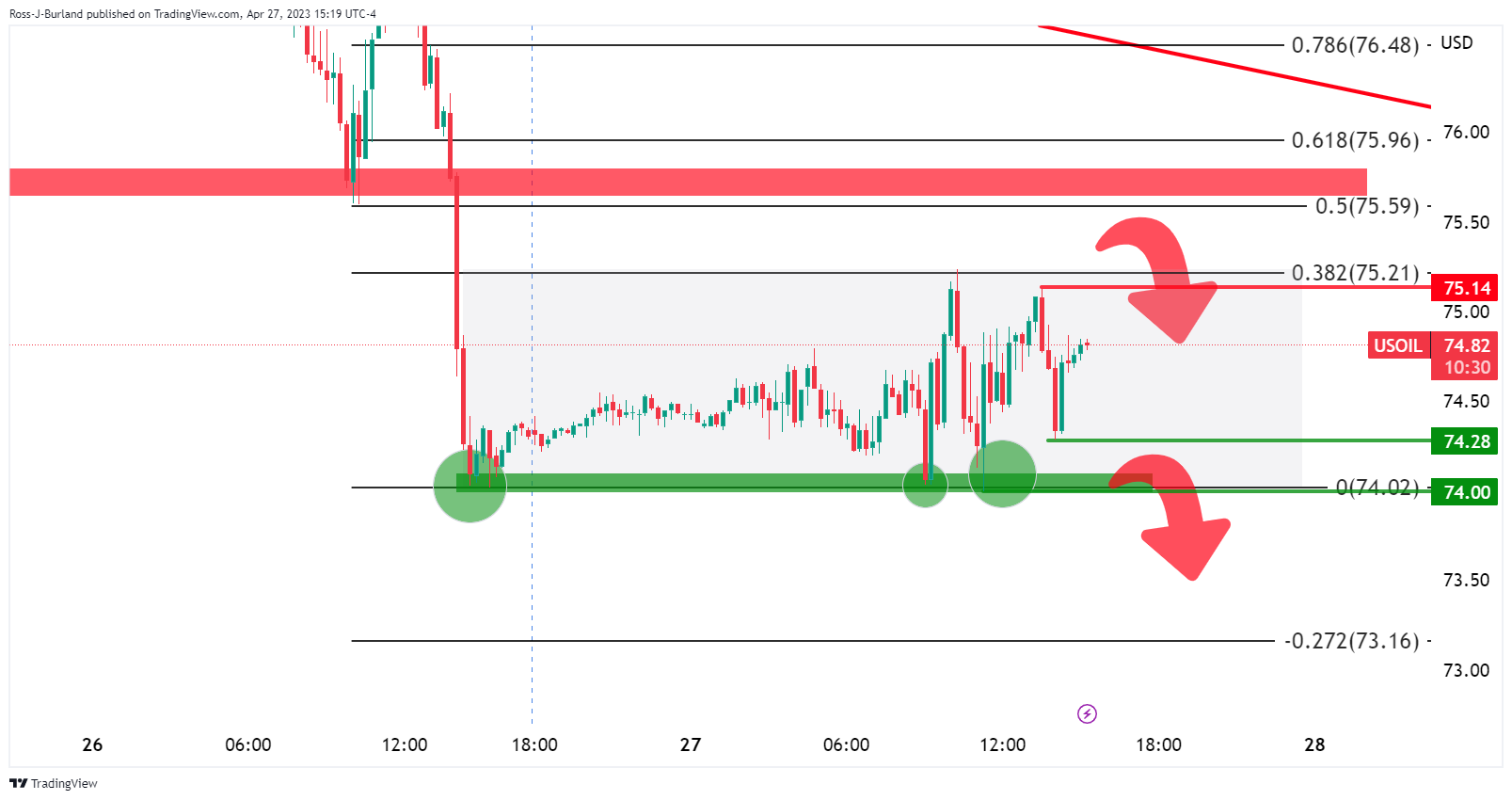
While below the gap resistance, the price is bearish on the front side of the trendline. A correction to the 38.2% Fibonacci has taken place already- on the 4-hour charts. However, there is plenty of support coming in which leaves the market in a sideways chop:
Author

Ross J Burland

Ross J Burland, born in England, UK, is a sportsman at heart. He played Rugby and Judo for his county, Kent and the South East of England Rugby team.


More from Ross J Burland
Share:

Editor's Picks

AUD/USD keeps the red near 0.6950 after weak Aussie jobs data

AUD/USD holds losses near 0.6950 on disappointing Australian jobs data, extending the previous day's retracement slide from the monthly high and hitting a fresh weekly low during Thursday’s Asian session. Meanwhile, declining US bond yields drag the US Dollar away from the April 2025 high, touched after Wednesday's hot US CPI, helping limit losses for the currency pair.

USD/JPY slides back below 158.00 as USD reverses post-CPI gains

USD/JPY extends the previous day's pullback from a three-week high, attracting follow-through selling and sliding below 158.00 during Thursday's Asian session. Traders remain on high alert amid speculation that authorities will step in to prop up the Japanese Yen. The US Dollar, meanwhile, reverses Wednesday's hot CPI-led gains to April 2025 highs as US bond yields retreat on China bond-buying talk, further pressuring the pair.

Gold shrugs off hot US PPI as risk aversion drives bond yields lower

Gold attracts fresh buying on Thursday as weakness across global equities, driven by mounting concerns over AI-related investments, triggers a sharp pullback in US Treasury yields and drags the US Dollar lower from fresh year-to-date highs.

Ripple clings to $1.30 support as downside risks intensify

Ripple is stuck in a bearish trend, trading near $1.30 on Thursday. The remittance token’s bearish shift reflects the broader cryptocurrency market, which remains under heavy selling amid concerns about accelerating inflation in the US.

Budget preview: Is Healey impressing the bond market?

There is less than 2 weeks to go before the Chancellor delivers his first budget. Unusually for the UK, the economic and financial backdrop to this budget is upbeat. UK bonds have been rallying, the FTSE 100 is the top performing major stock index this week, and the Pound is also stabilising versus the Dollar.

Has Bitcoin really escaped the macro forces it was built to fight?
Over 17 years ago, Satoshi Nakamoto designed Bitcoin (BTC) on the back of a global financial crisis as an alternative to the global monetary system outside the control of central banks, governments and traditional intermediaries. This raises a key question: has Bitcoin really become independent of the macroeconomic forces it was built to challenge?















