Eurozone flash Composite PMI remains steady at 51.5, misses estimates of 51.6
Eurozone's flash HCOB Composite PMI remains steady at 51.5 in January, missing estimates of 51.6 due to a slowdown in the service sector activity.
The Services PMI drops to 51.9 from 52.4 in December, while it was expected to rise to 52.8. The manufacturing business activity declines again, but at a moderate pace. The Manufacturing PMI rises to 49.4, more than the consensus of 49.0 and the prior reading of 48.8.
“The recovery still looks rather feeble. In manufacturing, the headline PMI continues to signal weakness, while growth in services activity is somewhat more moderate than the month before. Overall economic growth remains unchanged. Looking ahead, the low growth in new orders is certainly no game changer. Instead, the start into the new year points to more of the same in the months to come," Dr. Cyrus de la Rubia, Chief Economist at Hamburg Commercial Bank (HCOB), said,.
"Comparing countries, services activity in Germany expanded in January at a fairly robust pace, while in France service companies slipped into contractionary territory. This may be linked to the political difficulties in finalising the 2026 budget. In manufacturing, France shows a slightly better performance than Germany, but in both countries output growth is nothing to write home about. Overall, Germany’s economy started the new year on a growth path, while monthly output in France has declined," de la Rubia added.
FX Implications
EUR/USD strives to hold the intraday low of 1.1728 after the Eurozone/German PMI data release.
Euro Price Today
The table below shows the percentage change of Euro (EUR) against listed major currencies today. Euro was the weakest against the Japanese Yen.
| USD | EUR | GBP | JPY | CAD | AUD | NZD | CHF | |
|---|---|---|---|---|---|---|---|---|
| USD | 0.05% | -0.06% | -0.28% | -0.02% | -0.19% | 0.00% | 0.07% | |
| EUR | -0.05% | -0.11% | -0.37% | -0.08% | -0.23% | -0.05% | 0.02% | |
| GBP | 0.06% | 0.11% | -0.21% | 0.03% | -0.13% | 0.06% | 0.12% | |
| JPY | 0.28% | 0.37% | 0.21% | 0.28% | 0.11% | 0.29% | 0.37% | |
| CAD | 0.02% | 0.08% | -0.03% | -0.28% | -0.17% | 0.02% | 0.09% | |
| AUD | 0.19% | 0.23% | 0.13% | -0.11% | 0.17% | 0.19% | 0.26% | |
| NZD | -0.01% | 0.05% | -0.06% | -0.29% | -0.02% | -0.19% | 0.06% | |
| CHF | -0.07% | -0.02% | -0.12% | -0.37% | -0.09% | -0.26% | -0.06% |
The heat map shows percentage changes of major currencies against each other. The base currency is picked from the left column, while the quote currency is picked from the top row. For example, if you pick the Euro from the left column and move along the horizontal line to the US Dollar, the percentage change displayed in the box will represent EUR (base)/USD (quote).
(This section below was published at 08:33 GMT to cover the release of Germany's preliminary September HCOB PMIs data for January.)
According to flash estimates, the Composite PMI in the German economy expanded at a faster pace to 52.5 in January from 51.3 in December, also beating estimates of 51.8. The overall business activity rose strongly due to upbeat service sector activity.
The Services PMI has come in at 53.3, higher than estimates of 53.0 and the prior release of 52.7. The Manufacturing PMI has contracted again, but at a moderate pace to 48.7. Economists expected the data to come in higher at 48.0 from the previous reading of 47.0.
“The data show a good start to the new year, overall. Output in the manufacturing sector returned to - albeit meagre - growth, and so did new orders. Even more encouraging is the stronger pickup in activity in the services sector. Looking ahead, confidence has risen noticeably in the services sector and has held at a solid level in manufacturing," Dr. Cyrus de la Rubia, Chief Economist at Hamburg Commercial Bank (HCOB), said.
FX Implications
There seems to be a positive impact of upbeat German PMI data on the Euro (EUR). EUR/USD rebounds to near 1.1740 from its intraday low of 1.1728.
(This section below was published at 06:32 GMT as a preview of the Germany/Eurozone preliminary September HCOB PMIs data for January.)
German/ Eurozone flash PMIs Overview
The preliminary German and Eurozone HCOB Purchasing Managers’ Index (PMI) data for January is due for release today at 08:30 and 09:00 GMT, respectively.
Amongst the Euro area economies, the German and the composite Eurozone PMI reports hold more relevance, in terms of their impact on the European currency and the related markets as well.
The flash Composite PMI for Germany is expected to come in higher due to an improvement in both manufacturing and the service sector activity. In December, the Composite PMI came in at 51.3.
Preliminary Services PMI is seen at 53, higher than 52.7 in December. The Manufacturing PMI is expected to have contracted again, but at a slower pace, to 48.0 from the prior reading of 47.0. A figure below the 50.0 threshold is considered a contraction in the business activity.
The forecast for the Eurozone flash Composite PMI also shows that overall private sector output increased at a faster pace in January, driven by improvements in both manufacturing and the services sector. The Services PMI is seen at 52.8, up from 52.4 in December. Like the German Manufacturing PMI, the manufacturing activity in the old continent has contracted too, but at a moderate pace to 49 from the previous release of 48.8.
How could German/ Eurozone flash PMIs affect EUR/USD?
Signs of strength in overall business sector activity from the German/ Eurozone flash PMI prints would be favorable for the Euro (EUR), while weak numbers would act as a drag on the shared currency.
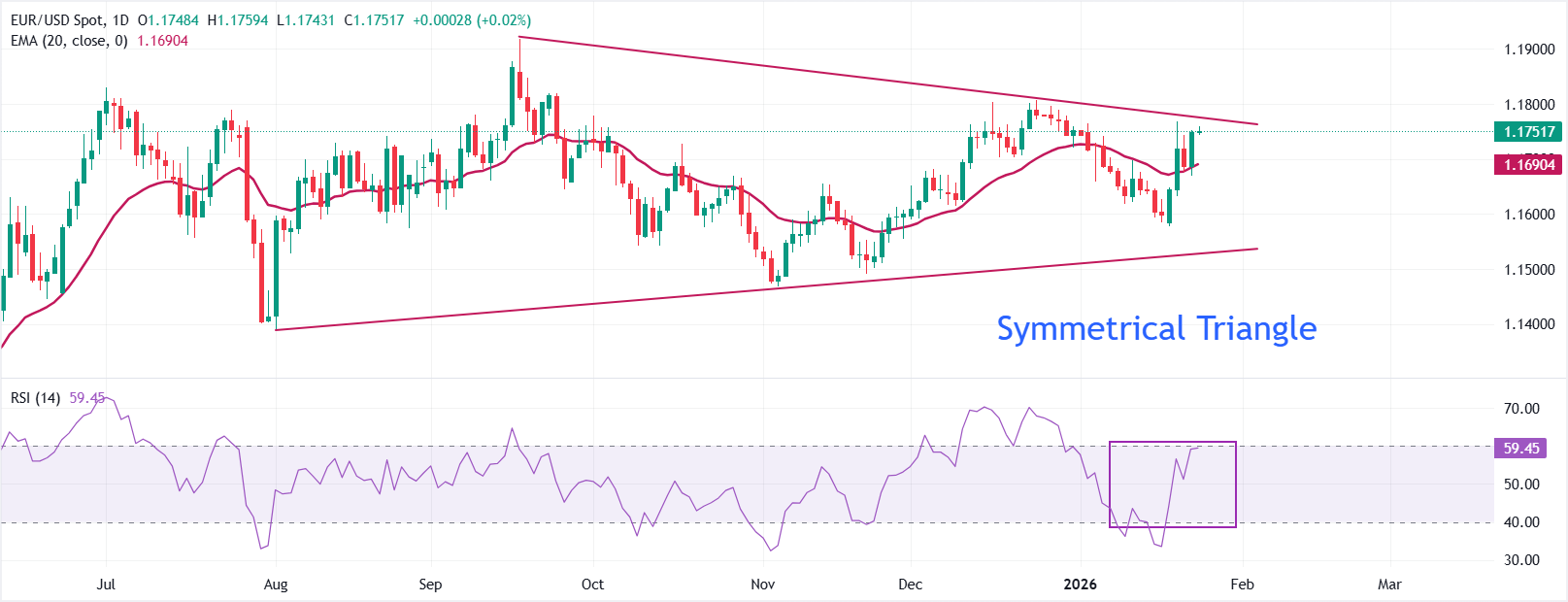
EUR/USD trades close to the three-week high of 1.1769 as of writing. The major currency pair trades within a Symmetrical Triangle on the daily chart, indicating broader volatility contraction. The price is close to the upper boundary of the volatility contraction pattern around 1.1770, which is plotted from the multi-year high of 1.1919 posted on September 17.
The 20-day Exponential Moving Average (EMA) at 1.1690 turns higher, and price holds above it, keeping the short-term recovery in place. A close above the 20-day EMA would preserve the bullish bias. The 14-day Relative Strength Index (RSI) at 59.44 signals firm momentum.
Looking up, the pair could advance towards 1.1800 and 1.1900 following a decisive breakout of the January 20 high at 1.1769. On the upside, the 20-day EMA will act as key support for the pair.
(The technical analysis of this story was written with the help of an AI tool.)
Economic Indicator
HCOB Composite PMI
The Composite Purchasing Managers Index (PMI), released on a monthly basis by S&P Global and Hamburg Commercial Bank (HCOB), is a leading indicator gauging private-business activity in Germany for both the manufacturing and services sectors. The data is derived from surveys to senior executives. Each response is weighted according to the size of the company and its contribution to total manufacturing or services output accounted for by the sub-sector to which that company belongs. Survey responses reflect the change, if any, in the current month compared to the previous month and can anticipate changing trends in official data series such as Gross Domestic Product (GDP), industrial production, employment and inflation. The index varies between 0 and 100, with levels of 50.0 signaling no change over the previous month. A reading above 50 indicates that the German private economy is generally expanding, a bullish sign for the Euro (EUR). Meanwhile, a reading below 50 signals that activity is generally declining, which is seen as bearish for EUR.
Read more.Last release: Fri Jan 23, 2026 08:30 (Prel)
Frequency: Monthly
Actual: 52.5
Consensus: 51.8
Previous: 51.3
Source: S&P Global
Author

Sagar Dua
FXStreet
Sagar Dua is associated with the financial markets from his college days. Along with pursuing post-graduation in Commerce in 2014, he started his markets training with chart analysis.














