XRP losses as bearish trends persist, inflows slow and OI stabilizes
- XRP recovers from an intraday low of $1.33, but bearish pressure persists in the long term.
- XRP investment products recorded $3.5 million in capital inflows last week, while both Bitcoin and Ethereum's registered outflows.
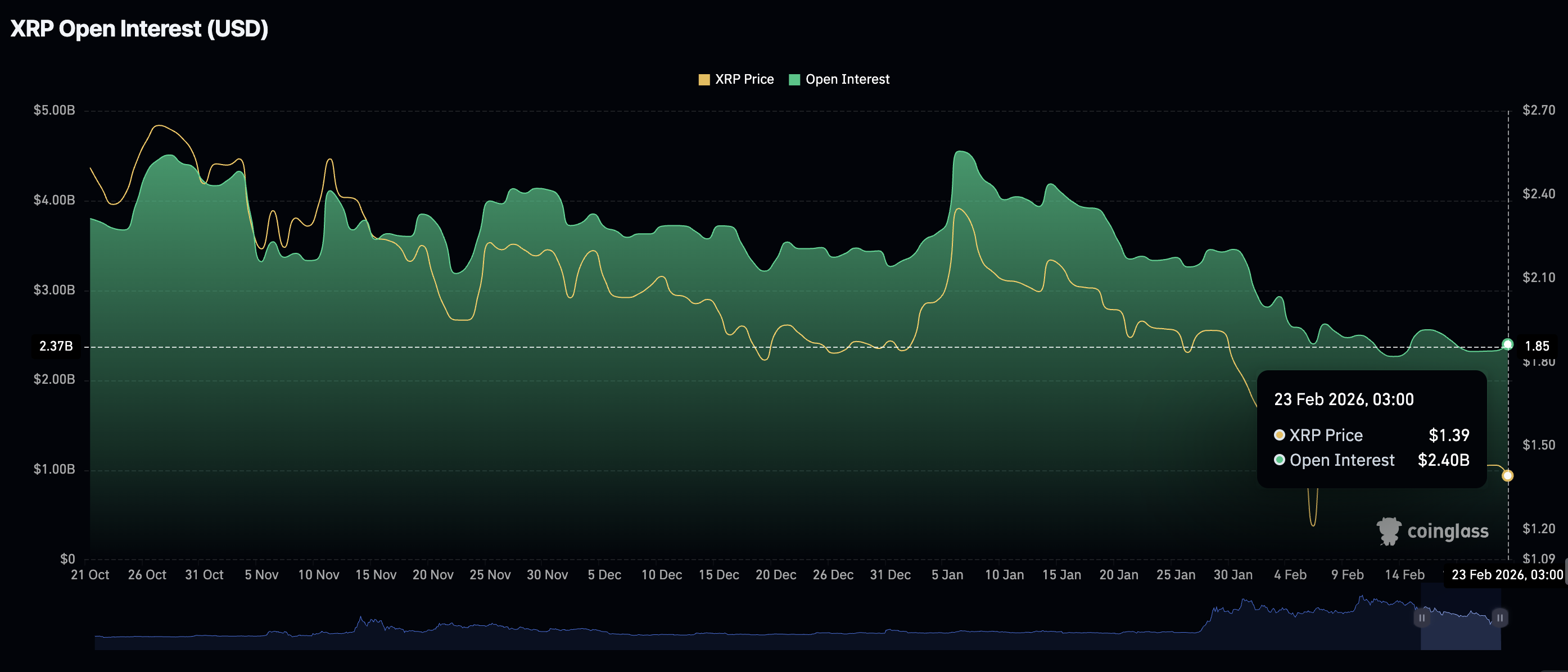
- The XRP futures Open Interest holds at $2.4 billion as retail interest recovers slightly from last week’s lows.

Ripple (XRP) is rising above $1.40 at the time of writing on Monday amid fresh tariff-triggered headwinds in the broader cryptocurrency market. The sell-off to $1.33, the token’s intraday low, can be attributed to macroeconomic uncertainty, geopolitical tensions and risk-averse sentiment among other factors.
XRP inflows slow as Bitcoin, Ethereum see capital exit
Inflows into XRP-related investment products declined to $3.5 million last week, according to the CoinShares report. In hindsight, this marks a 90% drop from the previous week’s $33 million in inflows. The total assets under management average $2.6 billion, with YTD inflows at $151 million.
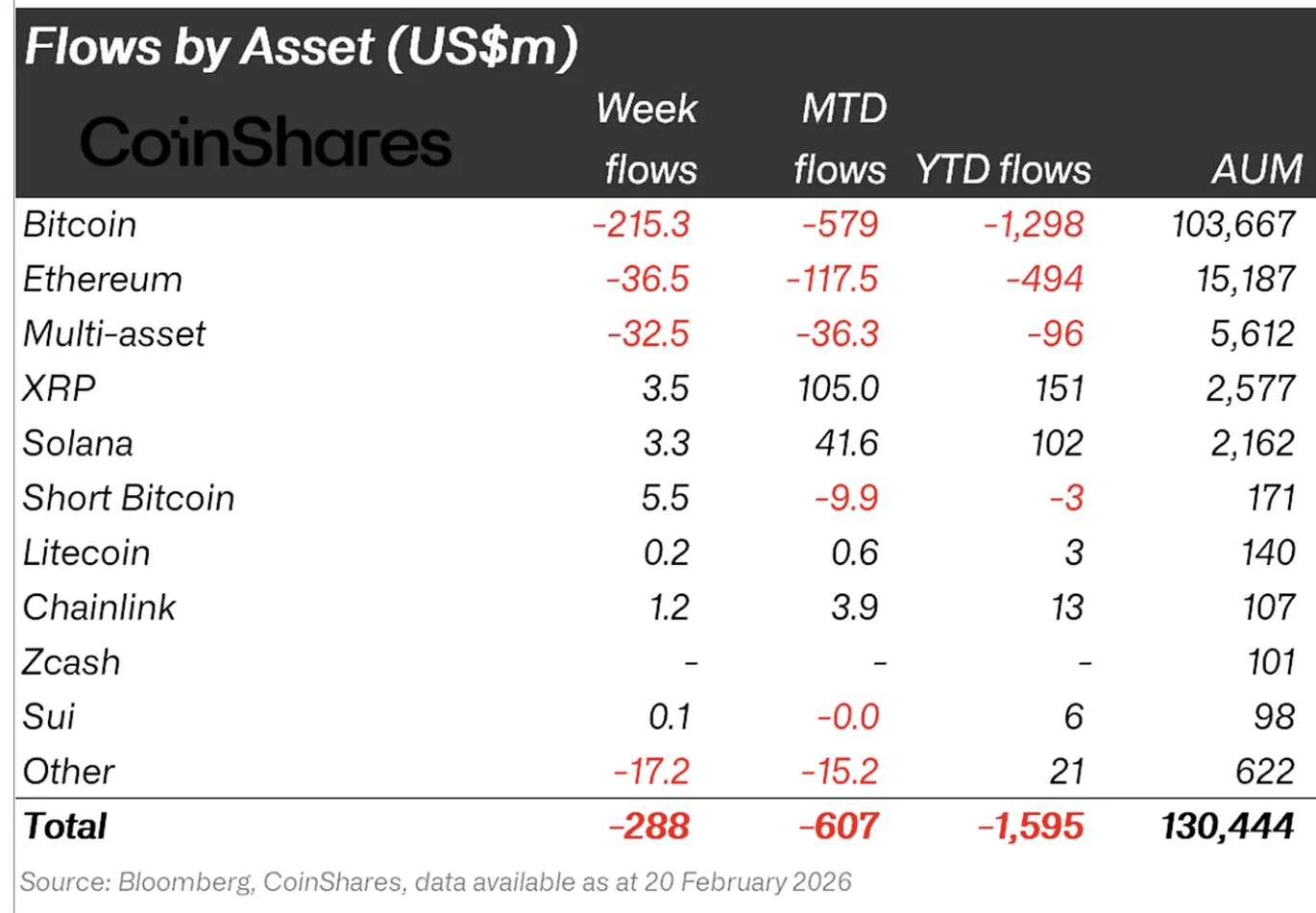
Meanwhile, demand for Bitcoin-linked financial products remained on the back foot, with cumulative outflows reaching $215 million last week. Despite the sell-off that has dragged the Crypto King below $65,000, the total assets under management stand at $104 billion. However, YTD outflows average $1.3 billion, according to CoinShares.
“Bitcoin remains the key proponent of this negative sentiment, seeing US$215m in outflows, while short-bitcoin investment products saw renewed interest with US$5.5m inflows, the largest of any asset,” CoinShares reports.
Ethereum, like Bitcoin, experienced an extended capital exit last week, with outflows totalling $36.5 million. The leading asset YTD outflows stand at $494 million, while cumulative assets under management exceed $15 million.
As for retail interest, XRP derivatives are showing stability, as futures Open Interest (OI) rises slightly to $2.4 billion on Monday from $2.33 billion the previous day. CoinGlass data affirms OI’s stability, which has remained above $2.32 billion since its drop to $2.56 billion on February 16.
A steady increase in OI suggests that investors are leaning into risk as confidence in the token improves, increasing the odds of a potential recovery in the coming sessions.
Technical outlook: Assessing XRP’s recovery potential
XRP hovers around $1.40, supported by the Moving Average Convergence Divergence (MACD) indicator, which holds above its signal line on the daily chart. However, as green histogram bars contract, the remittance token’s upside may limit further price increases.
At the same time, the Relative Strength Index (RSI) at 39 remains well below neutral on the daily chart, aligning with the overall weak technical structure.
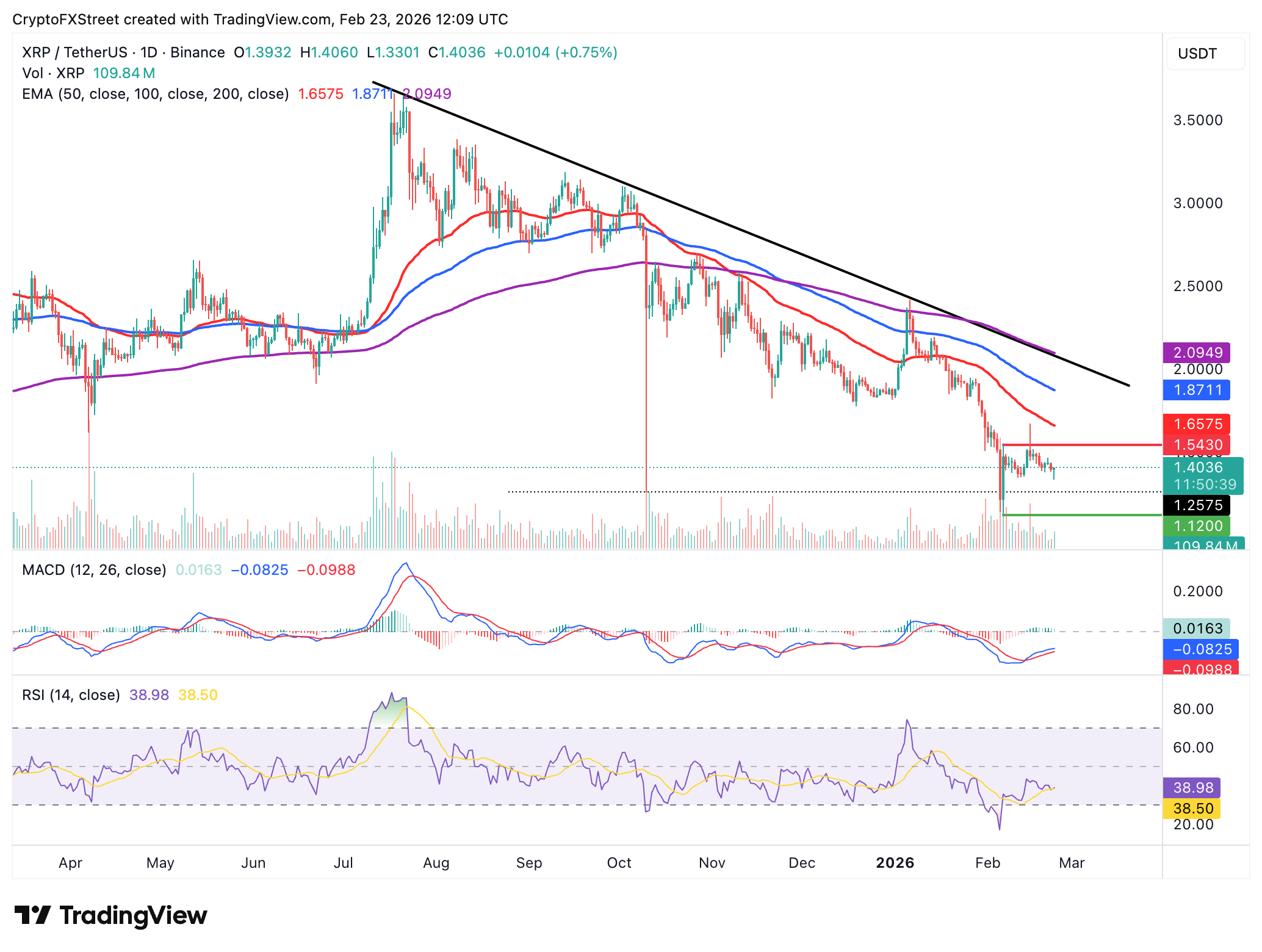
The 50-day Exponential Moving Average (EMA) at $1.66, the 100-day EMA at $1.87 and the 200-day EMA at $2.09 are sloping lower, indicating that XRP could face an extended downside movement, aiming for the intraday low at $1.33, the October 10 support at $1.25.
If sentiment improves and investors increase exposure, a modest increase would bring XRP to the supply zone at $1.54, aligning with the February 6 low at $1.12.
Cryptocurrency prices FAQs
Token launches influence demand and adoption among market participants. Listings on crypto exchanges deepen the liquidity for an asset and add new participants to an asset’s network. This is typically bullish for a digital asset.
A hack is an event in which an attacker captures a large volume of the asset from a DeFi bridge or hot wallet of an exchange or any other crypto platform via exploits, bugs or other methods. The exploiter then transfers these tokens out of the exchange platforms to ultimately sell or swap the assets for other cryptocurrencies or stablecoins. Such events often involve an en masse panic triggering a sell-off in the affected assets.
Macroeconomic events like the US Federal Reserve’s decision on interest rates influence crypto assets mainly through the direct impact they have on the US Dollar. An increase in interest rate typically negatively influences Bitcoin and altcoin prices, and vice versa. If the US Dollar index declines, risk assets and associated leverage for trading gets cheaper, in turn driving crypto prices higher.
Halvings are typically considered bullish events as they slash the block reward in half for miners, constricting the supply of the asset. At consistent demand if the supply reduces, the asset’s price climbs.
Author

John Isige
FXStreet
John Isige is a seasoned cryptocurrency journalist and markets analyst committed to delivering high-quality, actionable insights tailored to traders, investors, and crypto enthusiasts. He enjoys deep dives into emerging Web3 tren