GBP/USD treads water near 1.3500 as BoE-Fed divergence debate stalls
- The Pound Sterling consolidates in no-man's land as markets digest the SCOTUS tariff ruling and await fresh catalysts.
- The Bank of England (BoE) held rates at 3.75% earlier this month in a narrow 5-4 vote, with four members favouring a cut, keeping the March 19 decision live as the next potential inflection point for Pound Sterling.
- Trump's newly-threatened 15% global tariff under Section 122 of the Trade Act replaces the IEEPA tariffs struck down by the Supreme Court last Friday, while multiple Federal Reserve speakers on Tuesday could reshape the US rate outlook.

GBP/USD spent Monday spinning in place as market participants await a fresh catalyst to break the pair out of its recent range. The BoE's February hold came with a surprisingly dovish 5-4 split, and UK Consumer Price Index (CPI) data last week showed inflation easing to 3.0%, reinforcing the case for earlier rate cuts, with most economists now looking to April or March for the next move. On the US side, the Fed is holding rates at 3.50% to 3.75%, and the January CPI print at 2.4% supports a patient approach, though the Supreme Court's decision to strike down IEEPA tariffs last Friday and Trump's swift pivot to a 15% global tariff under Section 122 have injected fresh uncertainty into the inflation and growth outlook. The new tariff regime also clouds the status of the UK's existing trade deal with the US, adding a layer of political risk for the Pound Sterling. A heavy lineup of Fed speakers on Tuesday, including Governors Waller and Cook, will be closely watched for any shift in tone.
Flat session near 1.3500 as Stochastic enters the oversold zone
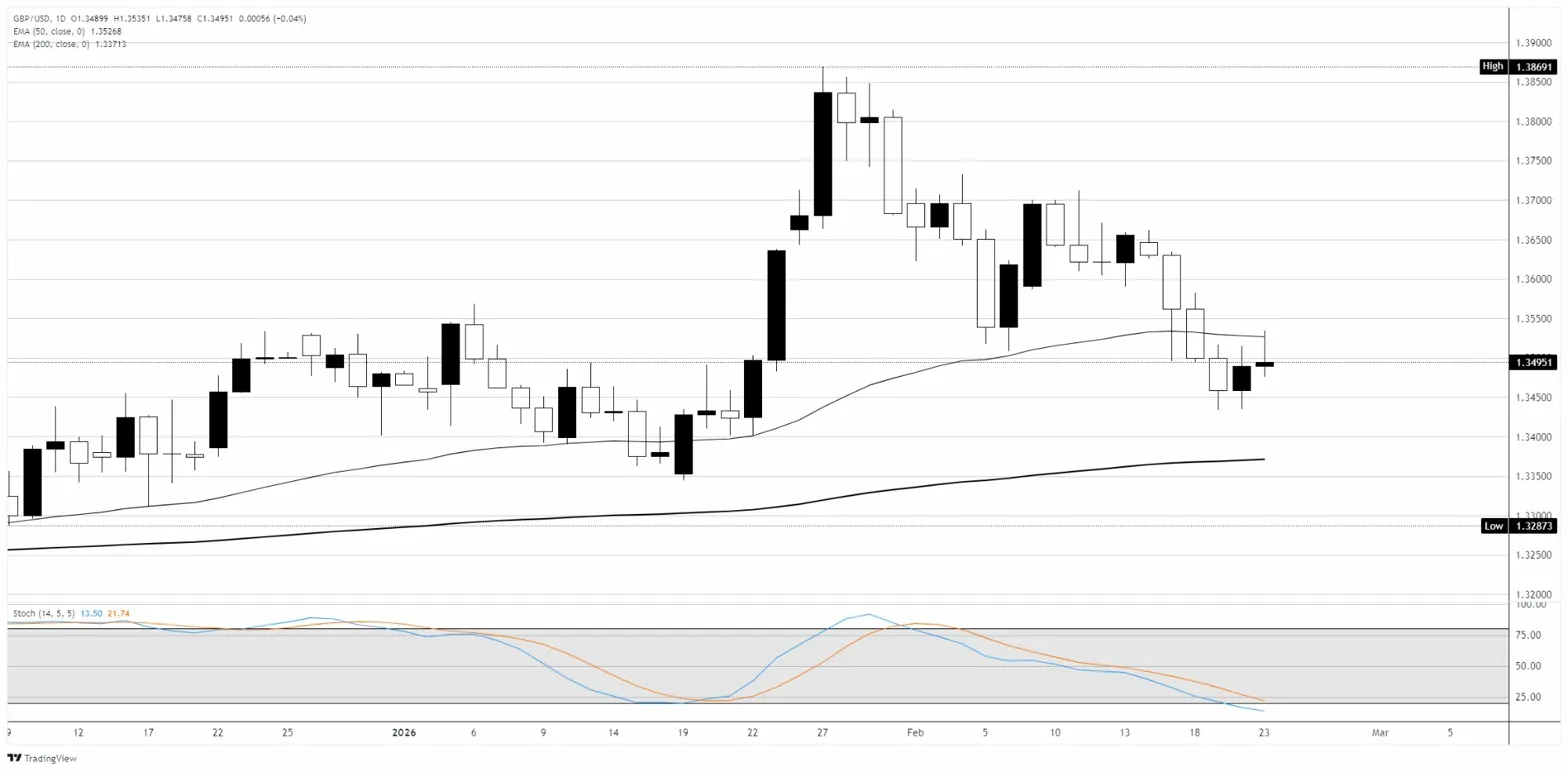
On the daily chart, GBP/USD closed broadly flat on Monday, edging up just 0.04% and settling near 1.3495 in a directionless session. The pair is trading just below the 50-day Exponential Moving Average (EMA) at 1.3523, having slipped beneath it during the pullback from the January high at 1.3869, while the 200-day EMA at 1.3371 remains below it. The broader structure shows a correction from the 1.3869 swing high, with the pair giving back roughly half of the rally from the December low near 1.3287. The Stochastic Oscillator has crossed bearish and is pressing into the oversold zone, suggesting the selling pressure from the February pullback may be nearing exhaustion. Recent candles show small bodies and overlapping ranges near 1.3500, consistent with a market searching for direction. Immediate support sits at the 1.3475 session low and then 1.3371 at the 200-day EMA, while resistance is at 1.3527 (50-day EMA) and then 1.3600; a reclaim of the 50-day EMA would be the first sign of stabilisation, while a break below 1.3371 would shift the structure bearish.
GBP/USD daily chart
Pound Sterling FAQs
The Pound Sterling (GBP) is the oldest currency in the world (886 AD) and the official currency of the United Kingdom. It is the fourth most traded unit for foreign exchange (FX) in the world, accounting for 12% of all transactions, averaging $630 billion a day, according to 2022 data. Its key trading pairs are GBP/USD, also known as ‘Cable’, which accounts for 11% of FX, GBP/JPY, or the ‘Dragon’ as it is known by traders (3%), and EUR/GBP (2%). The Pound Sterling is issued by the Bank of England (BoE).
The single most important factor influencing the value of the Pound Sterling is monetary policy decided by the Bank of England. The BoE bases its decisions on whether it has achieved its primary goal of “price stability” – a steady inflation rate of around 2%. Its primary tool for achieving this is the adjustment of interest rates. When inflation is too high, the BoE will try to rein it in by raising interest rates, making it more expensive for people and businesses to access credit. This is generally positive for GBP, as higher interest rates make the UK a more attractive place for global investors to park their money. When inflation falls too low it is a sign economic growth is slowing. In this scenario, the BoE will consider lowering interest rates to cheapen credit so businesses will borrow more to invest in growth-generating projects.
Data releases gauge the health of the economy and can impact the value of the Pound Sterling. Indicators such as GDP, Manufacturing and Services PMIs, and employment can all influence the direction of the GBP. A strong economy is good for Sterling. Not only does it attract more foreign investment but it may encourage the BoE to put up interest rates, which will directly strengthen GBP. Otherwise, if economic data is weak, the Pound Sterling is likely to fall.
Another significant data release for the Pound Sterling is the Trade Balance. This indicator measures the difference between what a country earns from its exports and what it spends on imports over a given period. If a country produces highly sought-after exports, its currency will benefit purely from the extra demand created from foreign buyers seeking to purchase these goods. Therefore, a positive net Trade Balance strengthens a currency and vice versa for a negative balance.
Author

Joshua Gibson
FXStreet
Joshua joins the FXStreet team as an Economics and Finance double major from Vancouver Island University with twelve years' experience as an independent trader focusing on technical analysis.