USD/RUB extends losses as effect from surprise interest-rate hike persists
- USD/RUB continues to trade lower after Tuesday's CBR rate hike.
- USD/RUB fall could inculcate a sense of caution in the market.
- Technical indicators reinforce the bearish bias.

The USD/RUB pair falls to around 93.10 during the early hours of the European session on Friday, retracting the gains registered on Thursday. The pair is facing downward pressure, which could be attributed to the emergency rate hikes implemented by the Central Bank of the Russian Federation (CBR) on Tuesday.
The USD/RUB pair experiences losses despite improved US economic data, which could inculcate a sense of caution in the market. The optimism of Russian policymakers stands in contrast to the mixed stance among the members of the US Federal Reserve (Fed). However, firmer US Treasury yields and mostly upbeat US data could be enough to support the USD/RUB pair. Additionally, uncertainties in the market regarding the CBR’s ability to protect the Russian Ruble (RUB) against the US Dollar’s (USD) strength could leave traders indecisive.
The US Dollar Index (DXY) trades around 103.50, recovering the losses incurred on Thursday and underpinning the USD/RUB pair. This recovery is driven by upbeat US economic data, prompting a cautious market sentiment as inestors look for additional cues regarding the inflation outlook.
Russian Ruble Technical Analysis
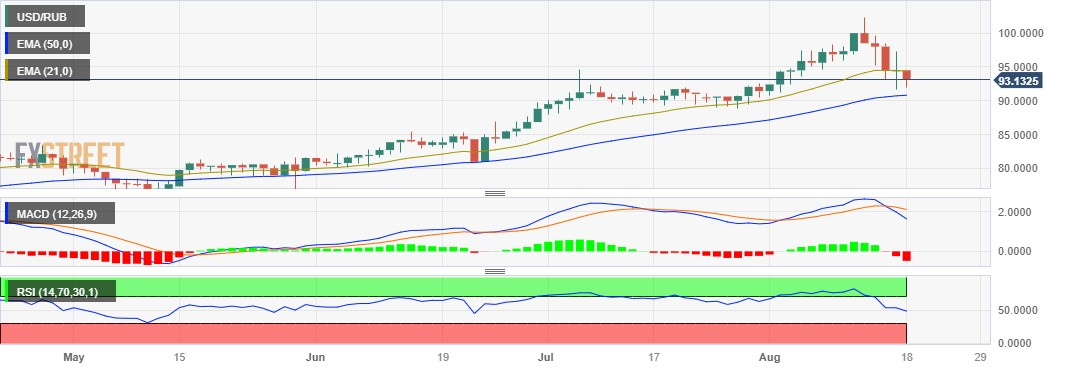
USD/RUB continues the downward trend that started on Monday. The pair could find immediate support around a two-week low at 91.5250. A firm break below this level could push the USD/RUB pair to navigate the region around the 50-day Exponential Moving Average (EMA) at 90.82.
The Moving Average Convergence Divergence (MACD) line stays in the negative territory of the centerline and shows divergence below the signal line, which indicates the bearish sentiment in the USD/RUB pair. The 14-day Relative Strength Index (RSI) continues to remain below 50, reinforcing the confirmation of the bearish bias.
On the upside, the 21-day EMA at 94.36 emerges as the key resistance, followed by the 94.50 psychological level.
USD/RUB: Daily Chart
Author

FXStreet Team
FXStreet
Composed of a group of economic journalists and FX experts, the FXStreet content team produces and oversees all content published on FXStreet. It provides a purely journalistic approach to the Forex market.