|

USD/MXN retreats as mixed US inflation data muddles Fed rate hike path

  • USD/MXN trades at 17.1200, down 0.53%, after US CPI for August comes slightly above the 3.6% forecast.
  • CME FedWatch Tool indicates a 41% chance of a 25 bps rate hike in November, keeping traders cautious.
  • Upcoming US labor and retail data and Banxico’s 11.25% TIIE could push USD/MXN to test the 17.0000 level.

The Mexican Peso (MXN) shrinks its losses and stages a comeback against the US Dollar (USD), after data from the United States (US) further cemented the case for the US Federal Reserve to hike rates at the September meeting. The USD/MXN is trading at 17.1200, down 0.53, after reaching a daily high of 17.2919.

Mexican Peso rebounds vs. the Greenback amid uncertainty over US monetary policy

US inflation exceeded estimates, as August’s Consumer Price Index (CPI) came at 3.7% YoY, while forecasts saw inflation at 3.6% above July data. Contrarily, core inflation dropped from 4.7% YoY in July to 4.3%, as projected by analysts, painting a mixed picture of inflation. Nevertheless, the data failed to price in additional tightening by the US Federal Reserve (Fed), as shown by money market futures data.

The CME FedWatch Tool still sees the Fed would keep rates at around the 5.25%-5.50% range for the upcoming September meeting, but for November, odds for a 25 bps rate hike are at 41%.

Nevertheless, USD bears are not out of the woods yet, as labor market data still shows signs of a hot jobs market. Unemployment claims for the last week are expected to rise to 225K, above the previous 216K reading. That, alongside August’s Retail Sales report, which is foreseen to come weaker than July’s numbers, could cement the case for an end of the Fed’s tightening cycle.

Additional inflation data will be revealed on Thursday, with the Producer Price Index (PPI) foreseen to continue decelerating.

If the data shows signs of an economic slowdown for the US, expect the USD/MXN to test the 17.0000 figure, as the interest rate difference between Mexico and the US favors the former, with Banxico’s TIIE at 11.25%, compared to the effective Federal Funds Rate (FFR) at 5.33%.

USD/MXN Price Analysis: Technical outlook

Even though the USD/MXN has retraced somewhat, the pair remains neutral to upward bias unless Mexican Peso buyers reclaim the August 28 daily low of 16.6924. However, it could challenge the psychological 17.00 figure, but traders must crack solid support standing in its way. Before testing the former, the 20-day Moving Average (DMA) is at 17.0902, followed by the 50-DMA at 17.0108. Conversely, a bullish continuation would resume once buyers reclaim the 100-DMA at 17.2452.
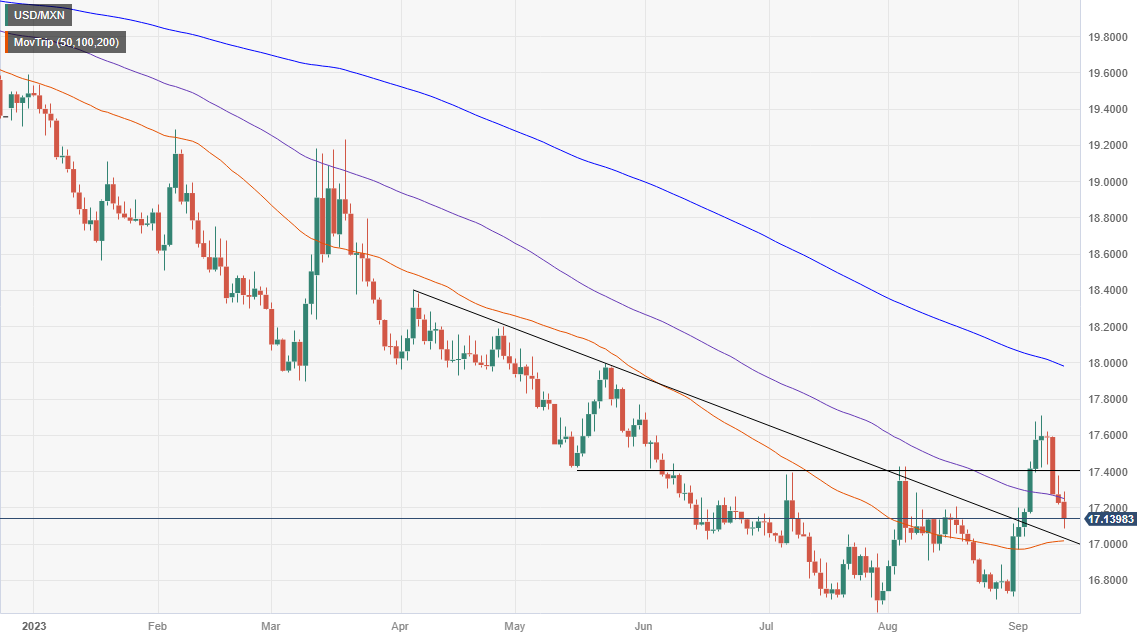
USD/MXN

USD/MXN

Overview
Today last price17.1384
Today Daily Change-0.0890
Today Daily Change %-0.52
Today daily open17.2274
 
Trends
Daily SMA2017.0964
Daily SMA5017.0159
Daily SMA10017.2617
Daily SMA20017.9948
 
Levels
Previous Daily High17.3811
Previous Daily Low17.2167
Previous Weekly High17.7094
Previous Weekly Low17.0447
Previous Monthly High17.4274
Previous Monthly Low16.6945
Daily Fibonacci 38.2%17.2795
Daily Fibonacci 61.8%17.3183
Daily Pivot Point S117.1691
Daily Pivot Point S217.1107
Daily Pivot Point S317.0047
Daily Pivot Point R117.3335
Daily Pivot Point R217.4395
Daily Pivot Point R317.4979
 

Author

Christian Borjon Valencia

Markets analyst, news editor, and trading instructor with over 14 years of experience across FX, commodities, US equity indices, and global macro markets.


More from Christian Borjon Valencia
Share:

Editor's Picks

AUD/USD remains depressed near 0.6950 after RBA minutes

AUD/USD attracts follow-through selling during Tuesday’s Asian session, looking to extend the overnight rejection slide from 0.7000, or a two-week top, following the release of RBA meeting Minutes. The US Dollar retains a bullish undertone near its highest level since April 2025 as energy-driven inflation risks keep December Fed rate hike bets firmly on the table. Adding to this, geopolitical risks further underpin the safe-haven USD.

USD/JPY eases from two-week top, hovers near 158.50 amid looming intervention risk

USD/JPY edges lower during the Asian session on Tuesday, snapping a two-day winning streak and pulling back from an over two-week top touched the previous day, despite Japan's soft PPI print. Bulls turn cautious amid speculation that authorities will step in to prop up the Japanese Yen, which, in turn, weighs on the currency pair. The downside, however, seems limited as the US Dollar stands firm near its highest level since April 2025, bolstered by the hawkish Fed and geopolitical uncertainties.

Gold struggles above $4.150 as bullish USD and elevated bond yields weigh

Gold remains depressed during the Asian session on Tuesday as elevated US Treasury yields and a hawkish Fed keep the US Dollar near its highest level since April 2025. Adding to this, persistent geopolitical uncertainties stemming from Middle East conflicts continue to underpin the safe-haven buck, which, in turn, is seen as weighing on the bullion. Traders now look to US inflation figures for some impetus ahead of Fed Chair Kevin Warsh's appearance on Friday.

Bitcoin shows bottoming signs despite recent macro pressures

Bitcoin remained range-bound above $82,000 on Monday as upcoming US economic data and onchain indicators weigh on market sentiment. Crypto trading firm QCP Group stated in its Monday report that Bitcoin has maintained a firmer footing a year after the market’s largest single-day liquidation event.

Earnings preview US and Europe: Can the stock market rally continue?
Stocks have been remarkably resilient this year. They have navigated geopolitical turmoil, an energy price spike and surging global bond yields which is rapidly pushing up the cost of borrowing. US blue chip stocks are now in their 4th year of a bull market, however, they now face their toughest test of Q4 so far, the latest earnings updates.
Has Bitcoin really escaped the macro forces it was built to fight?
Over 17 years ago, Satoshi Nakamoto designed Bitcoin (BTC) on the back of a global financial crisis as an alternative to the global monetary system outside the control of central banks, governments and traditional intermediaries. This raises a key question: has Bitcoin really become independent of the macroeconomic forces it was built to challenge?















