USD/MXN drops to new YTD lows past 16.8000 amid slowing US inflation, eyes 16.3000
- USD/MXN extends its losses, falling past the 16.80 mark, as the Mexican Peso benefits from easing US inflation.
- US Bureau of Labor Statistics shows import and export prices trending down, reinforcing previous reports of easing consumer and producer prices.
- Despite this, the US Federal Reserve is expected to lift rates 25 bps at July’s meeting.

USD/MXN extended its losses past the 16.80 mark, with the Mexican Peso (MXN) eyeing additional gains as inflation in the United States (US) subsides, as revealed during the week. The USD/MXN is exchanging hands at 16.8000, down 0.23%, and set to finish the week with losses of almost 1.90%.
US Inflation downtrend favors Mexican Peso; pair loses 1.90% over the week
The last week witnessed inflation figures easing in the US. The US Bureau of Labor Statistics (BLS) revealed that Import and Export prices continued their downtrend, falling below May’s and estimate numbers, aligning recent consumer prices and producer prices reports previously showcased on Wednesday and Thursday, respectively. Although the data could be used by the US Federal Reserve (Fed) to pause its tightening cycle, officials remain focused on bringing inflation towards its 2% goal.
Traders expect the US central bank to hike rates 25 bps at the upcoming July Federal Open Market Committee (FOMC) on 25-26, with odds at 96.1%. However, contrary to Fed policymakers saying that an additional increase is needed past the July meeting, the swaps market shows US rates peaking at 5.25%-5.50%.
The University of Michigan (UoM) revealed an improvement in US Consumer Sentiment, which was expected to print 65.5 but came at 72.6m at a two-year high. Further data showed that inflation expectations for one year were upward revised to 3.4% from 3.3% in June, while for five years, it edged high to 3.1%, up from 3%.
Joanne Jsu, the UoM Surveys of Consumers Director, said, “The sharp rise in sentiment was largely attributable to the continued slowdown in inflation along with stability in labor markets.”
US Treasury bond yields are recovering some ground, as the 10-year Treasury note rate sits at 3.816%, gaining four and a half basis points, while the US Dollar Index, a measure of the dollar’s performance against a basket of peers, stopped its drop at 99.887, gaining 0.10%.
Across the border, a light economic calendar in Mexico left USD/MXN traders leaning into the interest rate differential between both countries and recent US inflation data, which could warrant the Fed could finish its tightening cycle.
USD/MXN Price Analysis: Technical outlook
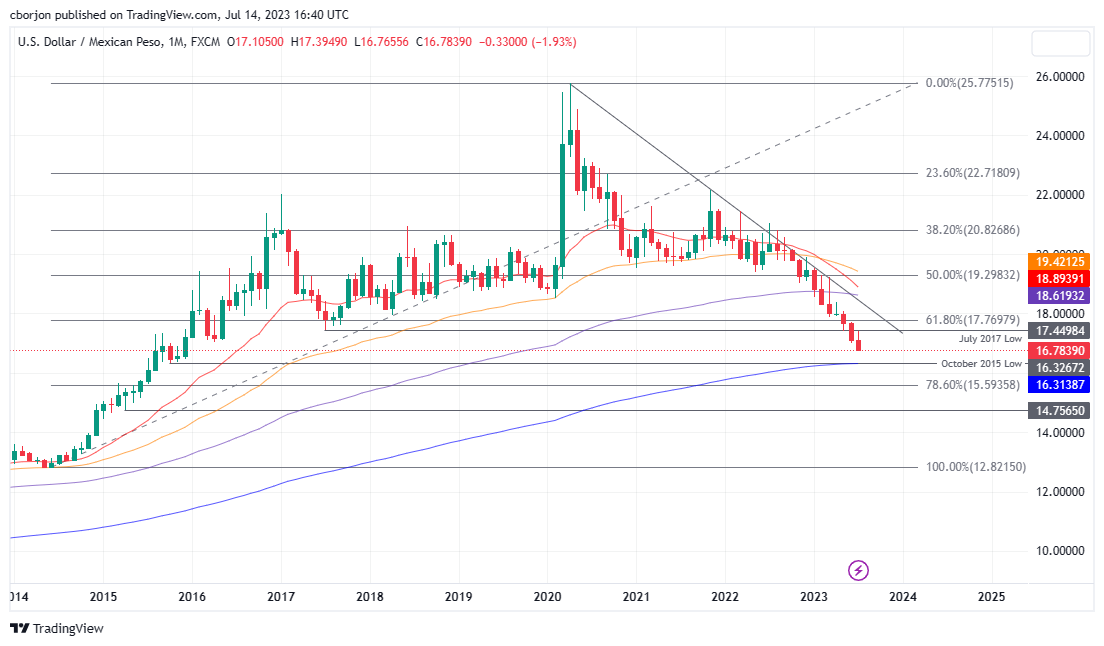
The USD/MXN monthly chart depicts that the pair might continue to trend lower as the next support emerges at the October 2015 swing low of 16.3267 and the 200-month Exponential Moving Average (EMA) at 16.3138. But firstly, a psychological 16.50 barrier must be taken out by sellers, which should be said, they had no issues taking psychological support levels out of the way, to the downside. Conversely, USD/MXN buyers must claim the July 2017 swing low of 17.4498, so they can have a chance, to lift exchange rates, to the 61.8% Fibonacci retracement at 17.7697, before rallyings toward the 18.0000 figure.
Author

Christian Borjon Valencia
FXStreet
Markets analyst, news editor, and trading instructor with over 14 years of experience across FX, commodities, US equity indices, and global macro markets.