|

USD/JPY hits nearly 34-year peak amid surging US inflation and Treasury yields

  • USD/JPY ascends following a US inflation report indicating reacceleration, challenging levels that might prompt intervention.
  • Rising inflation figures push Treasury yields higher and boost the US Dollar.
  • Market anticipates future Fed actions with keen interest in upcoming monetary policy minutes.

The USD/JPY rallied to an almost 34-year high after a hotter-than-expected inflation report in the United States (US) sent US Treasury yields soaring. Consequently, the major climbed past the 152.00 figure, seen as a level that could trigger intervention, which so-far hasn’t happened. At the time of writing, the pair trades at 152.70, gains 0.90%.

The pair advances to 152.70, as US CPI data prompts a sharp yield increase, fueling speculation about Fed's rate path–

US economic data revealed by the Bureau of Labor Statistics (BLS) showed that inflation is reaccelerating. The Consumer Price Index (CPI) rose by 0.4% MoM and 3.5% on the yearly figure, exceeding estimates, with the latter also the previous reading. Underlying CPI, which excludes volatile items like food and energy, was above projections but remained unchanged compared to February’s data at 0.4% MoM and 3.8% YoY.

That triggered a reaction in the financial markets, as US Treasury bond yields skyrocketed, with the short end of the curve, namely the 2-year T-note, climbing 20 basis points. Consequently, the Greenback refreshed the year-to-date (YTD) highs of 105.10 yet retreated somewhat, as shown by the US Dollar Index (DXY). The DXY is up 0.81%, at 104.95.

Following the inflation report, the Chicago Board of Trade (CBOT) Fed funds futures estimate just two rate cuts by December 2024, with speculators projecting interest rates to end at around 4.97%.

The USD/JPY rose sharply and hit a multi-year high of 152.73, a level last seen in June 1990, ignoring intervention threats by Japanese authorities that include Finance Minister Shunichi Suzuki, who said that he was watching the market with a high sense of urgency and wouldn’t rule out any steps to address excessive moves.

Ahead in the calendar, market players are eyeing the latest Federal Reserve monetary policy minutes' release.

USD/JPY Price Analysis: Technical outlook

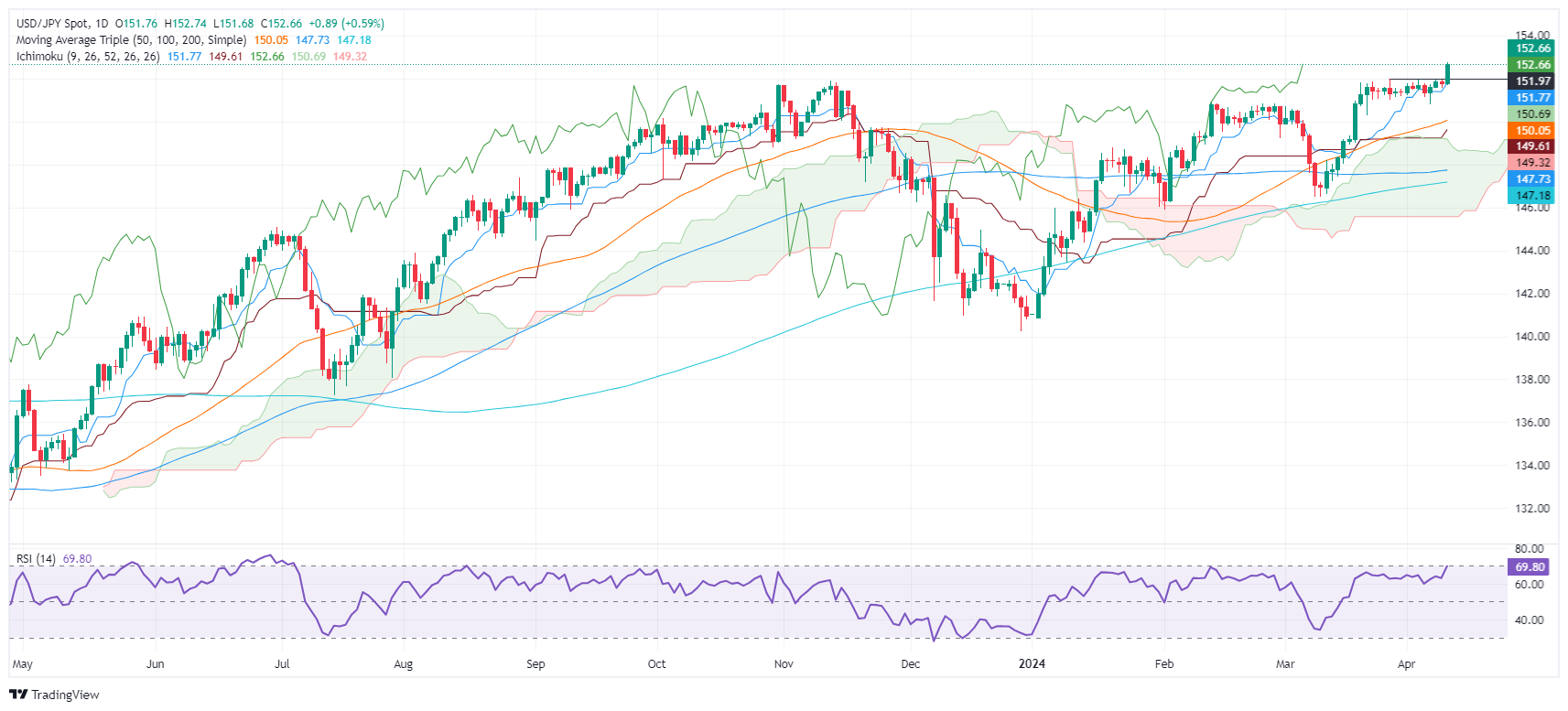
From a technical standpoint, the USD/JPY is trading at levels that were seen in the 1990s. With the major extending its gains past 152.00, that exposes as the next resistance level, the June 1990 highest peak at 155.78, followed by the 1990’s high at 160.32. On the flip side, the first support would be the psychological 152.00 level, followed by the Tenkan-Sen at 151.77 and the April 5 low of 150.81.
USD/JPY

Overview
Today last price152.65
Today Daily Change0.88
Today Daily Change %0.58
Today daily open151.77
 
Trends
Daily SMA20150.9
Daily SMA50149.94
Daily SMA100147.7
Daily SMA200147.14
 
Levels
Previous Daily High151.94
Previous Daily Low151.57
Previous Weekly High151.95
Previous Weekly Low150.81
Previous Monthly High151.97
Previous Monthly Low146.48
Daily Fibonacci 38.2%151.71
Daily Fibonacci 61.8%151.8
Daily Pivot Point S1151.58
Daily Pivot Point S2151.39
Daily Pivot Point S3151.22
Daily Pivot Point R1151.95
Daily Pivot Point R2152.12
Daily Pivot Point R3152.31

Author

Christian Borjon Valencia

Markets analyst, news editor, and trading instructor with over 14 years of experience across FX, commodities, US equity indices, and global macro markets.


More from Christian Borjon Valencia
Share:

Editor's Picks

AUD/USD sits at two-month lows near 0.6950 after Australian CPI data

AUD/USD is sitting at two-month lows near 0.6950 in the Asian session on Wednesday, as below-expectations August Australian underlying CPI data pours cold water on expectations for further RBA interest rate hikes. Chinese PMI data also fail to inspire the Australian Dollar, despite a pause in the US Dollar advance.

USD/JPY stays weak below 157.00 amid Japanese intervention risks

USD/JPY keeps losses below 157.00 in the Asian session on Wednesday, as hawkish BoJ expectations, along with intervention risks, underpin the Japanese Yen, countering dismal domestic factory output and retail sales data. Meanwhile, a broad US Dollar retreat also collaborates to the pair's downside.

Gold returns below $4,200 after a short-lived recovery

Gold tested $4,220 early in the American session after softer-than-expected US inflation figures. Encouraging US data weighed on the odds of a Federal Reserve rate hike in October, as employment and growth data beat expectations. Still, the precious metal was unable to retain its momentum and trades flat around $4,180

Crypto Today: Bitcoin holds $83K as Ethereum remains below $2,700 and XRP consolidates

Bitcoin trades lethargically on Wednesday, with bulls battling to defend the immediate $83,000 level as immediate support. Ethereum trades in tandem with Bitcoin, holding below key levels of $2,700 on the upside and $2,600 on the downside. Ripple, meanwhile, hovers near $1.50,

The Euro is near a one-year low: Inflation could trigger its rebound, not its fall
EUR/USD has fallen to its lowest level since May 2025, but a fresh inflation shock in the Eurozone could give the Euro (EUR) an unexpected lifeline. The pair hit 1.1312 on Wednesday and trades well below the January peak of 1.2082. The decline reflects a powerful combination of US Dollar (USD) strength, geopolitical uncertainty and renewed concerns about Europe's exposure to higher energy prices.
Silver is more volatile than Gold ahead of PCE and NFP. This chart shows the positioning gap
The market’s attention is focused on American data this week, but there’s something only those with a trained eye may be looking at: Gold and Silver positioning gap. Financial markets are moving on fears, mostly related to persistently high energy prices driven by the Middle East war. Sure, the US Dollar (USD) is strong, but at what cost?















