USD/JPY advances on strong US Dollar, higher US yields
- USD/JPY rises propelled by strong US retail data strengthening the Dollar against the Yen.
- US housing indicators falter as Building Permits and Housing Starts underperform, hinting at a construction sector slowdown.
- US Industrial Production remains stable, underlining a mixed yet resilient economic backdrop.
- Japan's Finance Minister Suzuki stresses vigilant Forex market monitoring.

The US Dollar clocks gains versus the Japanese Yen in early trading during the North American session. Strong economic data from the United States (US) and neutral to hawkish comments by US Federal Reserve officials boost the Greenback. The USD/JPY trades at 154.61, 0.22% above its opening price.
USD/JPY moves past 154.00 amidst strong retail sales data and hawkish Fed commentary
US housing data was weaker, revealing that builders may be taking a breather with the high level of inventory. Building Permits in March decreased by 4.3%, with figures dipping to 1.458 million, less than the 1.514 million estimates and February’s 1.523 million. Consequently, Housing Starts plunged -14.7%, from 1.549 million to 1.321 million, below forecasts of 1.48 million.
Other data revealed by the US Federal Reserve (Fed) showed that Industrial Production in March remained unchanged at 0.4% MoM.
Despite that, Monday’s strong Retail Sales data sparked a reaction in the fixed-income market, with US Treasury yields having been rising more than 10 basis points during the week. Traders had trimmed their bets that the Fed might cut rates twice instead of three times, as the Chicago Board of Trade (CBOT) data depicted. The Fed is expected to drive the main reference rate to 4.965% towards the end of 2024.
On Monday, San Francisco Fed President Mary Daly said the US central bank is in no rush to ease policy. Meanwhile, USD/JPY traders await speeches by Fed’s Governor Jefferson, New York Fed John Williams, and Chair Jerome Powell.
According to Finance Minister Suzuki, Japanese authorities have remained vocal about “closely monitoring the latest developments” in the Forex market. Market participants had pushed the exchange rate past the 154.00 threshold, and no reaction by the Bank of Japan (BoJ) or the MoF might keep the rally alive.
USD/JPY Price Analysis: Technical outlook
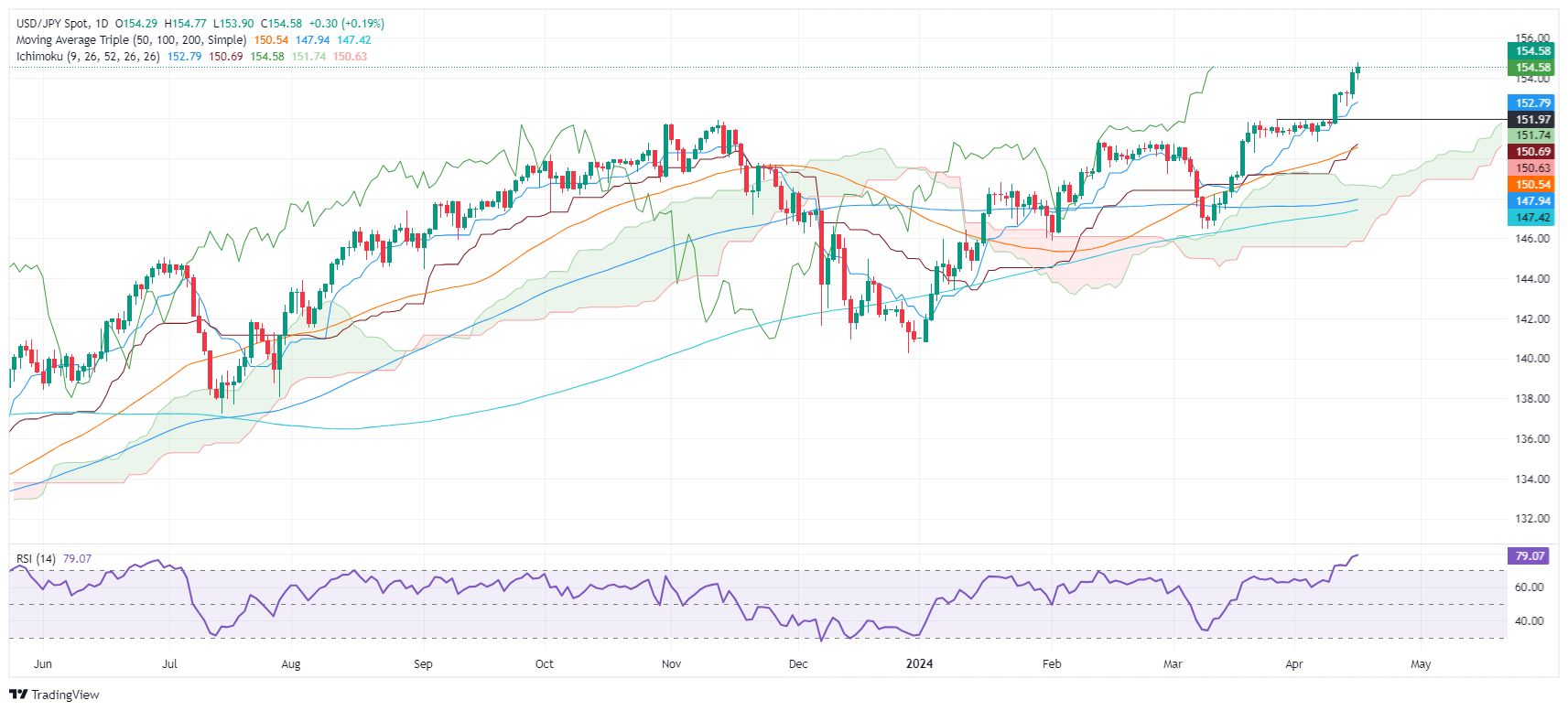
The major remains upward biased, and with no clear signs of intervention, USD/JPY buyers might drive the exchange rate to challenge 155.00. Once cleared, the next stop would be 155.78, followed by the latest cycle high at 160.32. On the flip side, if the pair drops below 154.00, that could open the door for a pullback to April’s 12 high turned support at 153.38 before dropping to 153.00.
Japanese Yen FAQs
The Japanese Yen (JPY) is one of the world’s most traded currencies. Its value is broadly determined by the performance of the Japanese economy, but more specifically by the Bank of Japan’s policy, the differential between Japanese and US bond yields, or risk sentiment among traders, among other factors.
One of the Bank of Japan’s mandates is currency control, so its moves are key for the Yen. The BoJ has directly intervened in currency markets sometimes, generally to lower the value of the Yen, although it refrains from doing it often due to political concerns of its main trading partners. The current BoJ ultra-loose monetary policy, based on massive stimulus to the economy, has caused the Yen to depreciate against its main currency peers. This process has exacerbated more recently due to an increasing policy divergence between the Bank of Japan and other main central banks, which have opted to increase interest rates sharply to fight decades-high levels of inflation.
The BoJ’s stance of sticking to ultra-loose monetary policy has led to a widening policy divergence with other central banks, particularly with the US Federal Reserve. This supports a widening of the differential between the 10-year US and Japanese bonds, which favors the US Dollar against the Japanese Yen.
The Japanese Yen is often seen as a safe-haven investment. This means that in times of market stress, investors are more likely to put their money in the Japanese currency due to its supposed reliability and stability. Turbulent times are likely to strengthen the Yen’s value against other currencies seen as more risky to invest in.
Author

Christian Borjon Valencia
FXStreet
Markets analyst, news editor, and trading instructor with over 14 years of experience across FX, commodities, US equity indices, and global macro markets.