USD Index regains some balance and extends the bounce off 106.00
- The index reverses three consecutive daily pullbacks.
- The probability of a Fed’s rate hike loses traction.
- Investors’ attention is expected to be on the US CPI.

The greenback reverses three daily drops in a row and regains the 106.30 region when tracked by the USD Index (DXY) at the beginning of the week.
USD looks at risk trends, inflation
The index leaves behind part of last week’s corrective decline and manages to pick up some buying interest on Monday.
In the meantime, the underlying bullish trend in the greenback remains well propped up by the equally robust march north in US yields across different time frames, which in turn looks underpinned by the persistent tighter-for-longer narrative around the Federal Reserve.
It is worth noting that the US bonds market will be closed on Monday due to the Columbus Day holiday.
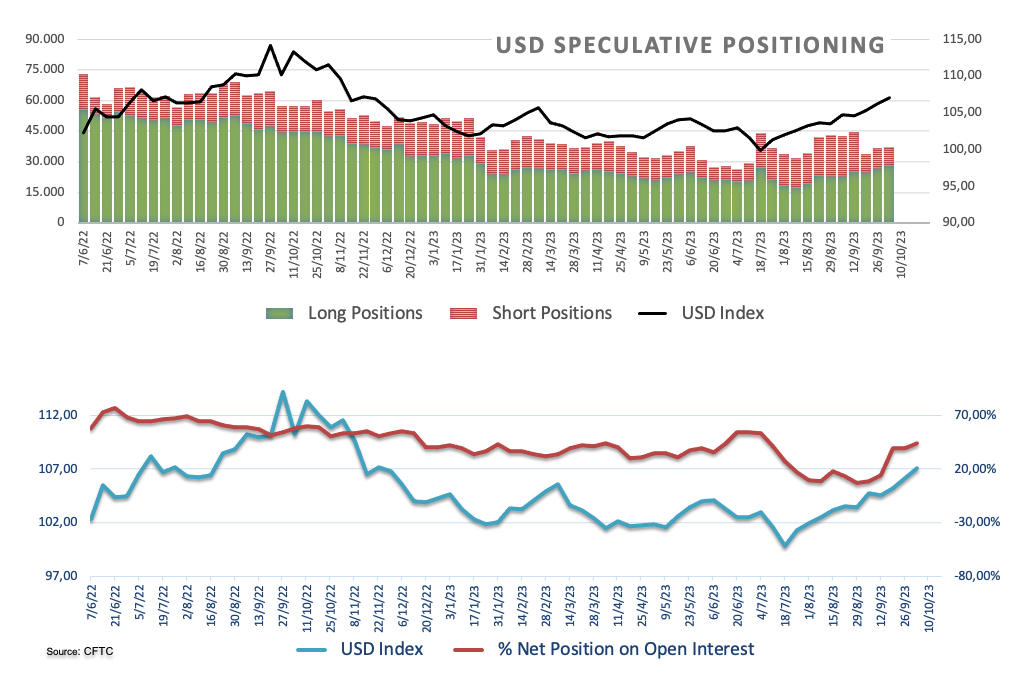
On another front, the USD net longs climbed to levels last seen in mid-December 2022 during the week ended on October 3, according to the CFTC Positioning Report. During that period, the index rose to fresh 2023 tops past the 107.00 hurdle, always bolstered by speculation that the Fed might extend its restrictive stance for longer than anticipated.
There are no scheduled data releases on Monday, although markets’ attention will likely be on the speeches by Dallas Fed Lorie Logan (voter, hawk), FOMC Governor Michael Barr (permanent voter, centrist) and FOMC Governor Philip Jefferson (permanent voter, centrist).
What to look for around USD
The index attempts a rebound after briefly piercing the key 106.00 support at the end of last week.
In the meantime, support for the dollar keeps coming from the good health of the US economy, which at the same time appears underpinned by the renewed tighter-for-longer stance narrative from the Federal Reserve.
Key events in the US this week: NFIB Business Optimism Index, Wholesale Inventories (Tuesday) – MBA Mortgage Applications, Producer Prices, FOMC Minutes (Wednesday) - Initial Jobless Claims, Inflation Rate (Thursday) – Flash Consumer (Friday).
Eminent issues on the back boiler: Persevering debate over a soft or hard landing for the US economy. Incipient speculation of rate cuts in early 2024. Geopolitical effervescence vs. Russia and China.
USD Index relevant levels
Now, the index is up 0.21% at 106.32 and a breakout of 107.34 (2023 high October 3) would open the door to 107.99 (weekly high November 21 2022) and finally 110.99 (high November 10 2022). On the downside, the next support emerges at 105.65 (low September 29) ahead of 104.42 (weekly low September 11) and then 103.17 (200-day SMA).
Author

Pablo Piovano
FXStreet
Born and bred in Argentina, Pablo has been carrying on with his passion for FX markets and trading since his first college years.
















