USD/CHF heading for 0.8500 as Swiss Franc climbs into four-month high against Greenback
- The Swiss Franc is testing further high ground against the US Dollar on Thursday.
- Risk appetite is cranking up after US inflation data tips lower.
- US Dollar declines across the board ahead of the holiday market wrap.

The USD/CHF slipped through the 0.8600 handle on Thursday as broader markets push over the US Dollar (USD), bolstering all other major currencies across the board and lifting the Swiss Franc into a new twenty-week high against the Greenback.
US inflation figures missed expectations on Thursday, coming on below forecasts and sparking a risk appetite rally as price growth deceleration takes hold in the US faster than most market participants anticipated, re-igniting market bets of a faster pace of Federal Reserve (Fed) rate cuts in 2024.
At current cut, the Fed’s dot plot of interest rate expectations sees around three rate cuts next year for a combined 75 basis points in interest rate declines, but Thursday’s softer-than-expected inflation print sees markets widening the gap between the Fed’s outlook and investor expectations. Money markets are now pricing in a heady 160 bps in rate cuts through the end of next December.
US Initial Jobless Claims ticked up slightly for the week into December 15, but much less than markets were expecting, printing at 205K versus the previous week’s 203K (revised up from 202K).
Data focus on Thursday was squarely on US Core Personal Consumption Expenditures (PCE) for the third quarter, which declined from 2.3% to 2.0% for the quarter. US Annualized third quarter Gross Domestic Product (GDP) also softened on Thursday to round out the US data dump, coming in at 4.9% versus the forecast steady reading of 5.2%.
With nothing else of note on the economic calendar this week for the Swiss France, market focus will be drawn squarely to US PCE Price Index figures on Friday. The US Core PCE Price Index from November is forecast to print flat at 0.2%, but odds of a downside print are increasing as preview PCE inflation data miss the mark on Thursday.
USD/CHF Technical Outlook
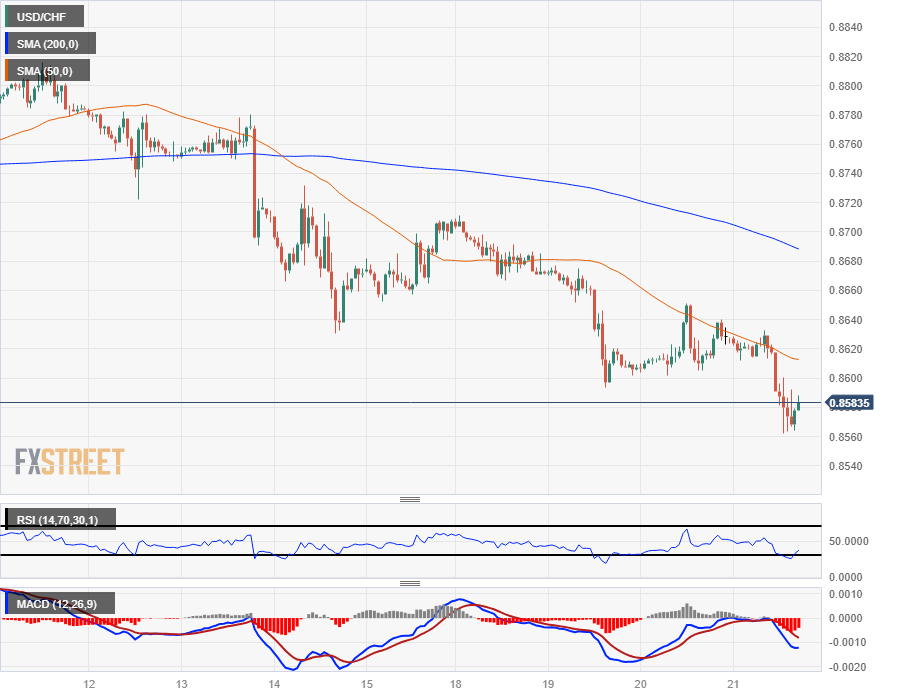
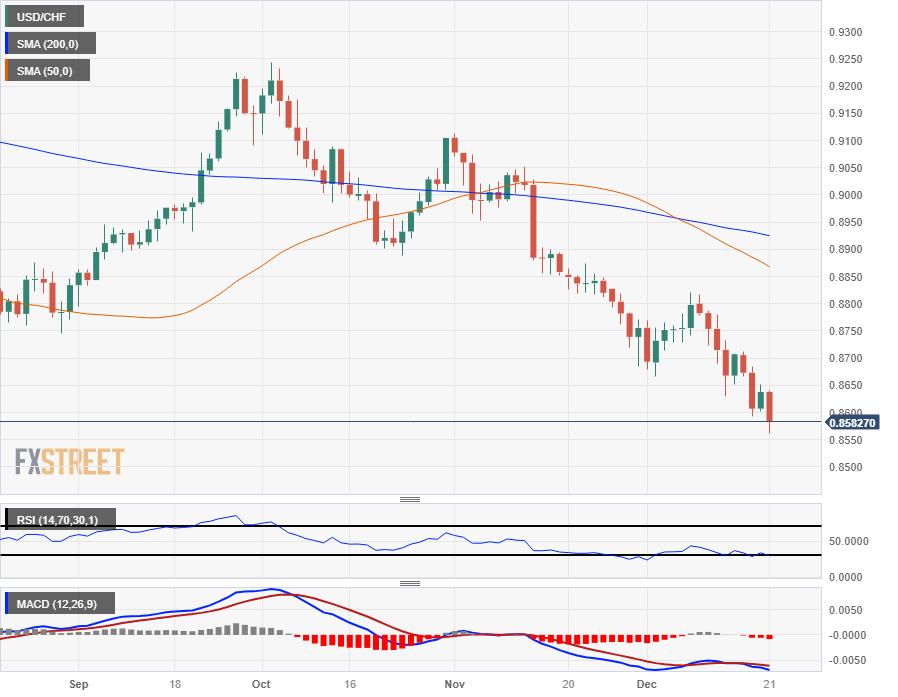
Thursday’s declines in the US Dollar dragged the USD/CHF into a new twenty-week low, slipping below the 0.8600 handle and driving towards 0.8550.
Daily candles show price action continuing to drop away from the 200-day Simple Moving Average (SMA) descending towards 0.8900, and medium-term momentum is tilting towards the downside with the 50-day SMA confirming a bearish cross of the 200-day SMA, and slipping towards 0.8850.
Intraday action continues to play into bearish territory, with bids facing steady rejection from the 50-hour SMA. A topside run will hit the 200-hour SMA near 0.8680, while the downside below 0.860 will see the way paved for additional declines into 2023’s lows.
USD/CHF Hourly Chart
USD/CHF Daily Chart
USD/CHF Technical Levels
Author

Joshua Gibson
FXStreet
Joshua joins the FXStreet team as an Economics and Finance double major from Vancouver Island University with twelve years' experience as an independent trader focusing on technical analysis.















