US dollar bears move in ahead of critical NFP
- The US dollar is pressured at month end and ahead of key US data.
- The focus stays on the prospects of a global recession and inflationary pressures.

The US dollar, as measured by the DXY index, is back under pressure on Wednesday in midday trade as traders count down to this week's US Nonfarm Payrolls data due on Friday that could make solidify the case for a 75bp rate hike by the Federal Reserve in September.
The dollar remains near the 2-decade high hit on Monday. The DXY, which measures the greenback against a basket of six currencies, was last down 0.1% at 108.66, after earlier coming within a whisker of Monday's two-decade peak of 109.48. The index is on track for a rise of around 2.6% in August, its third-straight monthly gain.
Record-high inflation in parts of the world is compounding recession fears stalking markets on Wednesday which is serving as a bullish plate for the US dollar and US Treasury yields. The two-year US Treasury yield, which is relatively more sensitive to the monetary policy outlook in the US, hit a 15-year high at 3.499% overnight but eased back to 3.446%. The 10-year Treasury yield, which hit a two-month high of 3.153% on Tuesday, stood at 3.123, easing back from 3.164%.
Traders are now pricing in about a 70% chance of a 75 basis points Fed rate hike next month, according to data from Refinitiv following Fed officials reiterating their support for further rate hikes. New York Fed President John Williams told Wall the Wall Street Journal that inflation expectations in the US were well anchored but added that it would take a few years to bring inflation back to 2%. Richmond Federal Reserve Bank President Thomas Barkin said on Tuesday that the United States is facing "post-war-like" inflation. The remarks made by officials have followed the comments from Fed Chair Jerome Powell who spoke at the Jackson Hole central banking symposium in Wyoming late last week that left the door wide open for ongoing rate hikes into mid-2023, which prompted a wave of US dollar strength.
Meanwhile, economic news remained grim with overnight data showing economic activity in China. The nation has extended its decline this month after new COVID-19 infections, the worst heatwaves in decades and struggles in the property sector. China’s PMI survey data for August showed a contraction in factory activity. The data has led some analysts to believe the world's second-largest economy will likely dip below 3.0% in the third quarter of this year. ''We have trimmed our 2022 GDP forecast to 3.0% from 4.0% as both domestic and external demand continues to weaken,'' analysts at ANZ Bank said.
Eyes on NFP
The data is expected to keep the yuan on the back foot, supporting a bullish outlook for the greenback. Meanwhile, for the US, PMI surveys already released point to a deceleration in manufacturing activity for August, with 4 out of 5 registering notable declines on an ISM-equivalent basis. There will be data tomorrow that analysts at TD Securities explained a sharp drops in shipments/new orders doesn't bode well for current/future manufacturing output. ''We look for a decline in the ISM index, but may revise the forecast as more surveys are released.''
The showdown for the start of the month, however, will be Friday's jobs data. The analysts at TD Securities explained that ''employment likely continued to advance robustly in August but at a more moderate pace following the booming 528k print registered in July. High-frequency data, including Homebase, point to still above-trend job creation.'' The analysts also look for the UE rate to drop by a tenth for a second consecutive month to 3.4%, and for wage growth to advance at a firm 0.4% MoM (5.3% YoY).
DXY technical analysis
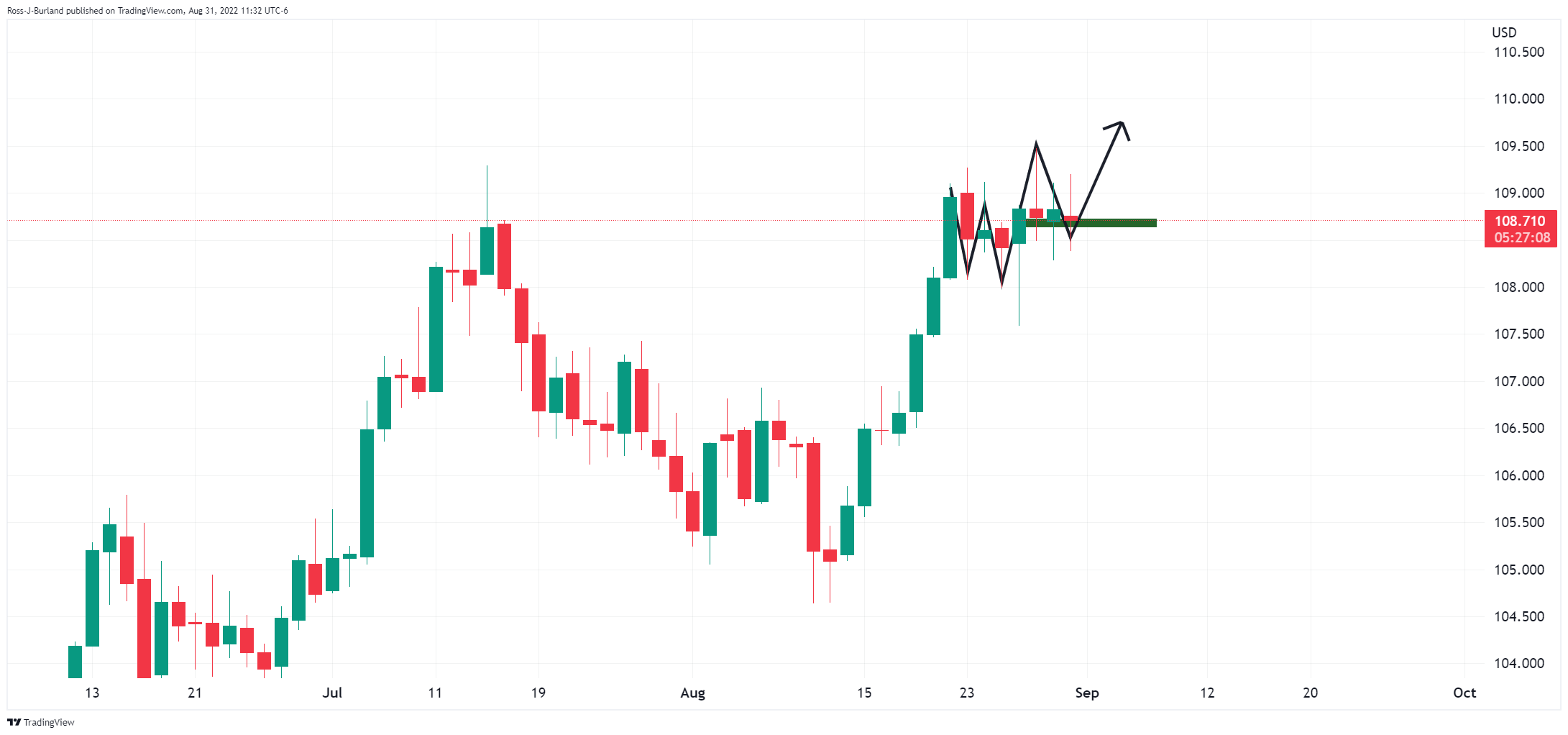
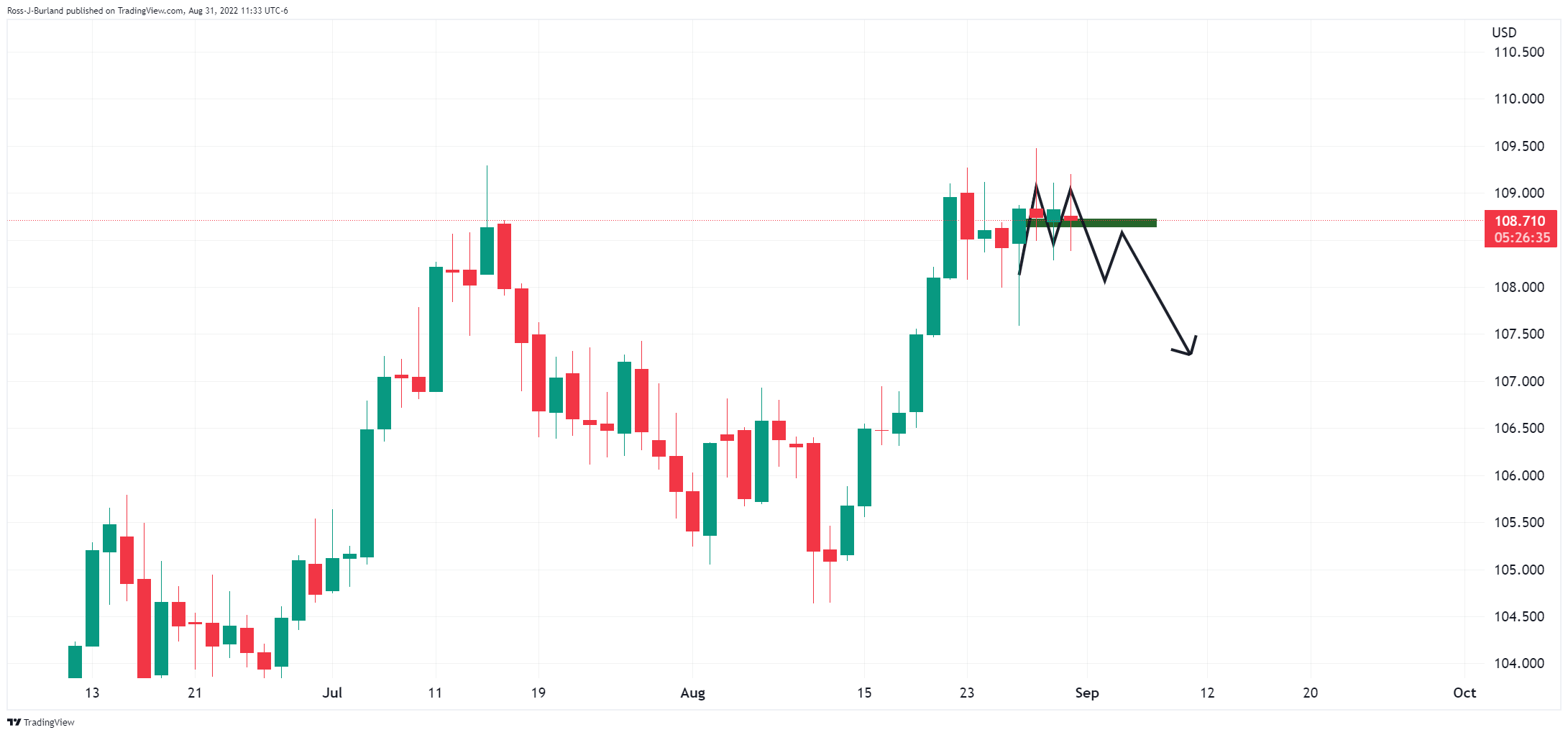
The above two charts are the daily outlook from a bullish and bearish perspective. Both scenarios are determined by either a W or an M formation. Should the current support in the 106.60s hold up, then the focus will be on the upside for the immediate future. On the other hand, a break below and tests of recent lows could result in a wave of selling pressure for a run on the prior bullish impulses.
Author

Ross J Burland
FXStreet
Ross J Burland, born in England, UK, is a sportsman at heart. He played Rugby and Judo for his county, Kent and the South East of England Rugby team.