Swiss Franc declines after SNB cuts policy rate to 1.50%
- The Swiss Franc weakens after the Swiss National Bank decides to cut interest rates from 1.75% to 1.50%.
- The move was not widely expected by markets and the Swiss Franc has sold off heavily following the news.
- The SNB gives victory over inflation, a too-strong Swiss Franc and the need to stimulate economic activity as reasons for the cut.

The Swiss Franc (CHF) is trading weaker by about one percent in its most heavily traded pairs on Thursday after the Swiss National Bank (SNB) decided to cut interest rates at their March meeting.
The SNB cut its policy rate by 0.25% from 1.75% to 1.50% on Thursday, surprising traders who had been expecting a maintenance of the status quo. The move comes after a larger-than-expected fall in Swiss inflation in the first months of the year, and a slowdown in economic growth in 2023.
The Swiss Franc weakened on the news since lower interest rates tend to reduce foreign capital inflows.
SNB decides to ease monetary policy after victory against inflation
In its monetary policy assessment, the SNB said that it cut interest rates because it had won the battle against inflation.
“The easing of monetary policy has been made possible because the fight against inflation over the past two and a half years has been effective,” said the SNB.
Further, it added that, “For some months now, inflation has been back below 2% and thus in the range the SNB equates with price stability. According to the new forecast, inflation is also likely to remain in this range over the next few years.”
The appreciation of the Swiss Franc over the last year and the need to “support economic activity” were given as other reasons for reducing interest rates.
The Swiss economy saw its GDP growth sliced almost in half in 2023 when it recorded only a 1.3% expansion compared to 2.5% in 2022, according to its 2023 Annual Report. Lower interest rates will make it cheaper for businesses to borrow capital and a weaker Swiss Franc for them to export their wares abroad.
The decision somewhat surprised markets, who had only rated the chances of a cut at about one in three prior to the event, according to Reuters.
The bank also revised down its forecasts for future inflation and foresaw constraints to growth coming from a still-strong Swiss Franc and weaker demand from abroad.
Technical Analysis: Swiss Franc extends break out from range against US Dollar
The USD/CHF, which measures the buying power of a single US Dollar in Swiss Francs, is trading in the 0.8960s after penetrating the top of a range – between roughly 0.8900 and 0.8740 – it had been yo-yoing within since the middle of February.
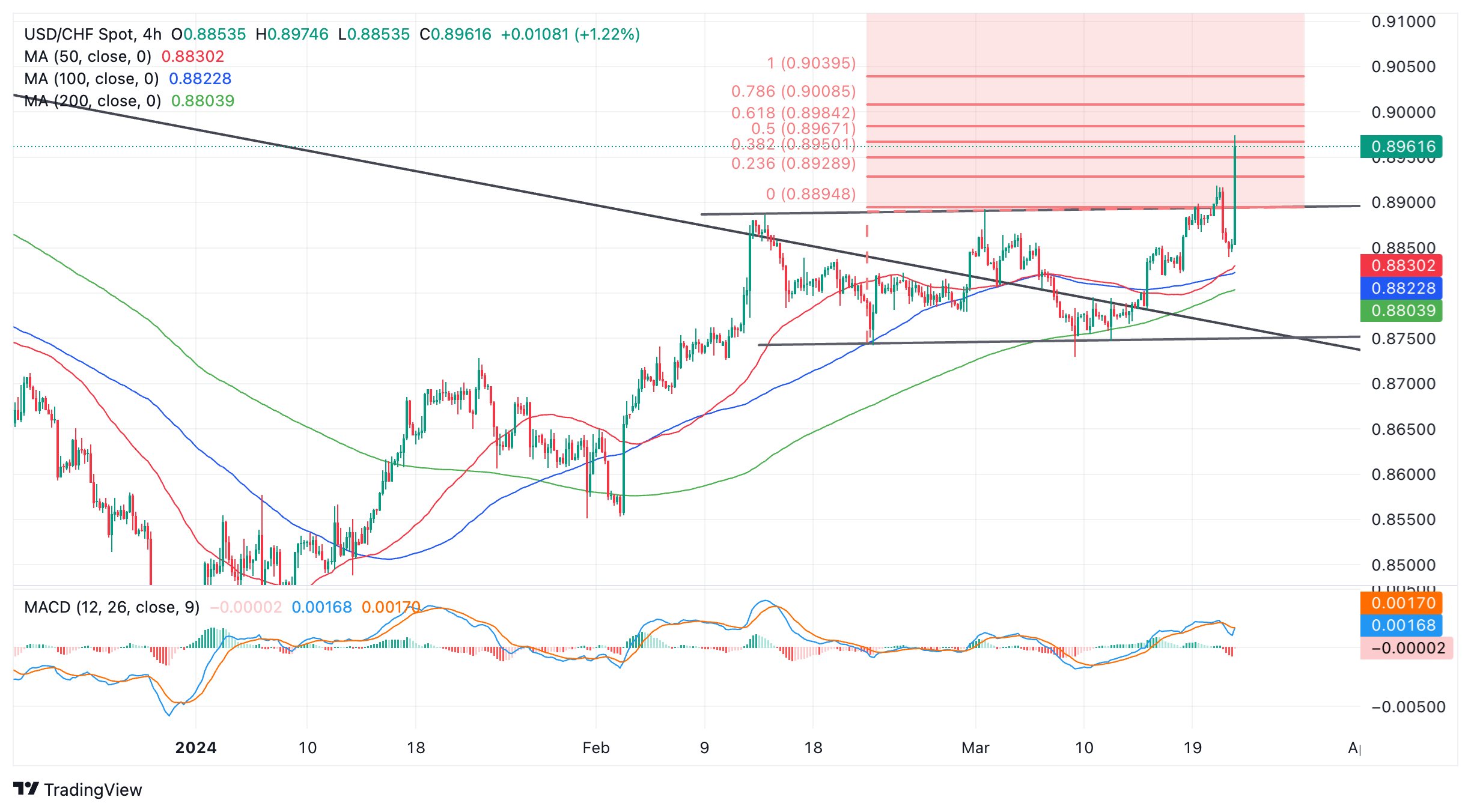
US Dollar versus Swiss Franc: 4-hour chart
The current move marks a decisive break above the range highs at 0.8900 and a continuation of the previous short-term uptrend.
The usual technical method for forecasting range breakouts is to take the height of the range and extrapolate higher from the breakout. This activates an initial target at 0.8992, the 0.618 Fibonacci (Fib) ratio of the height of the range extrapolated higher, followed by 0.9052, the full height extrapolated higher.
If the pair continues the strong performance into the end of the week and closes near or above the current level it will have confirmed a decisive break above the 50-week Simple Moving Average (SMA) – a formidable obstacle. It has also now convincingly broken above a long-term trendline, another bullish sign.
A break back below 0.8900 range high, however, would spoil the party and bring into doubt the validity of the breakout.
A move below the range low at 0.8729 could indicate a short-term trend reversal and the start of a deeper slide.
The first target for such a move would be the 0.618 Fib. extrapolation of the height of the range at 0.8632, followed by the full extrapolation at 0.8577, which is also close to the 0.8551 January 31 lows, another key support level to the downside.
Swiss Franc FAQs
The Swiss Franc (CHF) is Switzerland’s official currency. It is among the top ten most traded currencies globally, reaching volumes that well exceed the size of the Swiss economy. Its value is determined by the broad market sentiment, the country’s economic health or action taken by the Swiss National Bank (SNB), among other factors. Between 2011 and 2015, the Swiss Franc was pegged to the Euro (EUR). The peg was abruptly removed, resulting in a more than 20% increase in the Franc’s value, causing a turmoil in markets. Even though the peg isn’t in force anymore, CHF fortunes tend to be highly correlated with the Euro ones due to the high dependency of the Swiss economy on the neighboring Eurozone.
The Swiss Franc (CHF) is considered a safe-haven asset, or a currency that investors tend to buy in times of market stress. This is due to the perceived status of Switzerland in the world: a stable economy, a strong export sector, big central bank reserves or a longstanding political stance towards neutrality in global conflicts make the country’s currency a good choice for investors fleeing from risks. Turbulent times are likely to strengthen CHF value against other currencies that are seen as more risky to invest in.
The Swiss National Bank (SNB) meets four times a year – once every quarter, less than other major central banks – to decide on monetary policy. The bank aims for an annual inflation rate of less than 2%. When inflation is above target or forecasted to be above target in the foreseeable future, the bank will attempt to tame price growth by raising its policy rate. Higher interest rates are generally positive for the Swiss Franc (CHF) as they lead to higher yields, making the country a more attractive place for investors. On the contrary, lower interest rates tend to weaken CHF.
Macroeconomic data releases in Switzerland are key to assessing the state of the economy and can impact the Swiss Franc’s (CHF) valuation. The Swiss economy is broadly stable, but any sudden change in economic growth, inflation, current account or the central bank’s currency reserves have the potential to trigger moves in CHF. Generally, high economic growth, low unemployment and high confidence are good for CHF. Conversely, if economic data points to weakening momentum, CHF is likely to depreciate.
As a small and open economy, Switzerland is heavily dependent on the health of the neighboring Eurozone economies. The broader European Union is Switzerland’s main economic partner and a key political ally, so macroeconomic and monetary policy stability in the Eurozone is essential for Switzerland and, thus, for the Swiss Franc (CHF). With such dependency, some models suggest that the correlation between the fortunes of the Euro (EUR) and the CHF is more than 90%, or close to perfect.
Author

Joaquin Monfort
FXStreet
Joaquin Monfort is a financial writer and analyst with over 10 years experience writing about financial markets and alt data. He holds a degree in Anthropology from London University and a Diploma in Technical analysis.