SPDR S&P 500 ETF Trust (SPY) Stock News and Forecast: Buy the dip?
- SPY finally sheds some gains and closes down nearly 1%.
- SPY was hit by weak retails sales numbers and Delta fears.
- S&P 500 ETF has now dipped, so is it time to buy?

Do not get too excited, but we may have spotted a dip on the horizon for you to dip into! Dips, any dips, have been eagerly bought up since the pandemic started as equity markets have gone on the greatest bull run in decades. CNBC reported yesterday that the S&P 500 has doubled from the pandemic low, the quickest doubling since World War II. This may be worrying with our friends over at the Market Ear pointing out that 100% returns tend to result in corrections. Some are modest ones, but some others are rather nasty ones.
Source: Refinitiv and themarketear.com
Nobody it seems is overly bullish, but with a backdrop of the Fed and every other central bank pumping and households and corporates awash with cash, we cannot see the party stopping just yet. Earnings season was stellar, and buy-back season is starting. Dips then are there to be bought in our view. The problem is making sure it is just a dip and getting in at the right time.
SPY stock forecast
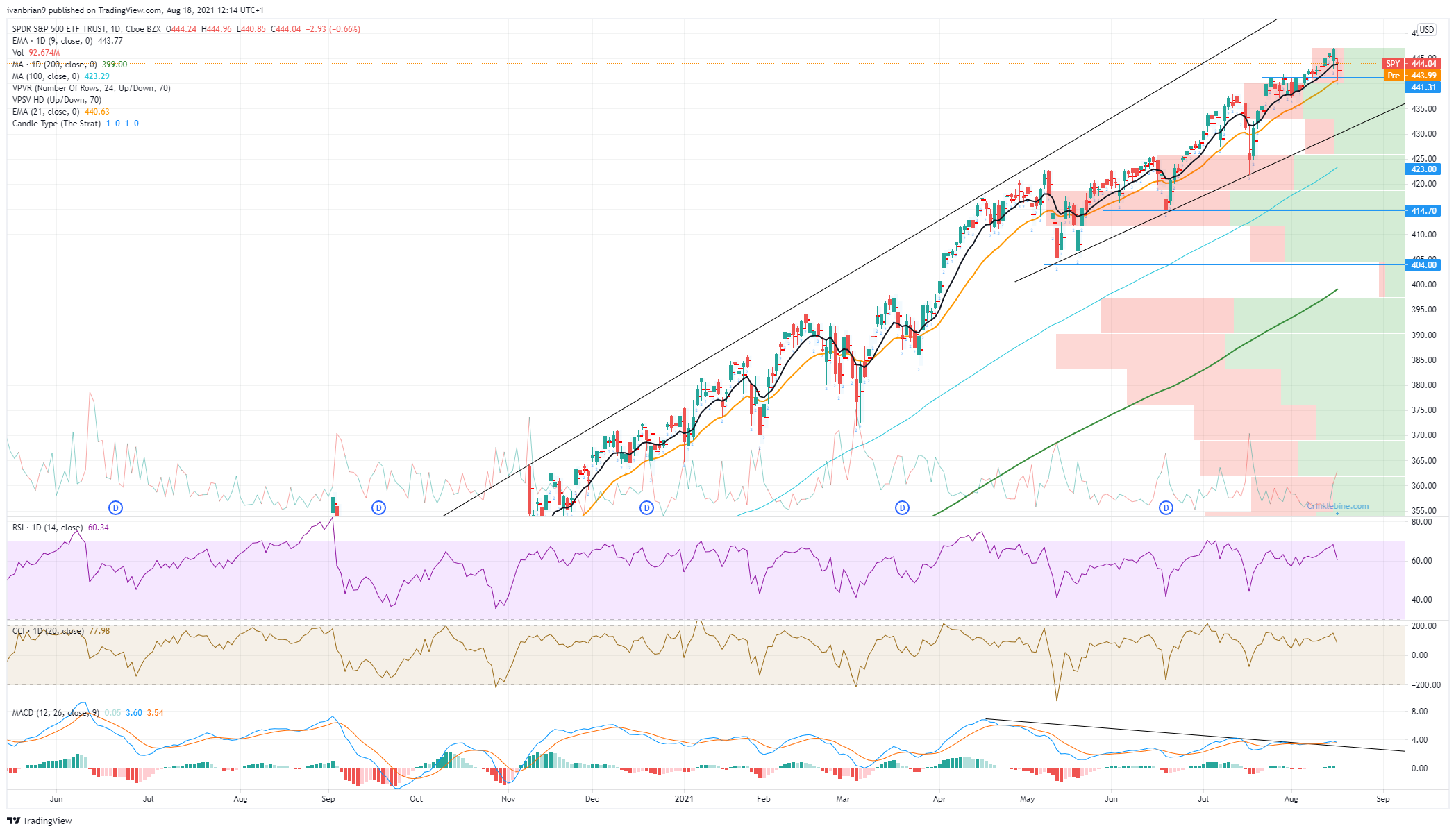
We identified $441.31 yesterday as the first support, and so it was that $440.85 was the low, close but not perfect. Will this support hold? Who knows, but savvy buyers may have stepped in to buy, seeing the volume profile just below and knowing that there should be volume-based support underneath to limit losses and make any slippage on a trailing stop minimal. There is prety decent volume support until $436. If $436 breaks, then it is a waitng game. The trend line will come into play at $430, but we are not too happy with this support level and prefer $423.
For now the market remains bullish with the classic series of higher highs and lows, but the 9-day moving average has given way. The 21-day has held though and adds to our $441 support level as its sits there. The momentum osciallators are not giving us too much, but the Moving Average Convergence Divergence (MACD) indicators have broken out of the bearish divergence downtrend.
Like this article? Help us with some feedback by answering this survey:
Premium
You have reached your limit of 3 free articles for this month.
Start your subscription and get access to all our original articles.
Author
Ivan Brian
FXStreet
Ivan Brian started his career with AIB Bank in corporate finance and then worked for seven years at Baxter. He started as a macro analyst before becoming Head of Research and then CFO.