S&P 500 seesaws between 3830-3896 post-Fed decision, on Powell commentary
- The S&P 500 rallied once the Federal Reserve’s decision was known, as the statement was perceived as dovish.
- Powell “rocked the boat” when he said that the “ultimate level of rates will be higher than previously expected.”
- The S&P 500 erased its gains achieved in reaction to the Fed’s decision.
The S&P 500 is seesawing in a volatile session after the US Federal Reserve raised rates as expected by 75 bps, and by its statement, announced that “cumulative tightening” in place would be taken into account and acknowledged that monetary policy is still lagging in specific sectors of the economy, namely the labor market and price stability. Therefore, the S&P 500 retreats some of its early gains, hoovering around 3842.16-3866.28 at the time of typing.
Jerome Powell’s press conference remarks
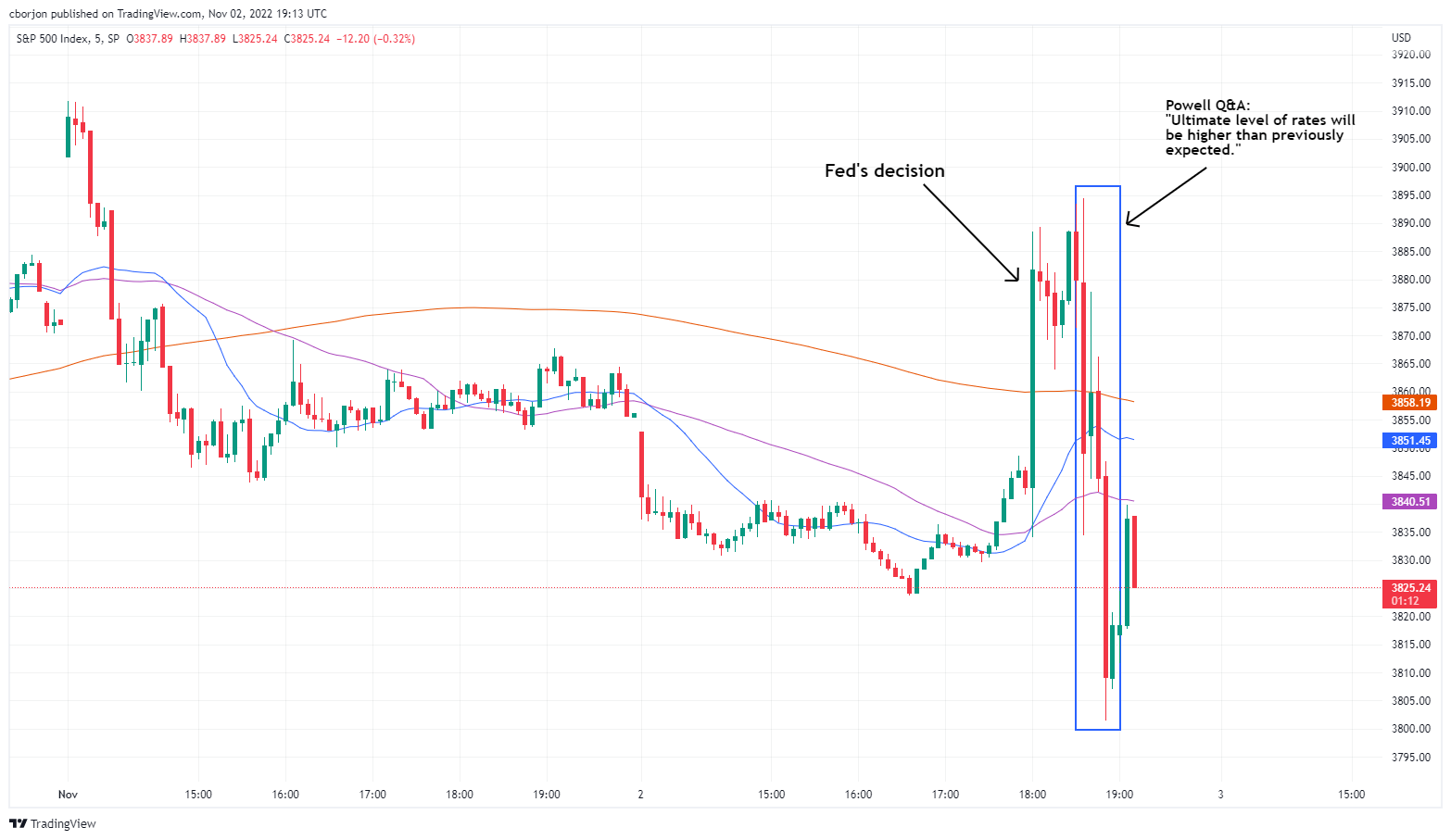
During his press conference, Federal Reserve Chairman Jerome Powell said that the central bank is strongly committed to bringing inflation down, and he added that the ongoing rate increases are “appropriate” to get policy sufficiently restrictive. Even though those are some of his usual remarks, once he said that the “ultimate level of rates will be higher than previously expected,” the S&P 500 tanked from its daily highs at 3894.44 to 3801.50, as it was perceived as a hawkish statement.
Powell’s additional remarks:
No One Knows If There Will Be A Recession
A Soft Landing Is Possible But Window Has Narrowed
Have A Ways To Go, Ground To Cover With Hikes
Strong Economy In US, Says Strong Dollar Is A Challenge For Some Countries
Broader Picture Is Still An Overheated Labour Market
Have A Ways To Go On Rates
Very Premature To Be Thinking About Pausing
If We Overtighten, Can Use Our Tools To Respond
Short-Term Inflation Expectations Have Moved Up, Could Affect Wages
The Time For Slower Hikes May Come ‘As Soon As December’
Data Suggests We May Ultimately Move To Higher Levels Than Anticipated At September Meeting
Need To See Inflation Coming Down Decisively, But We Don't Need Inflation To Come Down To Slow Pace Of Hikes
We Think Ongoing Hikes Will Be Appropriate To Get Policy Sufficiently Restrictive
Summary of Fed’s monetary policy statement
Regarding the monetary policy statement, the Fed acknowledged that growth was slowing down in spending and production and commented that labor market conditions remain “robust” and the unemployment rate is slow. Policymakers added that inflation remains elevated, a reflection of the supply/demand imbalances blamed on the pandemic and higher food and energy prices.
Even though Fed policymakers mentioned that they are resolute in taming inflation and will continue to tighten monetary conditions, they laid the ground for a slower pace of interest-rate increases. Fed officials added to the statement, “the Committee will take into account the cumulative tightening of monetary policy, the lags with which monetary policy affects economic activity and inflation, and economic and financial developments.”
Concerning the Fed’s balance sheet reduction, policymakers added that it would keep reducing as expected and added that the Federal Reserve Open Market Committee (FOMC) would be data-dependent, taking into account public health readings, labor market conditions, inflation pressures, and inflation expectations.
The market reacted negatively, sending the US Dollar down, and the S&P 500 rallied toward its daily highs as traders perceived the monetary policy statement. Nevertheless, the Federal Reserve Chair Jerome Powell press conference, shifted the initial markets reaction, as shown below by the S&P 500 5-minute chart.
S&P 500 5-minute chart
Author

Christian Borjon Valencia
FXStreet
Markets analyst, news editor, and trading instructor with over 14 years of experience across FX, commodities, US equity indices, and global macro markets.

















