S&P 500 Forecast: US CPI in focus, Oracle revenue marginally misses target
- S&P 500 pulled back 1.3% last week, trading as low as 4,430.
- Wednesday sees the release of the US CPI for August.
- Oracle reports slight earnings miss on Monday after the close.
- US Retail Sales for August arrive on Thursday and are expected to add 0.2% MoM.
- Adobe and Lennar report earnings on Thursday.

The S&P 500 closes up over half a percent at the end of Monday's US session and the markets remains buoyant about Wednesday’s US Consumer Price Index (CPI) release for August. Many traders see this release as the nail in the coffin for any interest rate hikes from the Federal Reserve (Fed) for the rest of the year. A more certain end to monetary tightening means the market can look forward to cuts – even if they aren’t expected for at least six months.
The earnings calendar is largely on vacation, but Oracle’s (ORCL) quarterly results out after the close on Monday showed a slight miss in first quarter revenue, coming out at $12.45 billion compared to the $12.47 billion expected. The underperformance was put down to companies cutting their spending on cloud services due to an uncertain economic outlook, according to MarketScreener.
S&P 500 News: CPI, Retail Sales, Consumer Sentiment all on deck
Inflation has been steadily falling since the summer of 2022, but now the United States is beginning to get within spitting distance of the Fed’s goal of 2% annual core inflation. July’s CPI had core reaching 4.7% YoY. With Wednesday giving us August’s figure, the consensus has core inflation rising 0.2% from last month – the same as July’s result.
This gives the equity market hope that the August report won’t have enough surprises to alter the expectation that the Fed will keep interest rates unchanged at its September 20 meeting next week. The CME Group’s FedWatch Tool gives us a 93% chance that rates remain unchanged in the range of 5.25% to 5.5%. It also places the odds in the high 50% range that the central bank declines to raise rates at both the November and December meetings. This is why the equity market now views the rate hiking cycle as completely over despite Fed officials still remaining publicly open to a higher terminal rate.
Consensus for the monthly headline CPI has risen from 0.2% in July to 0.5% in August due to the rising price of gasoline. As long as the core monthly CPI is not higher than 0.2%, then the stock market should be happy. Otherwise, any deviation higher than consensus will likely cause a steep drop in the S&P 500 index.
Then on Thursday US Retail Sales for August are expected to deliver a 0.2% MoM growth rate. This is much lower than the 0.7% seen in July, but the market approves of slower growth since it means that inflation is less likely to perk up.
Friday gives us the preliminary Michigan Consumer Sentiment Index for September. Analysts are shooting for 69.5, the same reading as August but lower than July’s 71.6. A higher reading tends to be bullish for the US Dollar and bodes well for the strength of the US economy.
Adobe and Lennar headline week’s earnings releases
As far as earnings go, Thursday sees both Adobe (ADBE) and Lennar (LEN) report. Adobe management should give more details about its acquisition of Figma, another digital design software company. Analyst consensus calls for $3.97 in adjusted EPS on revenue of $4.87 billion.
Lennar will give the equity market a chance to assess the US housing market. Lennar is one of the largest homebuilders in the US, and shareholders have to wonder how badly mortgage rates topping 8% are going to put a lid on new home sales. The consensus forecast calls for $3.50 in adjusted EPS on revenue of $8.52 billion.
Inflation FAQs
What is inflation?
Inflation measures the rise in the price of a representative basket of goods and services. Headline inflation is usually expressed as a percentage change on a month-on-month (MoM) and year-on-year (YoY) basis. Core inflation excludes more volatile elements such as food and fuel which can fluctuate because of geopolitical and seasonal factors. Core inflation is the figure economists focus on and is the level targeted by central banks, which are mandated to keep inflation at a manageable level, usually around 2%.
What is the Consumer Price Index (CPI)?
The Consumer Price Index (CPI) measures the change in prices of a basket of goods and services over a period of time. It is usually expressed as a percentage change on a month-on-month (MoM) and year-on-year (YoY) basis. Core CPI is the figure targeted by central banks as it excludes volatile food and fuel inputs. When Core CPI rises above 2% it usually results in higher interest rates and vice versa when it falls below 2%. Since higher interest rates are positive for a currency, higher inflation usually results in a stronger currency. The opposite is true when inflation falls.
What is the impact of inflation on foreign exchange?
Although it may seem counter-intuitive, high inflation in a country pushes up the value of its currency and vice versa for lower inflation. This is because the central bank will normally raise interest rates to combat the higher inflation, which attract more global capital inflows from investors looking for a lucrative place to park their money.
How does inflation influence the price of Gold?
Formerly, Gold was the asset investors turned to in times of high inflation because it preserved its value, and whilst investors will often still buy Gold for its safe-haven properties in times of extreme market turmoil, this is not the case most of the time. This is because when inflation is high, central banks will put up interest rates to combat it.
Higher interest rates are negative for Gold because they increase the opportunity-cost of holding Gold vis-a-vis an interest-bearing asset or placing the money in a cash deposit account. On the flipside, lower inflation tends to be positive for Gold as it brings interest rates down, making the bright metal a more viable investment alternative.
Earnings of the week
Monday, September 11 - Oracle (ORCL)
Wednesday, September 13 - Cracker Barrel Old Country Store (CBRL), REV Group (REVG)
Thursday, September 14 - Adobe (ADBE), Lennar (LEN)
What they said about the market – Goldman Sachs
The ladies and gents over at Goldman Sachs seem to be the cheeriest of the bunch on Wall Street these days. Last Friday, they released a report stating that they see only a 15% chance of recession over the next twelve months. This is well below peers like Wells Fargo and Barclays who appear much more worried about global growth prospects. Goldman’s report said China should continue to weigh on the global economy but that it will still grow by a respectable 2.6% in 2023.
"In the US, we expect solidly positive real GDP growth of 2.1% this year on a nQ4/Q4 basis, reflecting a reduced drag from monetary tightening and continued strength in real disposable income growth."
S&P 500 forecast
There are two main levels to watch this week. The first is 4,430. That is where the S&P 500 index bounced off last Thursday. A break below this level will send bulls running for cover. This is because the nearest support is in the 4,328 to 4,335 thicket, about 100 points below.
The second level to watch is the high of 4,541 from September 1. A break above there will cause bulls to rush in and join the move to the resistance band that surrounds 4,600.
Monday’s open places the S&P 500 index just below the 9-day Simple Moving Average (SMA). Breaking above that SMA will also give traders confidence that the index is moving toward a positive week.
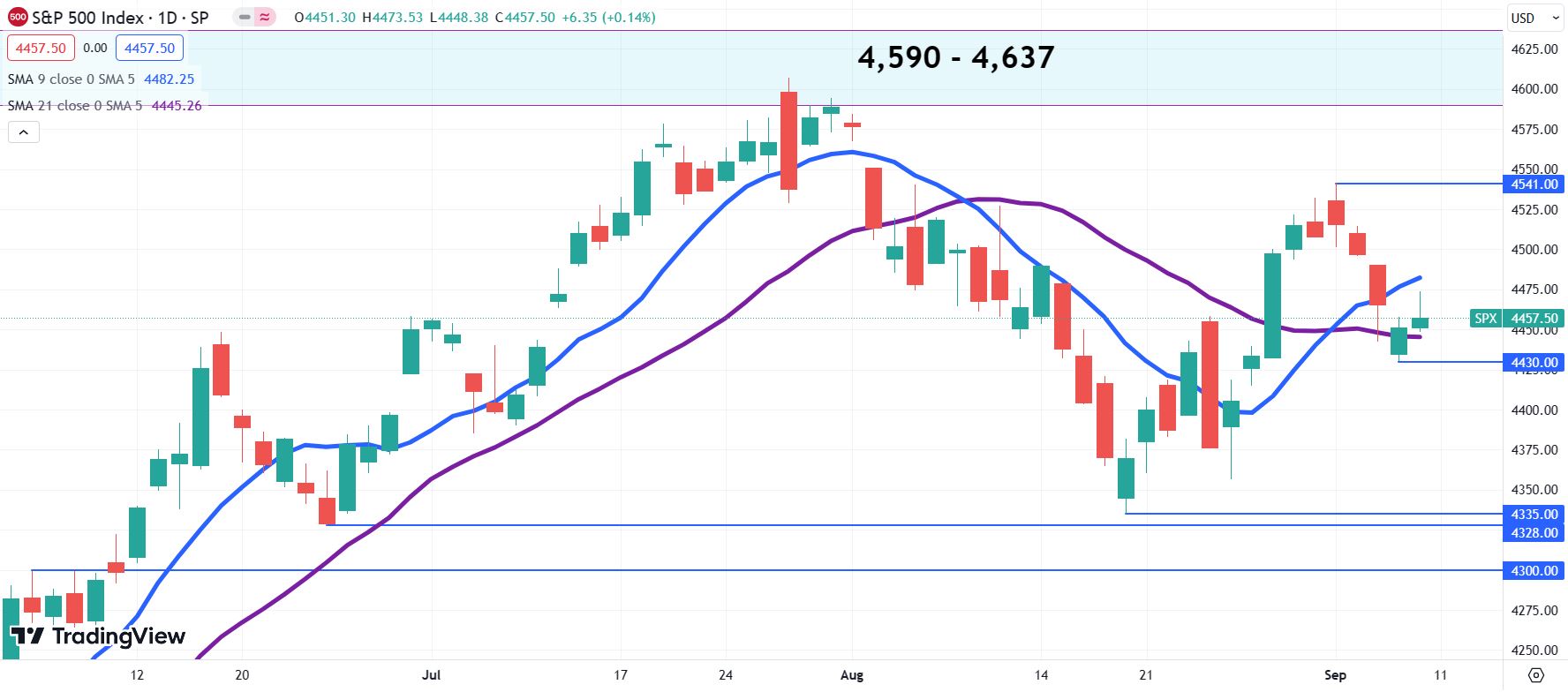
S&P 500 daily chart
Author

Clay Webster
FXStreet
Clay Webster grew up in the US outside Buffalo, New York and Lancaster, Pennsylvania. He began investing after college following the 2008 financial crisis.














